
Business storage in Sussex for stock, archive and office contents. Collected from your premises, inventoried properly, sealed at our Lower Dicker depot and retrievable on notice when the fit-out finishes or the audit lands.

Business storage in Eastbourne is usually bought in a hurry, because the lease ended before the new floor was ready, the stock arrived before the shelving did, or the auditor asked for six years of files that are currently in a cupboard nobody can shut.
What a business actually needs at that point is not a room and a key. It needs someone to come to the premises, take the load away properly, write down what they took, and bring the right part of it back when asked.
That is the job we do. The same crew wraps, loads, transports, stores and redelivers, working from one inventory raised at your door. There is no handover to a third-party carrier and no second contract with a storage operator, so nothing gets counted twice, nothing gets handled twice, and there is one firm to ring when something is missing.
A self-storage operator cannot structurally offer that, because the lifting and the storing are sold by two different companies.
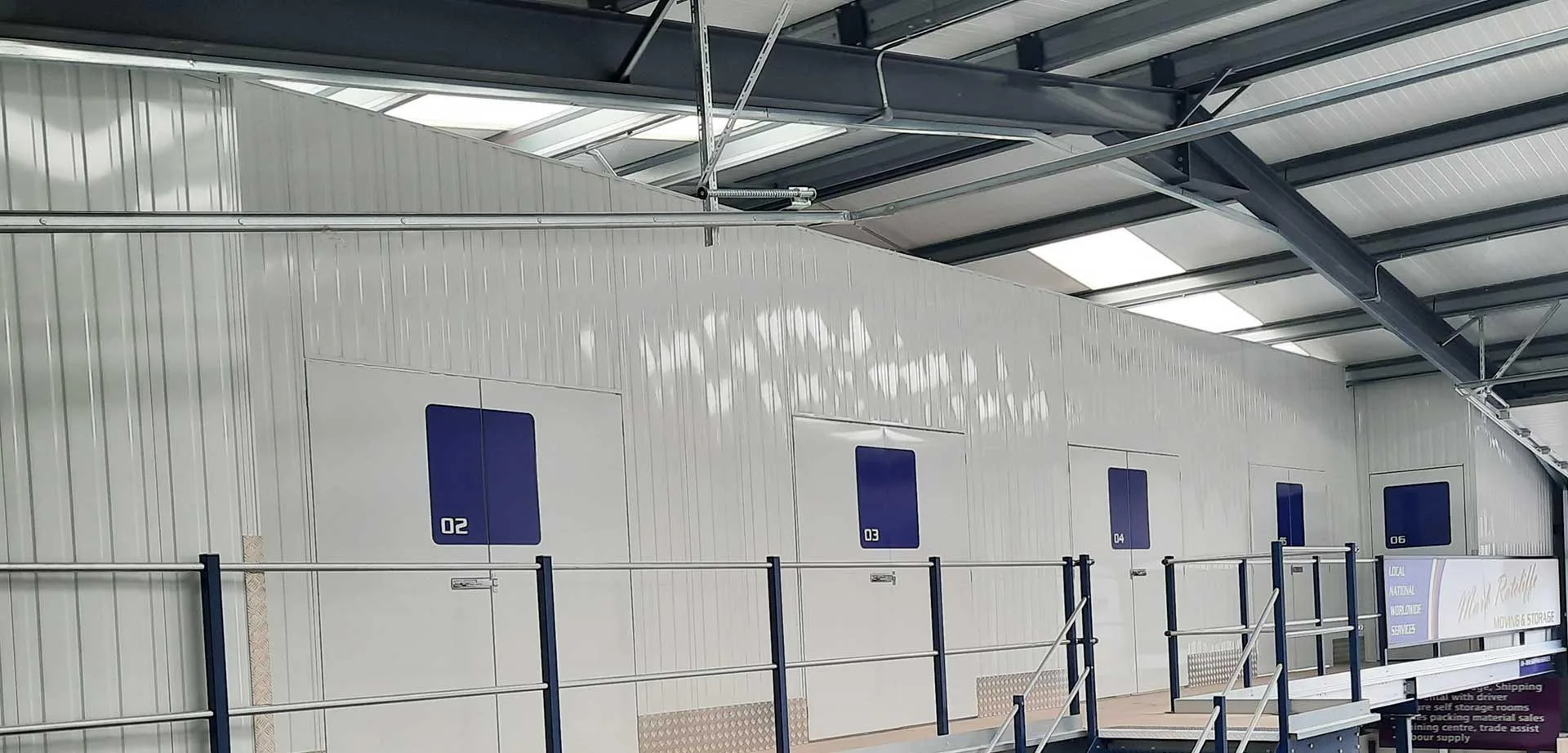
Goods go into individual steel-walled rooms at our Lower Dicker depot on the A22 just north of Hailsham, roughly twenty minutes from central Eastbourne. That facility is described in full on our Prestige steel storage rooms page, so this page stays on the part that is specific to a business: what commercial loads look like, what the law expects of your records while they are away, what a sealed room costs per week including VAT, and how you get a single box back.
Commercial storage is not one product. The handling, the labelling and the retrieval pattern change completely depending on what is in the boxes, and getting that wrong at collection is what makes a retrieval painful eight months later.
These are the five loads we see across Eastbourne, Hailsham, Polegate and Brighton.
Archive and records. Paper under a statutory retention period. Low volume, long dwell, and the only thing that matters is that the schedule is accurate enough to find one file in three hundred cartons. This is the load most likely to be needed back at short notice and the one most often packed worst.
Stock and overflow. Seasonal lines, an over-ordered pallet run, discontinued SKUs held pending a clearance sale. Higher volume, shorter dwell, and usually retrieved in whole pallets rather than by the box. We are a storage operation, not a fulfilment house, so we move pallets in and out; we do not pick to order.
Office furniture in a fit-out gap. Desks, task chairs, pedestals and storage walls that have to come out on the lease end date and go back in when the contractor finishes. Bulky, awkward, and worth dismantling properly. This is the load that pairs directly with our Eastbourne office removals service.
IT and display equipment. Monitors, docks, empty racks, screens, AV kit and exhibition stands. Wrapped and crated rather than stacked; anything with a lithium-ion cell comes out of the room, which we cover further down. Larger screens and display cases often warrant a purpose-built timber crate.
Event, hospitality and seasonal kit. Stacking chairs, banqueting tables, parasols, planters, Christmas display. Predictable calendar, two movements a year, and the load that benefits most from being racked the same way every time so the return run is quick.
The single most common reason a Sussex business rings us about archive storage is that someone has worked out how long the paper has to be kept and realised the office cannot hold it.
Retention periods are also the reason storage duration is rarely a free choice. You are not deciding how long you would like to store, you are being told.
The table below is the planning guide we work from when we scope an archive collection. It is not legal advice, and your accountant or data protection officer should sign off your own schedule, but it is accurate enough to size a room and set a review date against. Every period in the last column links to the legislation or the HMRC, HSE and NHS guidance it comes from, so you can check it rather than take a removals website’s word for it.
| Record type | Minimum retention | Where the period comes from |
|---|---|---|
| VAT records and invoices | 6 years | HMRC VAT Notice 700/21 |
| Company accounting records – private company | 3 years from the date made | Companies Act 2006, s.388 |
| Company accounting records – public company | 6 years from the date made | Companies Act 2006, s.388 |
| Corporation tax records | 6 years from end of accounting period | HMRC company and accounting records |
| PAYE and payroll records | 3 years after the end of the tax year | HMRC payroll record rules |
| National Minimum Wage records | 6 years | National Minimum Wage Regulations 2015, reg 59, extended from 3 years on 1 April 2021 |
| Sole trader and partnership business records | 5 years after the 31 January filing deadline | HMRC self-employed record keeping |
| Working time records and opt-out agreements | 2 years | Working Time Regulations 1998, reg 9 |
| Accident book entries | 3 years from the date of entry | Social Security (Claims and Payments) Regulations 1979, reg 25, read with HSE guidance on RIDDOR |
| Pension scheme and trustee records | 6 years | Registered Pension Schemes (Provision of Information) Regulations 2006, reg 18 |
| COSHH health surveillance records | Until the 40th year after the last entry | COSHH 2002, reg 11 |
| Asbestos exposure and medical records | Until the 40th year after the last record | Control of Asbestos Regulations 2012, reg 22 |
| CDM health and safety file | Life of the structure | CDM Regulations 2015, reg 12 |
| Adult health records | 8 years after last treatment | NHS Records Management Code of Practice |
Two practical points come out of that table.
The first is that the long tail is what fills a room. A firm holding COSHH or asbestos records is keeping paper on a forty-year clock regardless of how tidy the rest of the archive is.
The second is that retention dates should be written on the carton at packing, not worked out later. We put the destroy-not-before year on the label and carry it through onto the schedule, which turns a one-off clear-out into something you can review annually rather than inherit.
Moving personal data off site does not move the obligation with it.
Under UK GDPR and the Data Protection Act 2018 you remain the controller for the employee files, patient notes, client records and card receipts sitting in those cartons, and the security of processing duty follows the paper into our building. The ICO’s guidance on security of processing sets out what that duty asks of you, and the statute itself is the Data Protection Act 2018. What changes is that you now have to be able to evidence the arrangement.
What that means in practice is fairly short. You need a written agreement covering the storage. You need to know who at your organisation may authorise a retrieval, and we need that list in writing. You need to be able to say where the records physically are, which is why the schedule matters as much as the room.
You should also record the arrangement in your own processing documentation, because an ICO enquiry will ask about it before it asks about anything else.
On our side, sealed cartons are not opened. Rooms are individual and steel-walled rather than open shelving, sealed against your account reference, with 24-hour CCTV on the perimeter, yard and corridors, alarmed out of hours, entry and exit logged and a daily inspection. The construction of those rooms is covered on our containerised storage page.
A sealed business room is opened only against the authorised-signatory list you give us at the start, and each opening is recorded with the date and the carton numbers that moved, which is the difference between evidencing a chain of custody and asserting one. We are a British Association of Removers Overseas Group member and BS 8564 accredited (BS 8564:2011 in the BSI catalogue), which is what puts documented process behind that rather than a claim on a web page.
Be sceptical of anyone promising more than that. We are a removals and storage company, not a records management bureau, and the next section sets out exactly where that line falls. For sectors where the paperwork is unusually sensitive, our care home relocation guide covers the same chain-of-custody thinking applied to resident records.
Most firms searching for document storage in Sussex are shopping for two different things at once without having separated them yet.
One is a building with secure space in it and a crew who can fill it. The other is a records management bureau — bulk scanning, a digital index, keyword retrieval, confidential destruction with a certificate at the end of the retention period. We do the first properly. We do not do the second at all.
Saying so now is cheaper for both of us than you discovering it in month nine. Here is the split, written plainly.
| What you may need | Do we do it? | What actually happens |
|---|---|---|
| Collection from your premises by our own crew | Yes | Surveyed, wrapped and loaded by the same firm that stores it |
| Carton-level written inventory raised at your door | Yes | Numbered at packing, described on a schedule, copy issued to you as a file |
| Sealed individual room against your account reference | Yes | Steel-walled Prestige room, not a shared rack or open shelving |
| Retrieval of a named carton, delivered to your office | Yes | Written request from an authorised signatory, normally next working day |
| Supervised file reading at the depot | Yes | Booked appointment, photo ID, carton brought to the office |
| Redelivery of the whole archive at the end of the term | Yes | Crewed and booked like a delivery, against the same inventory |
| Bulk scanning and digitisation of files | No | You appoint a scanning bureau; we deliver the cartons to them and collect afterwards |
| Indexed digital retrieval or a keyword search portal | No | Our schedule is carton-level and searchable as a file; page-level search needs a bureau |
| Confidential destruction and a certificate of destruction | No | You appoint a contractor working to BS EN 15713; they certify directly to you |
| Order picking and despatch from stored stock | No | That is third-party logistics work, not storage — you need a 3PL |
Which leaves the question this page would be dishonest to dodge. What happens when the retention clock actually runs out?
There are two routes and you choose which one at the point the review date lands.
The first is simple. We deliver the cartons back to your premises against the schedule, you sign for them, and what happens next is yours to arrange. Most small firms take this route because the volume is one van load and they already have a shredding arrangement.
The second is that you appoint a destruction contractor and we deliver to them. You name the firm, you hold the contract with them, we book the delivery and hand over against a signed manifest. The certificate of destruction is issued by them to you, because a certificate is only worth anything when it comes from the company that actually destroyed the paper.
What we will not do is destroy anything ourselves, or act on a verbal instruction to dispose of a carton. Destruction instructions come in writing from a named signatory, or they do not happen.
The destroy-not-before year we write on the carton at packing is what makes the review workable. When the date comes round it is a sort, not an excavation, and you are deciding about a labelled stack rather than opening three hundred boxes to find out what is in them.
If that boundary is a problem for your sector, say so at the survey. There are good records management bureaux in Sussex and we would rather point you at one than sell you a room that half-fits.
Businesses almost always guess this badly, usually low, because a stack of cartons in a corridor looks smaller than it is.
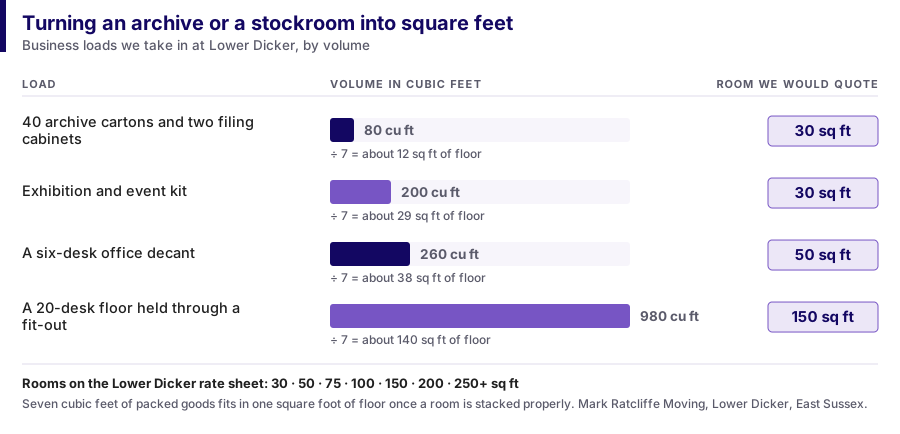
We plan at seven cubic feet of packed goods per square foot of floor, and how a storage quote is built from volume, duration and handling sets out the method. What changes on a commercial load is what has to be left empty: a working aisle at the door, and a gap between the walls and anything on a pallet or on castors.
A standard archive carton of roughly 15 by 12 by 10 inches is about one cubic foot, which makes paper easy to count. A shrink-wrapped UK pallet loaded to 1.2 metres is 1.44 cubic metres, or a shade over 50 cubic feet. Everything else we measure on survey.
The rooms we rent at Lower Dicker are 30, 50, 75, 100, 150 and 200 square feet, with 250 square feet and above quoted on survey for larger business stock. There is no size below the 30. The table converts real commercial loads into the smallest of those rooms that genuinely holds the load, with the Sussex weekly rate beside it so the answer arrives with a price attached rather than a phone call. Every figure includes VAT.
| Typical business load | Rough volume | Floor at 7 cu ft per sq ft | Room we would quote | Per week inc VAT |
|---|---|---|---|---|
| 40 archive cartons plus two four-drawer filing cabinets | 80 cu ft | 12 sq ft of floor | 30 sq ft | £18 |
| IT kit off one decommissioned floor (30 monitors, docks, empty racks, 15 crates) | 120 cu ft | 18 sq ft of floor | 30 sq ft | £18 |
| 150 archive cartons, stacked and racked | 160 cu ft | 23 sq ft of floor | 30 sq ft | £18 |
| Exhibition and event kit (gazebos, banner stands, display units, 25 cartons) | 200 cu ft | 29 sq ft of floor | 30 sq ft | £18 |
| Six-desk office decant (desks, chairs, pedestals, two cupboards, 20 cartons) | 260 cu ft | 38 sq ft of floor | 50 sq ft | £27 |
| Hospitality seasonal furniture (70 stacking chairs, 18 tables, parasols, planters) | 490 cu ft | 70 sq ft of floor | 75 sq ft | £36 |
| Twelve shrink-wrapped pallets at 1.2 m high | 610 cu ft | 88 sq ft of floor | 100 sq ft | £45 |
| A 20-desk floor held through a fit-out | 980 cu ft | 140 sq ft of floor | 150 sq ft | £63 |
Four of the eight rows land in the same room, and that is the rate sheet working rather than a rounding error. Thirty square feet is the smallest room we rent and it takes 210 cubic feet, so an archive of 80, 120, 160 or 200 cubic feet is the same room at the same £18 a week including VAT. The practical consequence for a business is headroom: a records account opened at 80 cubic feet can absorb another 130 before the price moves at all, which for most small firms is several years of filing.
Where a load lands close to a room’s working capacity, say so at the survey rather than booking on the arithmetic alone. The hospitality row at 490 cubic feet sits inside a 75 sq ft room that takes 525, and the fit-out row at 980 sits inside a 150 that takes 1,050. An archive you will dip into wants its cartons reachable without unstacking the whole wall, and a pallet load needs a pump-truck run down the middle, so both are worth reviewing against the next size up before anything is loaded.
If you want to run your own numbers before ringing us, our volume calculator works the cubic feet out room by room, and a surveyor will check the total against the racking and aisle you actually need before anything is quoted.
Business storage in Eastbourne is priced off the same rate sheet as a household store, because it is the same building, the same steel rooms and the same crew filling them. What changes for a business is which column you read.
Every price here includes VAT at 20 per cent. The nett column beside it is the figure a VAT-registered company carries in its accounts and recovers as input tax, so the real cost of a sealed archive room to a registered business is the nett line rather than the headline. Storage of goods in a room allocated to you is a standard-rated supply; your accountant will confirm the treatment for your own entity, but the recovery is ordinary rather than exotic.
These are the Sussex rates in full, exactly as we quote them.
| Room | Typically holds | Per week | Per week nett | Per 4 weeks | Collection or delivery, each way |
|---|---|---|---|---|---|
| 30 sq ft | One room, boxes | £18 | £15.00 | £72 | £240 |
| 50 sq ft | Studio or 1-bed flat | £27 | £22.50 | £108 | £390 |
| 75 sq ft | 2-bed flat | £36 | £30.00 | £144 | £550 |
| 100 sq ft | 2-bed house | £45 | £37.50 | £180 | £720 |
| 150 sq ft | 3-bed house | £63 | £52.50 | £252 | £990 |
| 200 sq ft | 4-bed house | £80 | £66.67 | £320 | £1,290 |
| 250 sq ft | 5-bed house or business stock | from £95 | from £79.17 | from £380 | Quoted on survey |
All prices include VAT (the nett column is what a VAT-registered business reclaims against). £5,000 of cover is included in every price. First 4 weeks half price when we collect for you.
Four things on that card matter more to a commercial account than to a household one.
The smallest room is the one most archive accounts want. Thirty square feet at £18 a week inc VAT, which is £15.00 nett, holds 210 cubic feet. That is roughly 200 standard archive cartons stacked properly, or the IT kit stripped off one decommissioned floor. A six-year VAT retention pile from a firm of twenty people rarely outgrows it.
Collection and delivery are charged each way, not once. A Sussex collection on a 30 sq ft load is £240, and bringing it back is the same charge again; at 150 sq ft it is £990 each way. Those figures buy a crew, a vehicle, the wrapping and the inventory rather than mileage, which is why they sit apart from the weekly rate. From 250 sq ft upwards the collection is quoted on survey, because at that size the vehicle count stops being predictable.
The opening offer applies to business accounts too. First 4 weeks half price when we collect for you — it is not a consumer-only promotion, and on a fit-out gap of three or four months it is the single largest saving available to you.
Cover is included, up to a point. £5,000 of cover comes with every price. Commercial stock, IT and display kit routinely exceeds that, so declare a real value at the survey and we will quote cover against it rather than leave you underinsured by default. It is worth checking your own commercial policy at the same time, because many lapse on goods the moment they leave your premises.
Two regional notes, because an Eastbourne business often has a second site. Kent is charged at the same weekly room rate as Sussex — £18 a week for 30 square feet, £45 for 100 square feet — with a higher collection charge of £290 each way on a 30 sq ft load, and a longer opening offer: first 8 weeks half price when we collect for you. London sits on a separate, higher weekly rate, £22 a week for 30 square feet and £55 for 100 square feet, where the saving on a long stay comes from the alternative offer instead: pay 26 weeks upfront and save 10% on storage.
What the card does not cover is the handling either side of the room: packing materials, timber crating for screens and display cases, permit-controlled or out-of-hours access at your premises, and retrieval runs beyond those agreed at the start. Each of those is quoted per job at the survey rather than estimated down the phone, and how a Sussex storage quote is assembled from volume, duration and handling sets out the arithmetic behind them. A purchase order raised against a quote that shows those lines separately is a far easier one to get signed off.
This is the part a rented unit structurally cannot match, because retrieval is a job somebody has to do rather than a door somebody has to open.
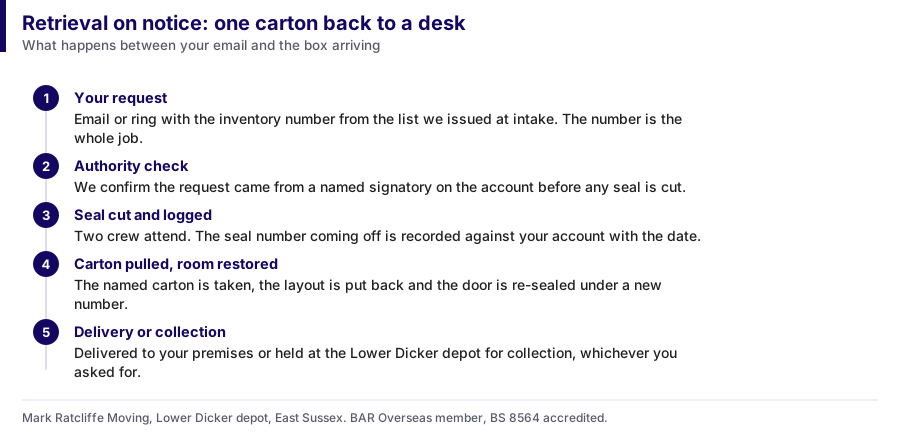
When a business stores records, the question is never “can I get in?” It is “can you find carton 147 and have it on my desk before the meeting on Thursday?” So the answer has to be a process, not an opening time.
Every carton is numbered at packing and the number is written on two faces, so it reads from the aisle without anyone turning the box. The numbers go onto a written schedule with a short description and, for archive, the destroy-not-before year.
We photograph the room layout once it is loaded, which is how we know carton 147 is on the left-hand stack, third row, without opening anything. A copy of the schedule goes to you as a file, so your side can search it even when ours is closed.
| What you need back | What we need from you | What we work to |
|---|---|---|
| One named carton, reference known | Written request from an authorised signatory before midday | Delivered to your premises the next working day |
| One carton, reference not known | A date range or description, and the years it could fall in | Schedule searched and confirmed within one working day, delivery the day after |
| A run of cartons or a whole pallet | Request plus a delivery window and who will sign | Next working day by our vehicle, or your courier from the depot by appointment |
| To read a file rather than take it away | Named person, photo ID, booked slot | Depot appointment in working hours; file read in the office, not in the room |
| Everything back at the end of the term | Written instruction and a target date | Booked and crewed as a delivery, same crew standard as the collection |
| To change who may authorise retrievals | Written instruction from a director or the original signatory | Schedule and authority list updated the same working day |
Two honest caveats go with that table.
Requests that land after midday roll to the following working day, because the retrieval has to be picked, checked and loaded onto a vehicle that is already routed.
And month-end, the last week of August and the fortnight before Christmas are our tightest periods, so a retrieval that is genuinely time-critical in those windows is worth flagging when you book the storage rather than on the day. The mechanics of the collection end are covered on our collection and storage service page.
A business collection is not a house move done in a suit.
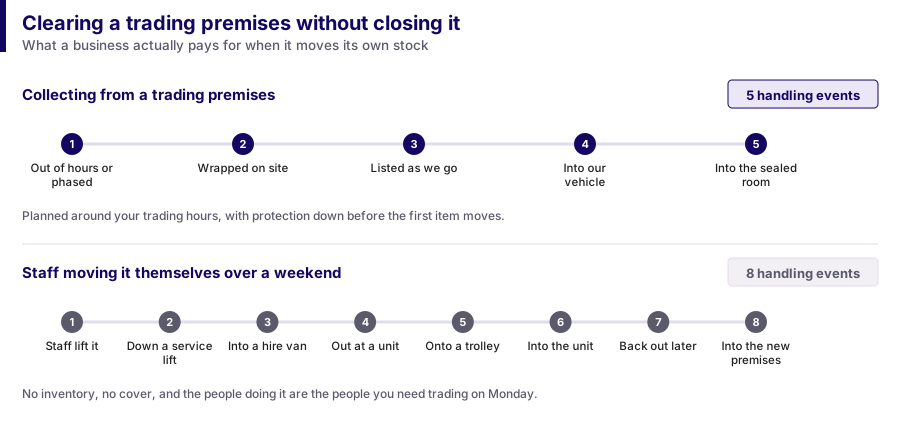
The building is usually still working, the access is usually shared, and the thing that wrecks the schedule is almost never the lifting. It is the loading bay booked by someone else, the goods lift that needs a permit, the one-way system on a Tuesday, or the fact that the shop cannot have a trolley across the floor between ten and four.
So we survey the access before we survey the goods. A 30 to 45 minute visit covers where the vehicle can legally stand, how far the carry is, whether a shuttle vehicle is needed, what the lift dimensions are, who signs the crew in, and what the building’s rules are on out-of-hours working.
If a shuttle or a permit is needed it goes into the quote from the start rather than appearing on the day. None of this is a problem when it is planned. All of it is a problem when it is discovered on the morning.
On the day the crew wraps freestanding items in heavy quilted blankets in the room they stand in, tapes drawer fronts, protects corners and loads stack-safe and strapped. Desks and storage walls are dismantled, fixings bagged and taped to the piece they came off, and the dismantle is logged so the reassembly on return is not a puzzle.
Cartons are numbered and listed as they leave the floor, not counted off the tail lift. A count taken at the vehicle is the count that goes wrong.
We cover the whole of Sussex for this, with the storage depot at Lower Dicker and a second depot at Coulsdon in Surrey for the London-facing work. Typical collections run from Eastbourne, Hailsham and Polegate within half an hour of the depot, and from Brighton and Hove on a same-day return-to-store run.
If part of the load is genuinely not worth keeping, it is cheaper to deal with it at collection than to pay to store it, and our clearance service can take that away on the same visit.
The commonest commercial storage booking we take is not an archive at all.
It is a lease that ends on a fixed date against a fit-out that will finish “probably the month after”, and a business that cannot leave twenty desks on a pavement in between. The gap is almost always longer than the contractor’s first estimate, which is why the storage term needs to be open-ended rather than fixed to a date you were given in a meeting.
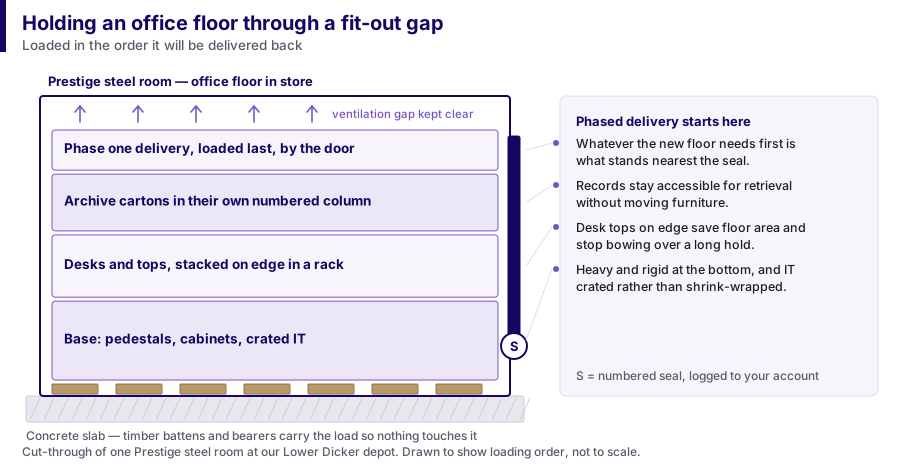
What makes the return work is deciding the delivery order before anything goes into store, because the order you load is the order you can unload.
We load last-in-first-out against the fit-out sequence: chairs and floor boxes at the front because they land on day one, storage walls and the reception furniture behind them, archive at the back because it goes in when everything else is standing. Getting that wrong means shifting the whole room to reach a stack of monitors.
Phased returns are the norm rather than the exception. A floor that is being handed over in sections gets two or three deliveries rather than one, each one booked against the section that is ready, with the reassembly crew on the same vehicle so desks go back together as they land.
That is the same discipline as a staged move, and the detail of how those windows are worked out sits in our write-up of phasing an office relocation out of hours.
Sometimes the gap turns into half a year or more — a planning delay, a landlord dispute, a site that stalls. At that point the account shifts onto a different footing, with a condition review and a re-inventory rather than simply sitting there, and that is covered on our long-term storage page.
Where the whole exercise is a move with a store in the middle, the single-contract argument is set out on our removals and storage in Sussex page.
A sealed room that nobody opens for months is a very good place for paper, furniture and boxed stock, and a very poor place for several categories of commercial goods.
Refusing them is not caution for its own sake. It is what keeps the rest of the building insurable and the other customers’ goods intact.
One more that is less obvious. Damp stock should not go in at all.
Goods that come out of a leaking unit or a basement need to be dried before they are sealed, because a sealed room will hold whatever moisture you put into it. If a load arrives visibly wet we will say so at collection and store it separately until it is dry rather than seal the problem in.
Cover for goods in store is arranged as part of the storage agreement and the terms are set out in our terms and insurance details. Business interruption and stock-value cover are worth checking against your own commercial policy, which frequently lapses on goods once they leave your premises.
There is a version of this service that is wrong for you, and it is worth saying which.
If your business needs to get into its own goods at seven in the evening, on a Sunday, or on no notice at all — a trader loading a van at dawn twice a week, a builder pulling tools every morning, an online seller picking single items daily — a self-storage site, rather than a managed store, is simply a better fit: a drive-up unit rented in your own name, opened whenever you like.
Our depot is open Monday to Friday, 08:00 to 17:30, and Saturday, 09:00 to 13:00. Access to the rooms themselves is by arrangement rather than on demand, because a room has to be opened by a member of staff against your authority list.
We would rather tell you that now than take a booking you will resent in a fortnight.
Where the managed model wins is everything with a low access frequency and a high handling cost. Archive under retention, furniture in a fit-out gap, seasonal kit with two movements a year, stock waiting on a clearance decision.
In those cases the lifting is the expensive part, not the floor space. Paying a firm that already has the crew, the vehicles, the blankets and the inventory beats renting a room and then hiring someone else to fill it. Goods are handled once at your door and once at the room, and every transfer you avoid is a damage opportunity you avoid.
The other quiet advantage is continuity. The same business handles the collection, the store and the return, so when a carton is queried there is one schedule, one crew and one phone number, rather than a storage operator pointing at a carrier.
Commercial customers notice that at the awkward moments rather than the ordinary ones — a carton queried against the schedule, a delivery wanted a day earlier than agreed — and several of them describe those moments in our customer reviews.
If you want to see the building before committing, we would prefer it. Come to the depot at Lower Dicker, look at a room, and decide then. Where records are being packed for a long dwell rather than a van journey, our packing for storage service covers why the materials change.
Yes. Every carton is numbered at packing and listed on a written schedule, so a named carton can be picked on its own. A written request from an authorised signatory before midday is normally delivered to your premises the next working day, or your own courier can collect it from the Lower Dicker depot by appointment.
Our Sussex rooms start at £18 a week including VAT for 30 square feet, which holds about 210 cubic feet or roughly 200 archive cartons, and run to £80 a week for 200 square feet; 250 square feet and above is quoted from £95 a week on survey. Collection or delivery is charged each way and starts at £240 for a 30 square foot Sussex load. £5,000 of cover is included in every price, the nett figure is reclaimable if you are VAT registered, and the full rate card is published further up this page.
It depends entirely on the record. VAT records run to six years, PAYE to three years after the end of the tax year, National Minimum Wage records to six, and COSHH health surveillance and asbestos records to forty. The retention table further up this page gives the periods we plan archive storage around, and your accountant or data protection officer should confirm your own schedule.
It can be, and the obligation stays with you as controller. What that needs in practice is a written storage agreement, a documented list of who may authorise a retrieval, a schedule that records where the cartons physically are, and the arrangement written into your own processing documentation. We keep cartons sealed, log entry and exit, and hold BS 8564 accreditation behind the process.
No, and we would rather say so plainly. We do not destroy anything ourselves and we do not issue certificates of destruction. When a retention date falls due we either deliver the cartons back to your premises against the schedule, or deliver them to a destruction contractor you have appointed who works to BS EN 15713, in which case that contractor issues the certificate directly to you. Destruction instructions are only ever acted on in writing from a named signatory.
No. Our inventory is carton-level rather than page-level, so you can search a written schedule for a box but not a phrase inside a file. If you need bulk scanning or an indexed digital retrieval portal you need a records management bureau, and we are happy to store the paper while one does the digitising.
No. We move stock in and out in cartons and pallets, not as a fulfilment operation, so there is no daily picking, packing or despatch. If your requirement is order fulfilment you need a 3PL, not a storage depot, and we will say so rather than take the booking.
Only the people you name in writing when the account is opened. We hold that authority list against your account reference and will not release goods to anyone outside it, including a director we have not been told about. Changes need written instruction from a director or the original signatory and are applied the same working day.
Yes, and it is the commonest business booking we take. We load the store last-in-first-out against your fit-out sequence so day-one items are at the front, then deliver in two or three phases with the reassembly crew on the same vehicle. The sequence needs agreeing before anything goes into the room rather than after.
Yes. Storage and transport are invoiced to your accounts address with your purchase order reference carried on the paperwork, and a VAT invoice issued so the input tax is reclaimable in the normal way if your business is registered.
From the blog

How a weekend office move runs — Friday-night crew shifts, lift and access bookings, out-of-hours passes and the Monday-morning IT order.
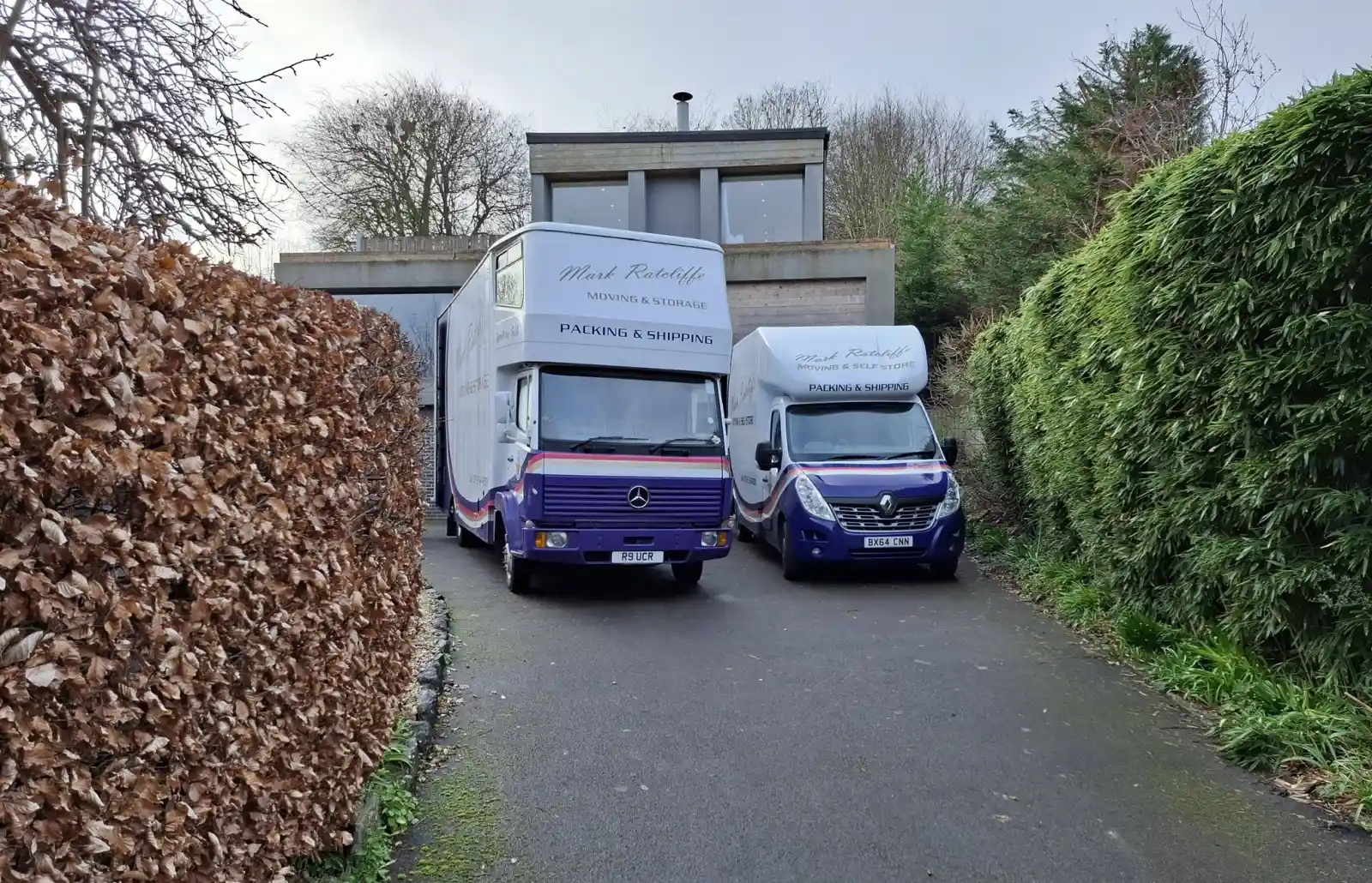
Planning an office move? Learn proven strategies to reduce downtime, keep your team productive, and ensure a smooth business relocation.
How to transfer a premises licence, vary the DPS, move duty-paid stock, decommission cellar and kitchen gas, and register with the new EHO.
Tell us what the load is, when it has to leave your premises and how often you expect to need something back, and we will survey the access and the goods and quote a room against it. Sussex storage starts at £18 a week including VAT for a 30 square foot room, with £5,000 of cover included and the first 4 weeks half price when we collect for you. Call 01323 848 008 or 07437 414 589, email office@markratcliffemoving.co.uk, or send the details through our online quote form. Mark Ratcliffe Moving is a family-run Sussex firm established in 2017, a member of the British Association of Removers Overseas Group and BS 8564 accredited, storing at Lower Dicker with a second depot at Coulsdon.