
Storage before shipping overseas, for the weeks between leaving the UK house and the container sailing. We export-wrap and collect once, write one inventory that serves both the storage room and customs, and hold the load sealed at our Lower Dicker depot until your visa, your sailing or your destination home is genuinely ready.

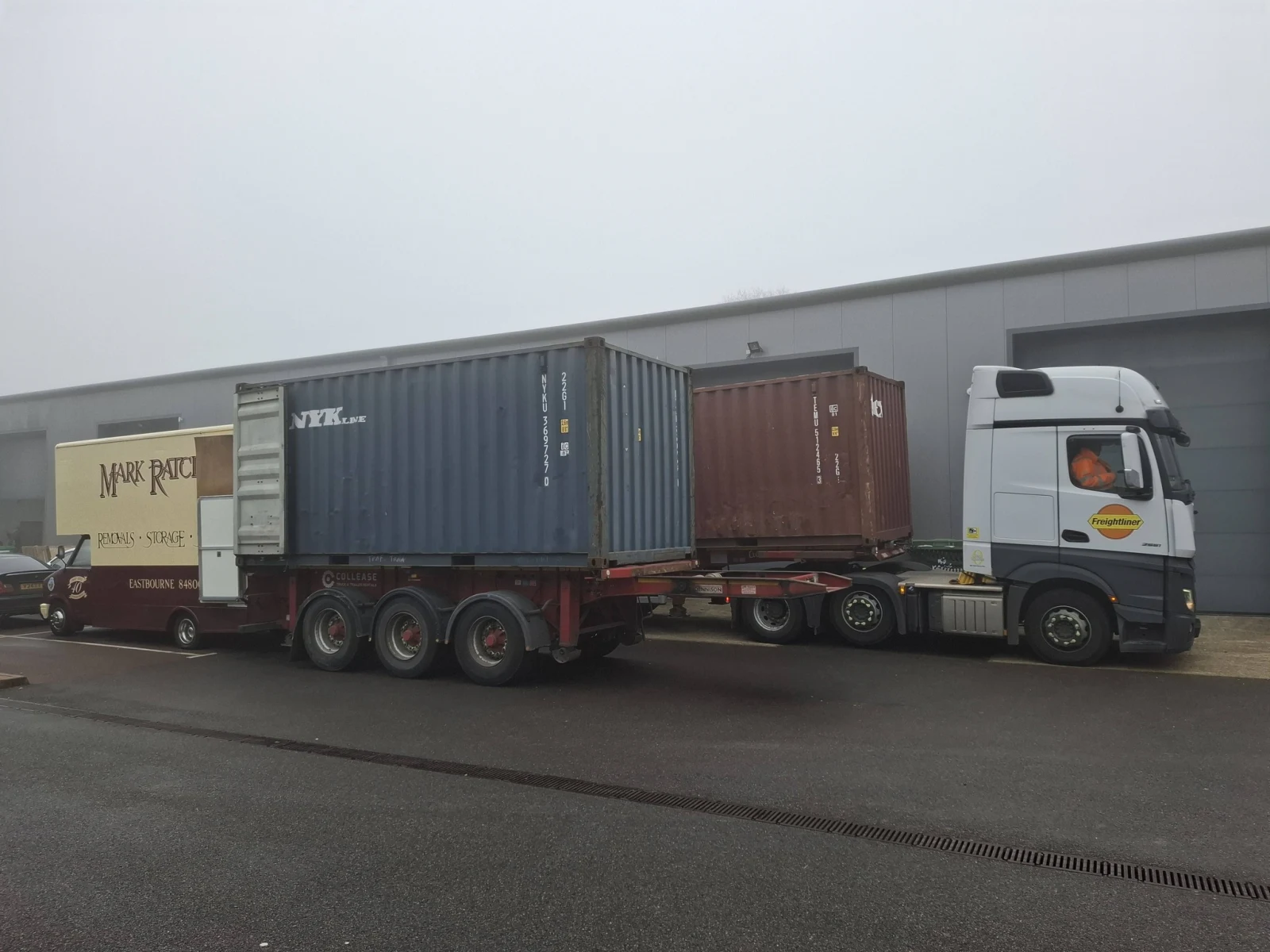
Storage before shipping overseas exists because two dates almost never line up. Your UK completion date is set by a conveyancer and a chain. Your sailing date is set by a shipping line, a visa officer and a landlord in another country. The weeks in between are the hardest part of an international move to plan for, and they are the weeks our Sussex depot is built to absorb.
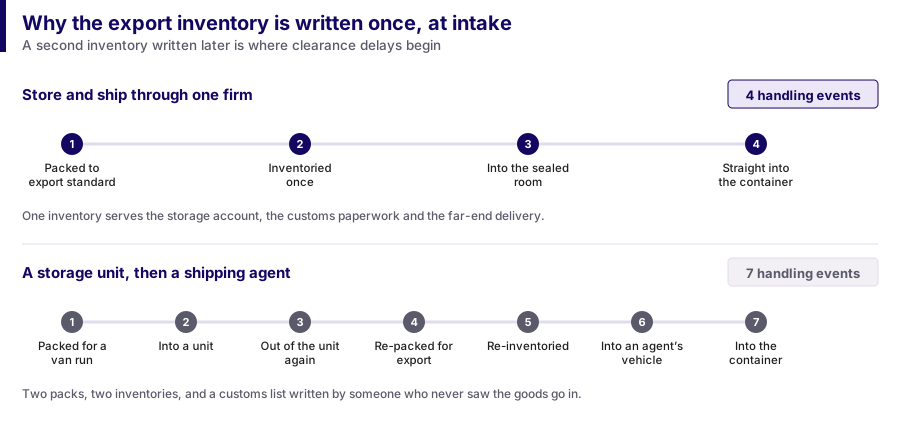
We collect the household once, export-wrap it at the door, write one inventory, and put it into an individual steel-walled room at our Lower Dicker depot near Hailsham. It stays sealed there until the sailing is confirmed. Nothing is repacked, nothing is handed to a third party, and nothing is counted twice.
That is the difference between us and a storage room rented separately from a shipping agent. In the split arrangement your goods are loaded by one firm, unloaded and shelved by another, then loaded again by a third on the day the container is stuffed. Six handling events instead of our four, three inventories that never quite agree, and nobody who owns the whole timeline when a date moves.
Ask anyone who has moved abroad which date slipped and the answer is rarely the shipping. It is the permit, the medical, the apostilled certificate that came back with a name spelled wrong, or a start date that moved by six weeks because a team reorganised.
The pattern is consistent enough that we plan for it. The UK house sells first because it has to, because that is what funds the move. The destination side firms up last, because a landlord abroad will not hold a property for someone without a residence permit, and an employer abroad will not confirm a start date until the paperwork clears. So the household is homeless for a while, and it has to live somewhere.
We have held pre-shipment loads for a fortnight and we have held them for the best part of a year. A Swiss permit application that ran long. A Thai visa category that changed while the customer was mid-application. A couple bound for Spain who decided, three months in, that they would rent for a year first and wanted only half the load shipped. None of that is unusual, and none of it needs a new contract each time the plan moves.
What we ask for instead is a review call roughly every eight weeks. It takes five minutes, it keeps the inventory and the contact details current, and it is how we catch the fact that a customer is now flying out in nine days rather than nine weeks. If your stay turns out to run past six months, the account moves onto the footing described on our long-term storage in Sussex page, which covers condition checks and reviews over time.
Cost is driven by the same three things it is always driven by: the volume you store, the number of weeks you store it, and the handling in and out. We are not going to make you wait for a survey to see the first of those, because a pre-shipment store is nearly always booked under date pressure. These are the rates our Lower Dicker rooms are let at, and the room your load needs is settled by its cubic footage rather than by a bedroom count.
| Room | Typically holds | Per week | Per week nett | Per 4 weeks | Collection or delivery, each way |
|---|---|---|---|---|---|
| 30 sq ft | One room, boxes | £18 | £15.00 | £72 | £240 |
| 50 sq ft | Studio or 1-bed flat | £27 | £22.50 | £108 | £390 |
| 75 sq ft | 2-bed flat | £36 | £30.00 | £144 | £550 |
| 100 sq ft | 2-bed house | £45 | £37.50 | £180 | £720 |
| 150 sq ft | 3-bed house | £63 | £52.50 | £252 | £990 |
| 200 sq ft | 4-bed house | £80 | £66.67 | £320 | £1,290 |
| 250 sq ft | 5-bed house or business stock | from £95 | from £79.17 | from £380 | Quoted on survey |
All prices include VAT (the nett column is what a VAT-registered business reclaims against). £5,000 of cover is included in every price. First 4 weeks half price when we collect for you.
Storage runs by the week from the day the room is sealed, so a sailing that slips by a fortnight costs two more weeks at the rate above and nothing else. Nothing is handled while it waits, so a moved date carries no second handling charge, and collection is charged once each way at the figure in the final column. Release out of store to the port is quoted on the same basis.
Kent collections are let on the same weekly room rates with their own collection charge and their own offer (Kent launch offer: first 8 weeks half price when we collect for you), while a London collection prices on the London column of the same sheet — £22 a week for the 30 sq ft room against £18 here. Whichever column applies, the method by which those three numbers become a single quote is set out on our storage costs explained for Sussex page.
The single most useful thing to know before you book storage is how long your route takes, because that is what decides when the goods have to come out. A road move to Normandy and a sea move to Auckland are not the same planning problem. One needs your destination address a week out; the other needs it two months out.
These are the transit figures we quote from across our destination pages, set against the lead time we work to when taking a load out of store. Shared loads add time because the vehicle or container waits for compatible volume, so if your dates are tight that is the first thing to discuss.
| Route from Sussex | Typical door-to-door transit | Add for a shared load | Out of store before departure |
|---|---|---|---|
| France – Normandy and Pas-de-Calais to Provence | 3–10 days by road | 3–7 days | 3–5 working days |
| Belgium and the Netherlands | 5–8 days by road | 3–7 days | 3–5 working days |
| Luxembourg | 6–9 days by road | 3–7 days | 3–5 working days |
| Spain – north coast to Andalucía | 6–12 days; Balearics add 3–5 | 5–10 days | 3–5 working days |
| Italy | 8–12 days by road | 5–10 days | 3–5 working days |
| Switzerland | 10–14 days by road | 5–10 days | 5 working days |
| UAE – Jebel Ali or Khalifa Port | 4–6 weeks at sea, 1–2 weeks clearing | 2–4 weeks | 7–10 working days |
| USA and Canada – east coast to west | 3–7 weeks at sea by port | 2–4 weeks | 7–10 working days |
| South Africa – Cape Town, Durban, Port Elizabeth | 6–9 weeks door to door | 2–3 weeks | 7–10 working days |
| Australia and New Zealand | 5–10 weeks at sea, plus 1–2 weeks quarantine | 2–4 weeks | 7–10 working days |
| Thailand – Bangkok and the resort provinces | 10–14 weeks door to door, 5–6 at sea | 2–4 weeks | 7–10 working days |
Read that last column as the working answer to “when do I stop being able to change my mind”. Once a sea consignment leaves our store for the port it is committed. Road routes are more forgiving, which is why a store-then-drive move to France or Spain can often be re-pointed at short notice while a Thailand sailing cannot.
Route detail, port pairings and the reason Swiss paperwork runs longer than the drive are on the individual destination pages, starting with European removals from Eastbourne and removals to Switzerland.
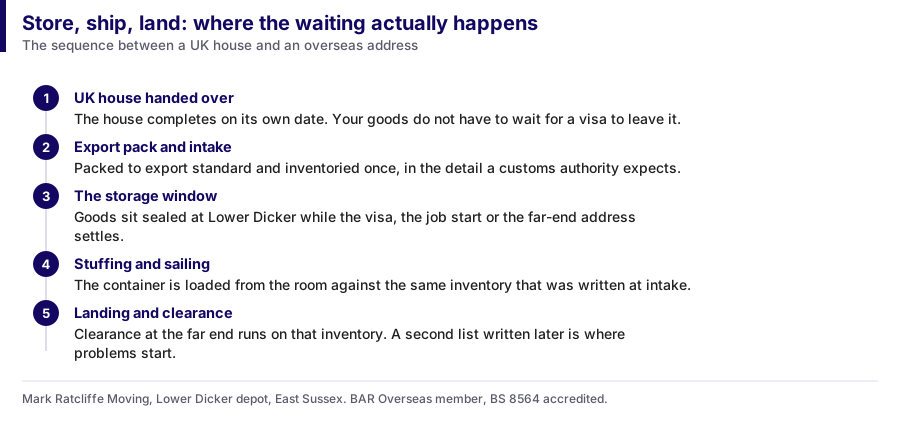
Storage duration on an overseas move is not really a storage decision. It is a customs decision wearing a storage hat. Goods that land before the relief paperwork is approved can sit in a port abroad accruing charges, and those charges are billed at the destination in local currency by people you have never met.
For a UK household going to a non-EU destination, the document that sets the pace is the destination country’s own transfer-of-residence or returning-resident relief, applied for with that country’s customs authority before the goods sail. The UK runs the same mechanism in the other direction, and it is the one with published rules you can read for yourself: HMRC’s transfer of residence relief application, form ToR1, which covers personal belongings coming into the UK. That matters here more often than people expect, because a good share of our storage customers are coming back rather than going out. Either way the shape is identical. A reference number the shipping documentation quotes, free to apply for, and the difference between used household effects entering duty and VAT free or clearing as a commercial import.
| What is needed | Who issues it | Lead time to allow | What it holds up if it is late |
|---|---|---|---|
| Destination transfer-of-residence or returning-resident relief (non-EU) | The destination customs authority, usually through the agent at the far end | Varies by country; start it the week you book the storage | Duty and VAT-free entry abroad; without it goods clear as a commercial import |
| UK Transfer of Residence relief reference, on moves into the UK | HMRC, on the GOV.UK ToR1 form | Four to six weeks on the jobs we have booked, longer over the summer peak | Duty and VAT-free entry; without it goods clear as a standard import |
| Visa or residence permit | Destination authority | Weeks to months, outside anyone’s control | Everything. This is the usual reason a store runs long |
| Confirmed destination address and consignee details | You, once a lease or purchase is signed | Often the last item to firm up | The bill of lading and the delivery booking at the far end |
| Export packing list and valued inventory | Us, written on collection day | Produced at intake, updated on any change | Customs declaration, marine cover, the stuffing plan |
| Marine transit valuation | You, before the sailing | Allow a week to value it honestly | Cover on the water; a rushed valuation is a bad valuation |
| Passport stamped on entry, where the relief runs from arrival | Destination border | On the day you land | Clearance at the far end on several long-haul routes |
| Treated-timber certification for crated items | Our crating workshop, to the GOV.UK wood packaging material rules | Produced with the crate | Timber crates entering countries that enforce ISPM-15 |
Transfer of Residence relief carries conditions, broadly around how long you have lived outside the UK, how long you have owned and used the goods, and how long you keep them after import. Those conditions change, so read HMRC’s transfer of residence guidance rather than a remover’s summary of it, including ours, and check the equivalent rules published by the country you are going to. What we will do is tell you when your storage plan and your relief application have drifted out of step, because that is the mistake that costs real money.
The one clause we will not repeat here: crating standards, heat-treatment marks and which items warrant a purpose-built box are covered properly on our custom timber crate service page.
On collection day a crew member works the list while the rest of the team wraps and carries. Every carton and every loose item gets a number. The number goes on two faces of the carton, not one, so it can be read from the aisle without turning the box. Room of origin, contents description and any pre-existing damage are written against the number there and then, not reconstructed later from memory.
That list does four jobs. It seals the storage room against your reference. It is the basis of the customs packing list. It is what a marine underwriter looks at. And it is the tick sheet used when the goods come out of store and go into the container, which is why the count at stuffing matches the count at collection instead of being an argument.
We photograph the room once it is loaded and stacked, so there is a record of how the load sat. If you ask us to add or remove anything during the store period, the inventory is amended and re-issued rather than annotated by hand. A customs packing list with crossings-out on it is a packing list that invites questions.
Two honest limits. First, values are yours to declare. We will describe an item accurately, but we will not put a figure on your grandmother’s writing desk, and any remover who offers to is doing you no favours. Second, a contents description is a description, not an opening. If a carton was packed by you and sealed by you, we record it as owner-packed, and that matters both for cover and at customs.
Where an item-level record with thumbnails and a signed condition report is wanted, that sits in our white-glove moving service. For fine art, longcase clocks and anything that will be asked about at the far end, the extra detail earns its keep. The same applies to pieces going through our antiques moving service, where condition at intake is the whole argument later.
The commonest self-inflicted problem on a pre-shipment store is a passport in a sealed carton. The second commonest is three months of medication somewhere in the middle of a stack that is about to spend six weeks at sea. Both are avoidable, and both are avoided by deciding at survey which leg each thing travels on.
We work to three legs: what you carry, what flies, and what sails. Anything that does not get allocated ends up in the sea consignment by default, which is fine for a sideboard and a disaster for a birth certificate.
| What it is | Which leg it travels on | Why it goes that way |
|---|---|---|
| Passports, visas, ToR correspondence, marriage and birth certificates | Hand luggage | You will be asked for them at the border and again at clearance |
| Prescription medication and repeat prescriptions | Hand luggage | A pharmacy abroad wants a named prescription, and sea freight is weeks away |
| Laptops, work devices, chargers, adaptors | Hand luggage or air freight | A start date rarely waits for a ship |
| School reports, immunisation records, pet paperwork | Hand luggage | School enrolment abroad usually asks in the first week |
| Two to three months of clothing for the season you land in | Air freight | You may be leaving a Sussex February for a Gulf summer |
| Children’s beds, comforters, a small box of familiar toys | Air freight | The fortnight in an empty rental is the hardest part of the whole move |
| Kettle, a few pans, basic crockery, one set of bedding | Air freight | Stops you buying a second household you will then own twice |
| Jewellery, watches, small high-value items | Hand luggage | Marine policies commonly cap or exclude them; declare anything you do ship |
| Furniture, appliances, books, the rest of the house | Sea or road freight from store | Released on the lead times in the route table above |
Making that call at survey is what lets us stage the store room properly. Air-freight cartons and anything flagged for early release are stacked at the front of the room by the door, not buried behind a wardrobe. It costs us nothing to load it that way on the day and saves a half-day dig later.
If you would rather we did the packing as well as the storing, the standards change once goods are going to sit still for months rather than ride in a van for two hours. That argument, and the materials that go with it, belong on our packing and storage service page.
A two-year posting is not a permanent emigration, and treating it like one is expensive in both directions. Ship the whole house to Dubai for twenty-four months and you pay freight twice on furniture that a serviced apartment did not need. Ship nothing and you spend the first month buying a second household.
The split is the sensible answer and it is more common than the whole-house move on assignment routes. A typical shape: clothing, kitchen kit, children’s things, one or two pieces of furniture that make a rental feel like yours, and the work equipment. Everything else holds in Sussex until the posting either ends or turns into something permanent.
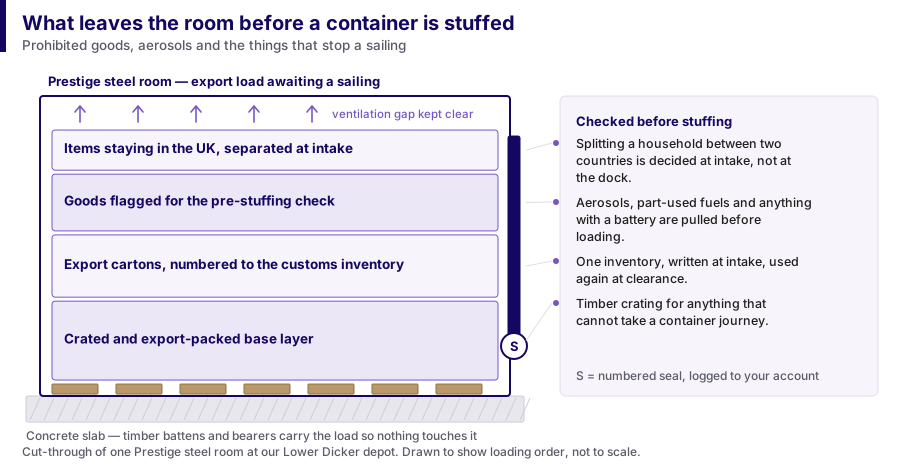
Mechanically it is one survey and two lists. At the survey each line is marked to ship or to hold, and you get two volumes and two quotes rather than one number with an asterisk. The held portion goes into a room sized to that volume, not to the whole house, which is the part customers most often get wrong when they arrange storage separately.
There is a threshold worth knowing about. Splitting a load can drop the shipped volume below the point where a sole-use container makes sense, which pushes you into a shared load and a consolidation wait. Sometimes the right answer is to ship slightly more than you planned and take the dedicated container; sometimes it is to ship far less and accept the wait. We will say which way your numbers point rather than quoting whichever option suits us. The freight side of that decision is set out in our guide to container shipping, groupage and what fits in a twenty-foot box.
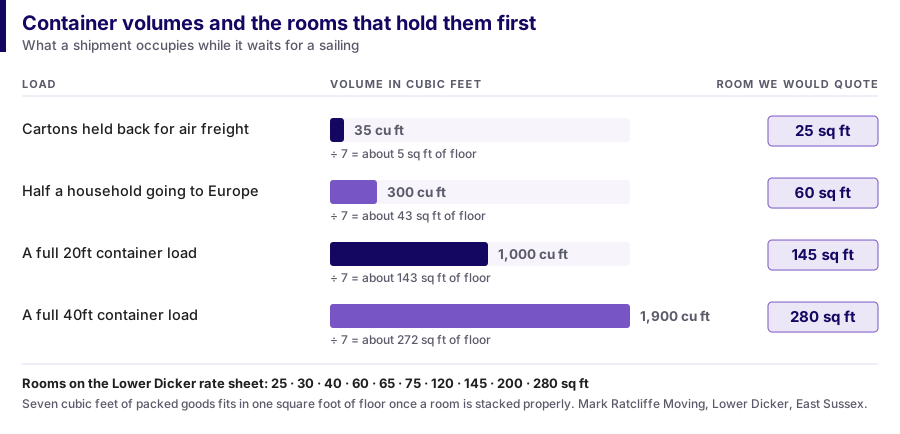
To sanity-check your own split before we visit, our volume calculator works your load out in cubic feet. Our internal planning figure is seven cubic feet of packed goods per square foot of storage floor, so a 280 cubic foot hold portion needs about 40 square feet of floor and goes into the 50 sq ft room, the one we list as holding a studio or 1-bed flat, at £27 a week including VAT.
We size a held portion to the smallest room that genuinely takes the volume rather than rounding a bedroom count upwards, which is why the working-capacity column matters more than the room name. These are the rooms at Lower Dicker:
| Room size | Working capacity | Approx. cubic metres | What that holds in practice |
|---|---|---|---|
| 30 sq ft | 210 cu ft | 5.9 cu m | One room, boxes |
| 50 sq ft | 350 cu ft | 9.9 cu m | Studio or 1-bed flat |
| 75 sq ft | 525 cu ft | 14.9 cu m | 2-bed flat |
| 100 sq ft | 700 cu ft | 19.8 cu m | 2-bed house |
| 150 sq ft | 1,050 cu ft | 29.7 cu m | 3-bed house |
| 200 sq ft | 1,400 cu ft | 39.6 cu m | 4-bed house |
| 250 sq ft or more | 1,750 cu ft | 49.6 cu m | 5-bed house or business stock |
Anything up to 210 cubic feet goes in the 30 sq ft room, a 280 cubic foot split portion takes the 50, and a whole three-bedroom household at 1,050 cubic feet needs the 150. Weekly prices for each sit in the table earlier on this page; every one of them includes VAT and £5,000 of cover.
Everything above assumes the hold-up is in the UK. Often it is not. The lease at the far end falls through, the permit is granted but the apartment handover slips, the destination agent cannot get a delivery slot for a fortnight. The container has already sailed and there is no recall.
Once goods land, the meter runs on somebody else’s terms. Port storage and demurrage are charged by the day by the terminal and the line, and destination-agent storage is charged at local warehouse rates in local currency. You have no leverage, no relationship and usually no ability to open the box and take out the one thing you need. Compared with holding the same load in a sealed room in East Sussex where the phone number is a UK landline, it is a poor place to be waiting.
So the rule we give customers is blunt. Do not release from store until two things are true: the residence paperwork is approved, and you have either keys or a written handover date at the destination. A confident email from a letting agent is not a handover date. If both are not true, wait. Waiting here is a known quantity, and it is one we control.
The exception is a groupage sailing that only runs monthly on a thinner route. Miss it and the next one may be four or five weeks out, which can cost more in extra store weeks than it saves in risk. That is a judgement call, and it is the sort of thing our international team takes on a case-by-case basis rather than by policy. Route frequency by destination is covered under international removals from Eastbourne.
Cover during the wait continues under the terms you signed at booking, which run across the removal, the storage period and the voyage as one arrangement. The detail is in our terms, conditions and insurance details rather than restated here.
The return leg is the mirror image and it catches people out more often, because coming home feels like it should be simpler. It is not. You are arriving into a rental market you have been away from, your UK purchase is subject to the same chain risk as anyone else’s, and your goods are on a ship that will land when it lands.
What usually happens is that the container arrives before the house does. We clear it, collect from the port on a dedicated run, and take it straight into store at Lower Dicker. The household never sees a temporary flat crammed with cartons, and you are not paying port charges while you wait for a completion date. When the house is ready we redeliver, unwrap in position and take the packing materials away.
Returning residents may also be able to claim relief on their own used goods coming back into the UK, and the conditions for that sit with HMRC on GOV.UK in the same place as the outbound rules. We will prepare the documentation from the inventory that travelled with the shipment, which is another reason the single list written at intake is worth the effort.
If the delay is a UK chain rather than a shipment, that is a different playbook with a different set of first phone calls, and it is set out on our storage while moving house page. For collection and redelivery across the coast, our Eastbourne removals coverage lists the towns we run daily from the depot.
We would rather set the limits out now than have them discovered in week three. Four things this service is not.
It is not a bonded or customs warehouse. Goods sitting in our store are ordinary UK goods in free circulation. They are not under customs control, no duty is suspended, and storing them here neither starts nor pauses any clock on your relief application. If your shipment genuinely needs a customs-controlled facility, that is a specialist arrangement and we will say so rather than improvise.
It will not accelerate a visa or an HMRC application. Nobody’s storage can. What it can do is remove the pressure to make a shipping decision before you have the answer, which is the practical value of the whole thing.
It is not an unattended facility you drop into at midnight. Access is by appointment during depot hours, a sealed room is opened by our staff with you present, and the inventory is amended whenever anything moves in or out. That is deliberate, and it is the trade you make for goods that are handled by people who are accountable for them. The building itself, the room sizes and the security arrangements are described on our Prestige steel storage rooms at Lower Dicker page.
And there is a short list of things we will not take at all, for the same reasons no responsible warehouse takes them. That list is published on the storage page rather than buried in small print.
What you get in exchange is continuity. One survey, one inventory, one crew, one contract covering the collection, the store and the voyage. If you want to compare that against the sealed-container format on its own merits, our page on containerised storage in Sussex sets out how the formats differ, and the duration question is worked through in short-term versus long-term storage.
Allow four to six weeks, and longer if you apply over the summer. Ship before the reference comes back and you are gambling that it arrives before the vessel does; if it does not, the goods clear as a standard import rather than under relief. Holding in store until the reference is in hand is the cheaper risk on every long-haul route we run.
No. Your own used household goods are already in free circulation in the UK, so storing them here creates no new duty or VAT event. Storage is a service and is invoiced as one; the import taxes that matter are the destination country’s, and those are decided at the far end.
Yes, and on assignment postings it is usually the right answer. We mark each line of the survey to ship or to hold, quote the two volumes separately, and size the storage room to the held portion rather than the whole house. The only thing to watch is that a smaller shipped volume can push you from a dedicated container onto a shared load.
Sussex storage starts at £18 a week including VAT for the 30 sq ft room, which takes one room of furniture and boxes, and runs to £63 a week for the 150 sq ft room that holds a three-bedroom house. A split-household hold portion of around 280 cubic feet sits in the 50 sq ft room at £27 a week. Collection is charged once each way, £5,000 of cover is included in the weekly price, and the current Sussex offer is first 4 weeks half price when we collect for you.
They stay exactly where they are while you decide. Nothing is committed until a load leaves the store for the port, so a refusal at that stage costs you storage weeks rather than freight. We have redelivered pre-shipment loads back to a UK address more than once when a plan changed, and it is a straightforward job because the inventory never left our hands.
Yes, with notice. A member of staff opens the room with you present, we pull the numbered carton, and the inventory is amended and re-issued so the customs packing list stays accurate. It is worth flagging anything you are likely to want at survey so we stack it by the door rather than behind the wardrobes.
Almost always the UK. Port storage and demurrage are charged daily by the terminal and the line in local currency, you cannot open the container, and you have no relationship with anyone involved. A sealed room in East Sussex with a UK phone number attached to it is the better place to lose four weeks.
Seven to ten working days for a sea consignment, three to five for a European road move. That window covers the load out of store, the run to the port or the start of the drive, and the documentation being finalised against the inventory. Tight dates are workable but they need to be flagged at booking, not the week before.
Yes. We collect from a UK address with a nominated key-holder present, write the inventory, photograph the loaded room and email the paperwork through. It is a common arrangement where one partner has already started a job overseas, and it works best when we have a written list of anything that must not be shipped before you see it again.
Yes, and doing it at collection rather than at release is the whole point. Wrapping once at your door means the load is voyage-ready the day it goes into the room, so releasing it is a straight load rather than a repack, and the goods are handled one time fewer than on a split storage-plus-shipping arrangement.
From the blog

How a shipping container house move is priced: sole-use vs groupage, 20ft and 40ft capacity, air freight, port and destination charges.
Planning an overseas move from Sussex? Our guide covers customs, shipping, insurance, and everything involved in international removals.

What it costs and how long it takes to ship a UK home to Thailand — container choice, customs, duty relief and a realistic timeline.
Tell us the completion date you are working to and the destination you are heading for, and we will tell you where the pressure points are before you commit to anything. A survey takes thirty to forty-five minutes in your home or by video, and it produces one volume figure, one inventory plan and a written quote covering the collection, the store and the shipping as a single arrangement.
Call the Lower Dicker depot on 01323 848 008, mobile 07437 414 589, or email office@markratcliffemoving.co.uk. We are BAR Overseas Group members, BS 8564 accredited, and rated 4.9 out of 5 across more than 120 reviews.