
Furniture storage near Eastbourne, where every piece is pad-wrapped before it goes in rather than stacked bare on a warehouse shelf. Raised off the floor, sealed in its own steel room, and inventoried so you know exactly what is in there.

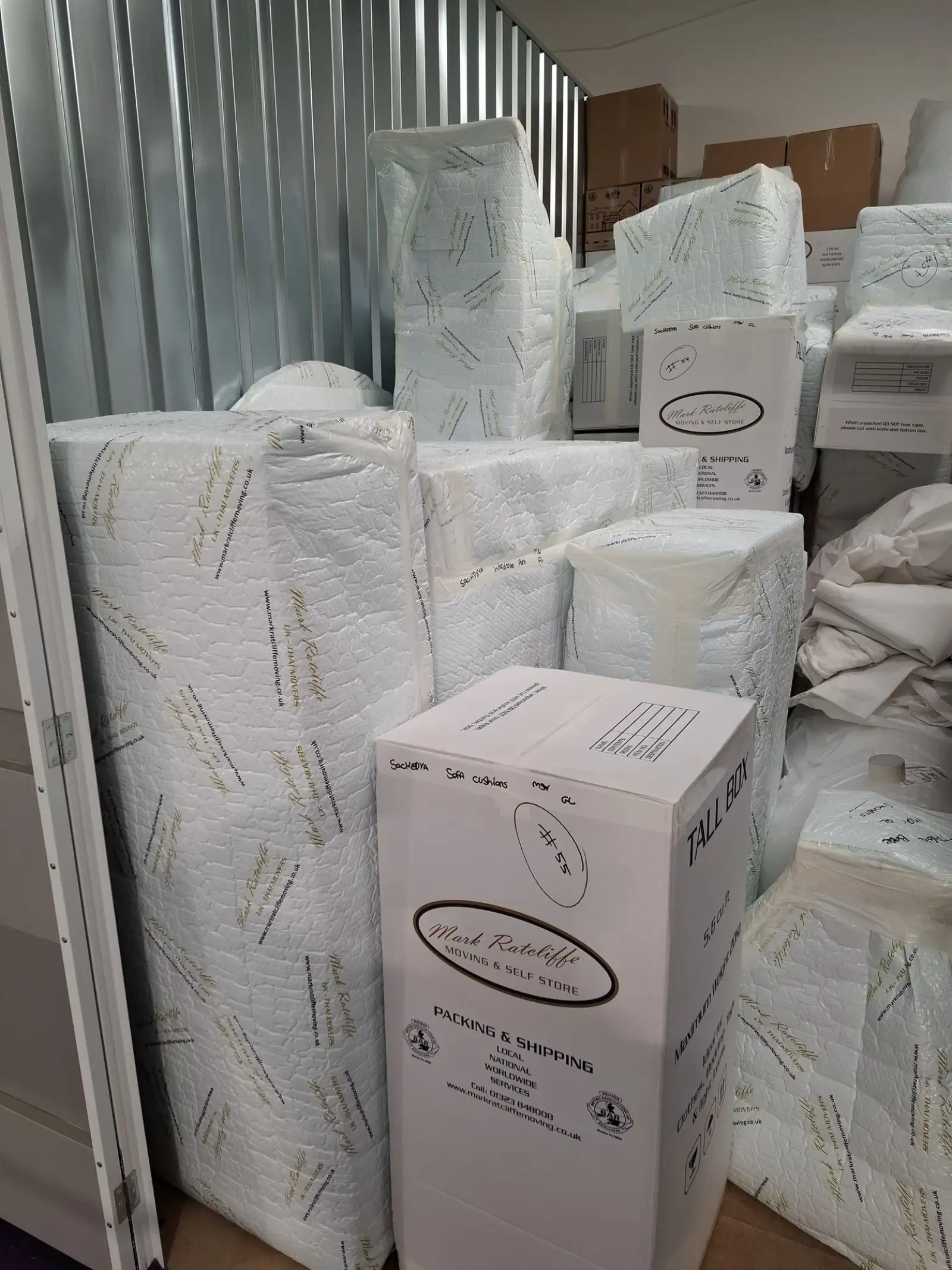
Furniture storage in Eastbourne covers three quite different jobs, so it is worth saying at the top which one this page is about. This is storage for furniture you are keeping — pieces you want back, in the condition they went in. It is not a second-hand sale, a charity handover or a disposal service. If what you need is furniture out of a property and gone for good, that is our house clearance service in Eastbourne instead.
Everything we store is collected by our own crew, wrapped at your address and sealed into an individual steel room at our Lower Dicker depot on the A22 near Hailsham, inland from Eastbourne. The crew that wrapped it brings it back. No handover to a storage company in the middle, and no second contract.
Two questions decide everything else. How big a room does your furniture actually need, which the next section answers piece by piece, and what that room costs — our Sussex weekly rates are published in full further down, VAT included. Between the two sits the part that decides what your furniture looks like when it comes back: exactly what we do to each material once the door is sealed.
Where the furniture is part of a house move, both halves run together under removals and storage from one Sussex firm. Where nothing is moving anywhere yet, it is our collection and storage service. We have been doing both from the same yard since 2017, as a family-run Sussex removals firm rather than a franchise.
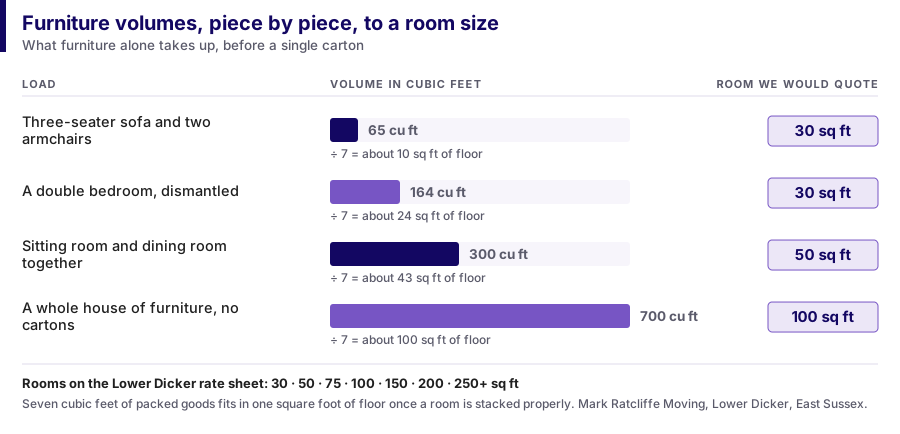
Everyone arrives at this with the same first question: how much room does my furniture need? Almost every answer online is given in bedrooms, and a bedroom count tells you very little. Two three-bedroom houses in Hailsham can differ by three hundred cubic feet on the loft and garage alone. Furniture is consumed in cubic feet and sold to you in square feet of floor, and those are not the same unit.
The bridge between them is a packing efficiency. Ours is seven cubic feet of packed goods for every square foot of floor, and it is the number our surveyors size rooms with. It allows for stacking to a safe working height, keeping soft goods out from under hard weight, leaving the stack self-supporting rather than leaning on the door, and leaving enough structure that nothing settles over six months. Total your furniture in cubic feet, divide by seven, and you have the floor area you genuinely need.
The table below does that arithmetic against the seven room sizes we actually run at Lower Dicker, using named pieces rather than flat sizes. The cubic-foot figures are the ones our surveyors carry: a three-seater sofa is about 35 cu ft, a double wardrobe 35, a double mattress 22 with its base at 20, a large chest of drawers 20, a four-seat dining table 18 and a medium removals carton 3.
| Room size | Working capacity | The furniture that genuinely fits | What tips it to the next size up |
|---|---|---|---|
| 30 sq ft | 210 cu ft | A double bed and base, double wardrobe, large chest of drawers, two bedside tables, a two-seater sofa, a small bookcase, a television and about 15 medium cartons — roughly 205 cu ft of the 210 | A three-seater sofa, a dining table and chairs, or the contents of a fitted cupboard nobody counted |
| 50 sq ft | 350 cu ft | Three-seater sofa, armchair, double bed and base, double wardrobe, tallboy, two bedsides, sideboard, four-seat dining table and four chairs, television and around 19 cartons, with about 70 cu ft spare for the things nobody counts | A second bedroom in full, or a washing machine and a fridge-freezer |
| 75 sq ft | 525 cu ft | Two complete double bedrooms, a sitting room with a three-seater and two armchairs, coffee table, television unit and bookcase, a six-seat dining set, a fridge-freezer, a washing machine and about 14 cartons | A third bedroom, a home office with a desk and filing, or a corner suite in place of the sofa |
| 100 sq ft | 700 cu ft | A three-bedroom flat or small house complete: the 75 sq ft list plus a single bed and base, single wardrobe, small chest, a desk with filing and dry garden furniture | Garage and shed contents, bikes and a mower, or a loft that has not been emptied yet |
| 150 sq ft | 1,050 cu ft | A family house cleared — corner suite, second sofa, three double bedrooms, dresser, eight-seat dining set, home office and roughly 60 cartons — with the shed and garage as well: mower, workbench, four bikes and a patio set | A loft that turns out to be full, or an upright piano |
| 200 sq ft | 1,400 cu ft | A large house with a full loft, a workshop bench with tooling, an upright piano and a dining suite for ten | Outbuildings, a stable, or a second household stored alongside |
| 250 sq ft or more | 1,750 cu ft or more | A substantial house emptied completely, outbuildings and all, with room to walk in and retrieve | Nothing — beyond this we run a second room on the same account |
Two honest caveats. Seven cubic feet per square foot is what a properly built stack achieves, not a guarantee. A load that is all awkward shapes and no cartons will not reach it, and we size up rather than wedge things in. And a room you intend to dip into needs the size above the arithmetic, because a retrieval lane costs floor area and earns it straight back the first time you want one chair out.
Those seven sizes are the whole list. There is nothing between them and nothing below the 30, so when a total lands between two rooms we quote the larger one and say why: a room packed to its absolute limit is a room nobody can walk into. The step up is smaller than people expect. Between a 75 sq ft storage room and a 100 it is £36 a week against £45 a week including VAT, which is rarely worth sizing short for. Every room size, weekly rate and collection charge is published in the table further down this page.
You can build your own cubic-foot total in about twenty minutes with our storage volume calculator, room by room, and bring the number to the enquiry. If the furniture is going into store because a chain has slipped rather than because you are between houses by choice, the sizing is the same but the timing is not — that is storage while moving house.
A wardrobe is not just a wardrobe. What we do to a piece depends on what it is made of and how it is built, and that is decided at the survey rather than on the morning. Below is our actual handling spec, written from what we see when rooms are opened up again. No storage operator in Sussex publishes one, which is precisely why it is worth reading before you choose where your furniture goes.
| Piece or material | What goes wrong when it is handled badly | How we wrap it | Where it sits in the room |
|---|---|---|---|
| Solid timber — oak, pine, walnut | Surface bruising from bare contact and from stacking, rather than anything wrong with the timber | Quilted pad-wrap over the whole carcass, drawer fronts taped shut, corners protected | Low and central, taking load from lighter pieces above |
| Veneered and MDF carcasses | Edge lift where a corner has taken a knock, which then peels along the whole edge | Pad-wrap plus a corner board on every exposed edge | Upright, never carrying weight on the top surface |
| Fabric upholstery | Compression marks where a piece has been wedged in, and dust on anything left open to the room | Breathable cover over the whole piece, arms padded separately | On end against a battened wall, cushions bagged and stacked on top |
| Leather upholstery | A crease line at the fold if it is jammed in, and surface rub where hide touches another piece | Padded blanket only, nothing taped to the hide | Free-standing, with clearance on both sides |
| Mattresses and divan bases | Edge distortion from being leant at an angle for months | Breathable mattress bag, never a sealed plastic sleeve | Flat on a raised platform, or fully upright against a flat face |
| Marble, granite and glass tops | Hairline cracks that only show under the light at retrieval | Top separated from the base, edge-padded and boarded or crated | Vertical in a purpose-made rack, never laid flat under load |
| Rattan, cane and wicker | Splits at the weave after a spell somewhere hot and dry, such as a loft | Loose pad-wrap, no compression on the weave | High and light, with nothing resting on it |
| Painted and lacquered modern pieces | Blanket texture printing into a soft paint finish in warm weather | Acid-free tissue interleaf underneath the pad-wrap | Away from the door, where temperature moves least |
| Antique furniture on animal-glue joints | Joints working loose after a stay somewhere that swings between damp and dry | Pad-wrap, nothing adhesive anywhere near the finish | Inside the stack, buffered on all sides by other goods |
| Garden and outdoor furniture | Stored damp, mouldy within weeks, then marking whatever it touches | Wrapped only once it is dry, and refused if it is not | Last in, nearest the door, clear of soft furnishings |
None of that is exotic. It is a handling spec, and it matters because the alternative — a bare sofa next to a bare wardrobe on an open shelf — is how furniture picks up the marks people then blame on storage. A stone or glass top that is going to sit for a year is the one case where wrapping is not enough on its own, and we build a boarded case around it under our custom timber crating service.
If you are preparing pieces yourself before we arrive, the customer-side version is our guide to preparing furniture for long-term storage yourself.
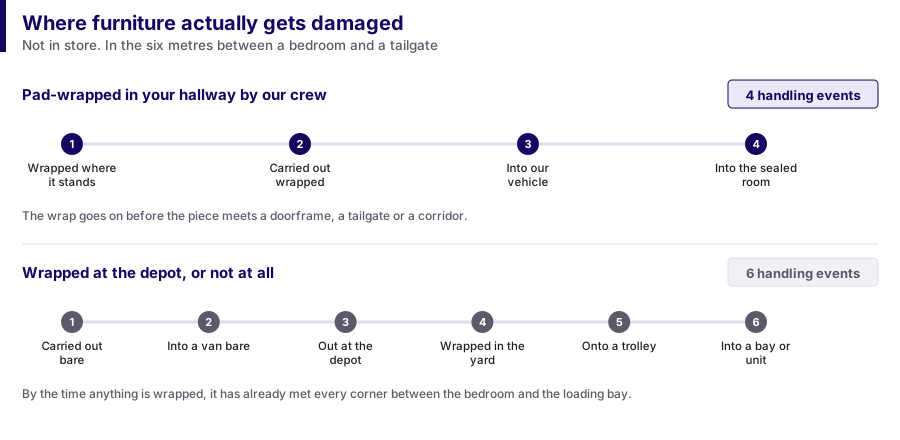
Most furniture damage happens in the first forty feet. A door frame, a stair spindle, the corner of a porch, the metal strip on a threshold. So the rule here is that nothing leaves the room it is standing in until it is wrapped.
Crews carry heavy quilted blankets, laundered in-house between moves rather than reused grubby. A chest of drawers gets the carcass wrapped whole, drawer fronts taped shut, corners protected, and only then does anyone lift it. Tape goes on the blanket, never on the finish; masking tape left on a waxed surface for weeks will lift it.
The wrap then stays on, which is the part people do not expect. A piece going into store is carried straight into its room still covered, and the blanket comes off once, in its final position in the next house. Every unwrap and rewrap is another handling event, and every handling event is another chance to mark something.
It is worth comparing that with how the same furniture would reach a rented unit. You wrap it yourself, or you do not. It goes into a hire van, across a car park, through a shutter, along a shared corridor, then onto a shelf beside somebody else’s goods. That is six or seven handling events with a different pair of hands at most of them, and no written record of the condition at any point. The wrap is not the expensive part of what we do. The count of times your sofa is picked up is.
Pad-wrapping is a technique we use on every job rather than a storage extra, and it is described in full on our packing services page. Boxed contents sharing the room are a different discipline, because a carton built to survive a van journey is not built for six months of stack pressure — see packing for goods going into store.
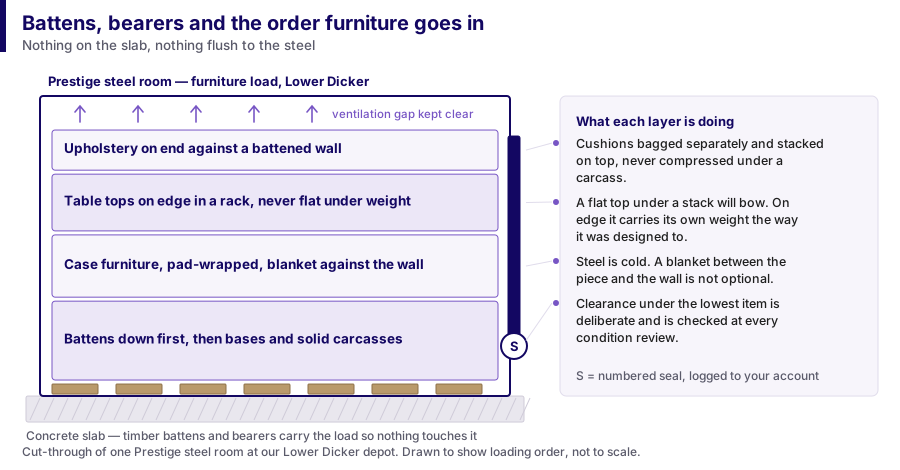
Every room is loaded onto timber battens laid across the floor first. Nothing touches the concrete slab, and nothing sits flush against a steel wall without a blanket between the two. Concrete is the coldest surface in any warehouse and it is where condensation shows first in a hard winter.
The loading order is worked out before anything goes in. Flat, heavy, rigid items form the base: divan bases, solid carcasses, table tops on edge in a rack. Lighter pieces go above, soft goods against a battened wall rather than under weight, and cartons stack in their own column so a wardrobe never rests on a box.
Cartons are the part of a furniture load that fails quietly. A double-wall carton holds its shape under months of stack pressure; a supermarket box does not, and when the bottom of a column softens the whole stack leans into whatever is beside it. We stack boxes no more than five high in their own square column, heaviest at the base, and we say so when a load arrives in boxes we would not store — the trade-offs are set out in our comparison of cardboard cartons against plastic crates.
On the larger rooms we leave an access lane down one side. It costs floor area and earns it back, because the commonest request is not to empty a room but to pull one thing out of it. A cot for a new grandchild, a dining table for a wedding. With a lane and a numbered inventory that is a short job; without one it means unloading half the room into the corridor.
The layout is photographed once the room is loaded and sealed against your reference, and that photograph is what we work from when you ring to ask where something is. The rooms themselves are described on our Prestige steel storage rooms page.
Two decisions made at collection do more for the room size than anything else: how a suite stands, and what comes apart. Both are part of the storage job rather than extras booked separately.
A three-seat sofa standing on its end takes roughly a third of the floor it takes sitting on its feet, which on its own changes the room size you need. The better reason is structural. On end, a sofa carries its own weight through the corner posts the frame was built around. On its feet under a stack, it carries somebody else’s furniture through a base never designed for it.
Cushions come off first into breathable bags, stacked on top rather than crushed inside the piece; feather and down fillings should not spend months compressed. Recliner and electric mechanisms are strapped closed, and a loose control handset is bagged and recorded on the inventory rather than left down the side of a seat.
Corner units come apart at the bolted returns, which is often the difference between a suite that fits comfortably and one that dictates a bigger room. One honest word: a sofa with a frame that already creaks, or a base that has gone soft, will not improve in store. We say so at the survey rather than take the storage charge and let you find out at redelivery.
A made-up wardrobe wastes a third of a room in fresh air, and a bed frame stored assembled marks itself where the joints bear. Here is what our crews do, with realistic timings, because the labour is how you judge any quote.
| Piece | Comes apart for store? | Rough crew time, each way | Why we do it that way |
|---|---|---|---|
| Divan base, king or super-king | Split bases separate; solid bases do not | 5 minutes | A solid king base is often the largest rigid item in the load, and it sets the room size on its own |
| Slatted or metal bed frame | Always | 15–25 minutes | Frames flex, and side rails mark each other if the bed is stored built |
| Flat-pack wardrobe on cam fixings | Only if it will survive it | 30–45 minutes | Chipboard cam housings lose their grip after two or three rebuilds; we tell you if yours is on its last one |
| Solid wardrobe with knock-down bolts | Always | 20–30 minutes | Built for it, and a made-up wardrobe stores mostly air |
| Corner sofa with bolted returns | Always | 10–15 minutes | Separated sections stand on end; a made-up corner unit cannot |
| Dining table | Legs off where they unbolt | 10 minutes | The top travels on edge in a blanket, legs bagged and taped to its underside |
| Bunk beds and cots | Always | 30–40 minutes | Safety-critical fixings, so we bag, label and refit them ourselves rather than hand you a bag of bolts |
| Garden table with a glass insert | Glass out, legs off | 15 minutes | The glass goes into a boarded sleeve and is racked vertically, well away from the frame |
| Wall-fixed units, shelving and TV brackets | Off the wall at collection | 10–20 minutes | Left behind they become a refit cost at the other end and a hole in somebody else’s wall |
| Treadmills and gym equipment | Folded, not stripped | 10 minutes | Most fold to a storable footprint, and a full strip-down can void the warranty |
Read the middle column as a volume saving as much as a labour cost. A dismantled double wardrobe, a stripped bed frame and a separated corner suite recover something in the order of seventy cubic feet between them. That does not sound like much until a load is sitting just over a room boundary, where it is the whole difference between two sizes — a 75 sq ft storage room at £36 a week rather than a 100 at £45 a week including VAT, every week the room is rented.
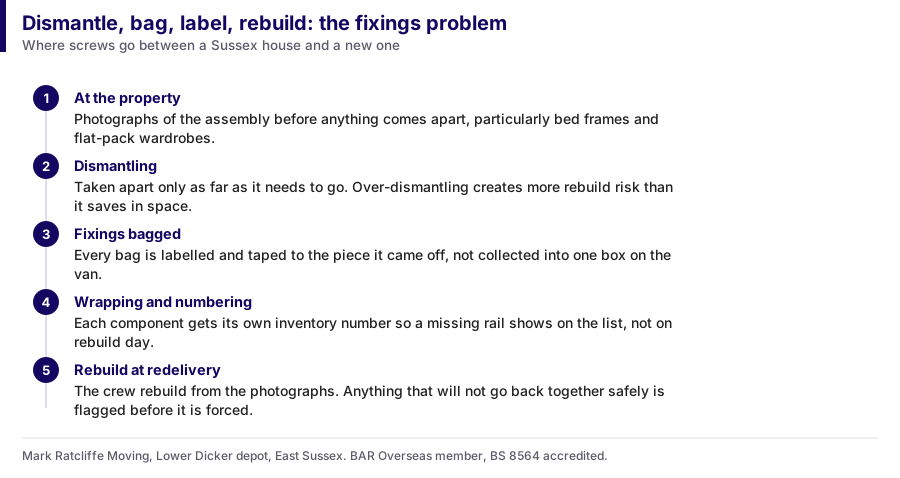
Fixings go into a labelled bag, taped to the piece it came off, and written onto that item’s inventory line. That sounds fussy until somebody cannot find the bolts for a bed at nine at night in a new house. Reassembly is quoted with the redelivery rather than as a separate visit, so the labour appears once.
Here is the figure first and the method behind it second. Storage is charged against the size of room your volume converts to, so the sizing table above has already done half the work; these are the weekly rates for the Sussex rooms at Lower Dicker that furniture collected in Eastbourne goes into. A collection from Kent pays exactly the same weekly rate into the same building; a London collection is quoted on our higher London rate, because the run is longer, not because the room is different.
| Room | Typically holds | Per week | Per week nett | Per 4 weeks | Collection or delivery, each way |
|---|---|---|---|---|---|
| 30 sq ft | One room, boxes | £18 | £15.00 | £72 | £240 |
| 50 sq ft | Studio or 1-bed flat | £27 | £22.50 | £108 | £390 |
| 75 sq ft | 2-bed flat | £36 | £30.00 | £144 | £550 |
| 100 sq ft | 2-bed house | £45 | £37.50 | £180 | £720 |
| 150 sq ft | 3-bed house | £63 | £52.50 | £252 | £990 |
| 200 sq ft | 4-bed house | £80 | £66.67 | £320 | £1,290 |
| 250 sq ft | 5-bed house or business stock | from £95 | from £79.17 | from £380 | Quoted on survey |
All prices include VAT (the nett column is what a VAT-registered business reclaims against). £5,000 of cover is included in every price. First 4 weeks half price when we collect for you.
That is the base of the bill, and it is the part most firms will not put in writing until they have your telephone number. Everything on top of it is handling, duration and cover, which is where two quotes that look alike at the top stop resembling each other. The table below lists what we measure, why each one moves the total, and what you can do about it before you book.
| What we measure | Why it moves the figure | What brings it down | How it appears on our written quote |
|---|---|---|---|
| Volume in cubic feet | It sets the room size, which is the base of the whole charge | Dismantling, sofas on end, an honest cull before collection | A cubic-foot total and the room size it converts to at 7 cu ft per sq ft |
| Duration of the stay | Storage is a recurring charge; the collection is not | A realistic end date rather than an optimistic one, reviewed at month three | The weekly rate against your room size, times the weeks, with the review date stated |
| Collection access | Stairs, a long carry, a restricted road or a permit zone all add crew hours | Booking a bay or a permit in advance; telling us about the access at survey | Crew numbers and hours for the collection, priced before the day |
| Dismantling and reassembly | Labour at both ends, and the timings in the table above are the honest ones | Leaving pieces we have advised will not survive another rebuild | One labour line covering both visits, not two separate call-outs |
| Packing materials | Storage cartons are specified heavier than van cartons, and mattress bags and covers are consumables | Reusing sound double-wall cartons you already have | Itemised by material and quantity, never bundled into the storage rate |
| Redelivery scheduling | A fixed date needs a vehicle and crew reserved against it | Giving notice, and accepting a mid-week slot where you can | A delivery line with the notice period we need stated next to it |
| Part-retrievals during the stay | Opening a sealed room against your reference is a booked visit with crew time | Choosing a room with an access lane if you know you will dip in | A per-visit line, quoted in advance rather than discovered later |
| Declared value and cover | Cover is priced against what the goods are worth, not the size of the room | A realistic, reviewed declared value rather than a guessed one | A separate cover line against the declared value you set |
| Split loads | Part to store and part to the new house is one job only if it is on one inventory | Keeping both halves with one firm instead of two contracts | A single inventory, with the split shown line by line |
Whoever you ask, make them itemise those nine things. The quotes that look cheapest at the top usually have the handling, the redelivery and the cover sitting somewhere below the fold, or nowhere at all, and the difference turns up on the day you want your furniture back. The full anatomy of a storage figure is on how a Sussex storage quote is built from volume, duration and handling.
Duration is the one people misjudge most often, in both directions. A renovation that was going to be eight weeks runs to five months; a sale that was going to complete in the spring goes through in six weeks. Our guide to short-term against long-term storage covers which way to book when you genuinely do not know, and the cover, liability and notice terms that sit behind any storage account are set out in our terms, conditions and insurance details.
Eastbourne is on the coast, and that is a real factor rather than marketing. Salt-laden air corrodes exposed hinges and fixings, and humidity near the front runs higher than a few miles inland. The buildings people reach for first — a garage, a lean-to, a lock-up, a spare room with a cold outside wall — are the ones that swing hardest between damp and dry across a year.
That swing is what furniture dislikes. Not cold, and not even damp on its own, but the repeated movement between the two. Upholstery and mattresses carry the highest risk because they hold moisture. Timber joints come second.
Our storage sits inland at Lower Dicker, in an insulated, ventilated building with no direct sun on the rooms. Why we say climate-stable rather than climate-controlled is set out on our write-up of the Prestige steel rooms. We keep food, fuels and moisture-generating goods out of the building entirely, which is half the reason conditions hold. The format itself is explained on our containerised storage page.
The security side is worth one paragraph rather than a page. The site is alarmed at the perimeter, covered by 24-hour CCTV, and every room is individually sealed against a reference rather than padlocked by the customer. Nobody browses a corridor of open shelving, because there is no corridor of open shelving. Access to your room is by appointment and against your name, which is slower than a keypad and a shutter, and safer for the same reason.
Being straight about this saves everybody a wasted morning.
We decline outright: anything actively damp or showing mould at collection; upholstery with food residue, pet soiling or any sign of infestation; fridges and freezers not fully defrosted, drained and dried; mowers, strimmers and patio heaters still holding fuel or gas; paint, solvents and garden chemicals left inside a cabinet; and anything living, plants included. That is not arbitrary. One damp armchair affects the room it sits in and, over months, the goods beside it.
We would rather discuss first: cam-fixed flat-pack already rebuilt twice; a sofa at the end of its life; a mattress you have privately decided you will not want back; and the large wall units that so often will not fit the next house. Paying to store a piece for most of a year when it will not go in the new room is the commonest regret we hear at redelivery. If you are downsizing, our guide to downsizing before a move and a frank half hour at survey usually settles it.
There is a simple test we give people who are hesitating over a piece. Work out what it would occupy in cubic feet, divide by seven to get its share of the floor, and ask whether you would rent that floor for a year to keep it. A wardrobe you love passes easily. A spare mattress and a wall unit for a room you will not have again usually does not, and the honest answer at survey is cheaper than the polite one.
Redelivery is where a storage job is actually judged. The room is opened against your reference, the inventory is read out item by item, and anything noted at intake is re-checked with you standing there. A piece that went in with a chipped corner has that chip on the record from day one, which protects both sides.
Each item comes in still wrapped and is unwrapped in its final position, so the blanket comes off in the bedroom rather than the hall. Dismantled pieces are rebuilt from the fixings bag taped to them, tested and left level. You sign the inventory back, and the signed copy stays on file.
Blankets, covers and packing debris leave with us the same day rather than filling your new wheelie bin. Where the furniture is coming back into a house that also needs its boxes dealt with, that is a booked unpacking service on the same visit rather than a second appointment.
We are a member of the British Association of Removers through its Overseas Group, and we work to BS 8564 (BS 8564:2011 in the BSI catalogue), the standard governing how a move is surveyed, documented and handled. That matters here because the inventory and condition record are an obligation rather than a courtesy, with an independent dispute route behind them. It is also why our 4.9 out of 5 across more than 120 reviews holds up on long storage jobs as well as short moves, and who you are actually dealing with is a fair question to ask before anyone seals a door on your furniture.
Furniture storage in Sussex comes from a handful of situations, and each changes what we do. Downsizers keep the pieces with history while a new layout settles. Renovators clear two rooms at a time and want them back in sequence. Landlords hold a furnished let’s contents between tenancies. Executors hold a house’s contents while a family decides, which is a longer stay and is covered on our long-term storage page.
Some pieces deserve more than a blanket. Grand and upright pianos are a specialist job with their own rules, under piano moving. Period and high-value furniture is handled under antiques moving. Where an item-level inventory with photographs and a signed pre-move condition report is wanted, that is our white-glove service.
We collect for storage across the area, most often from Eastbourne, Hailsham, Polegate, Seaford, Lewes, Hastings and Brighton, with our second depot at Coulsdon covering the Surrey side. If the furniture is going into store ahead of a shipment rather than a house move, sequence it with storage before shipping overseas, because the paperwork runs to a different clock.
Start with a survey. Thirty to forty-five minutes in the house, or by video, gives us a piece count, a volume in cubic feet, a room size and a realistic collection date, and gives you a written quote rather than a guess over the phone. Bring the list you built in the calculator if you have one; the surveyor will check it against the pieces in front of him and tell you where it is short. Begin with an online removals and storage quote.
Usually a 75 or a 100 sq ft room, but the bedroom count is the wrong way to work it out. Total your furniture in cubic feet and divide by seven, because seven cubic feet of packed goods sit in one square foot of floor. A three-bedroom house without the loft or garage tends to land around 525 cubic feet, which is exactly a 75 sq ft room at £36 a week including VAT; add the shed, the mower and the bikes and it moves up to the 100 at £45 a week, and a full garage as well puts it in the 150 at £63 a week.
It is charged against the room size your volume converts to. Our Sussex rooms start at £18 a week including VAT for a 30 sq ft room, £36 a week for a 75, £63 a week for the 150 that most three-bedroom houses need, and from £95 a week for 250 sq ft and over. Collection or delivery is quoted each way against the room size — £990 each way on a 150 — and £5,000 of cover is included in every price. First 4 weeks half price when we collect for you. Handling, materials and any part-retrievals are itemised separately on the written quote rather than buried in the weekly rate.
At your house. Quilted pad-wrap goes on in the room the piece is standing in, before it goes through a doorway, because door frames and stairs are where most damage happens. The wrap then stays on for the whole stay and comes off once, in its final position at the other end.
Yes to both, and it is the same crew. Beds, bunk beds, cots, knock-down wardrobes, dining tables and bolted corner sofas normally come apart. Fixings go in a labelled bag taped to the piece and written onto its inventory line, and we refit them at redelivery rather than handing you a bag of bolts.
It goes on the inventory at intake with the damage noted, and we point it out to you at the time. That record is read back at redelivery and re-checked in front of you, so an existing mark is never confused with something that happened in store.
Yes, and it is one of the reasons for keeping both halves with one firm. The load is split at your address on a single inventory, part goes into the room at Lower Dicker and part goes on to the new house, so nothing is double-handled or quoted twice.
Yes, with notice. The room is reopened, the new item is wrapped and added, and the inventory is updated so the written record still matches what is inside. It is a scheduled visit rather than a same-day one, because the room has to be opened against your reference.
We do store it, and yes, genuinely dry rather than surface dry. Rattan and teak that goes in damp will mark itself and anything near it. We wrap it loosely so the weave is not compressed and place it near the door, clear of soft furnishings.
Yes. We survey the access first and price the stair carry into the job from the start rather than adding it on the day. If a shuttle vehicle is needed because the road will not take a full lorry, that is agreed up front too.
From the blog

Planning to put furniture into storage? Learn how to properly prepare your items to prevent damage while in storage.

Moving antique furniture or valuable pieces? Learn how our trained team protects and transports high-value items safely.

What is full pad-wrap protection and why is it the safest way to move? Our complete guide explains our 3-step process and how it protects your …
Storage at Lower Dicker starts at £18 a week including VAT for a 30 sq ft room and runs to £80 a week for a 200, with £5,000 of cover in every price and collection quoted against the room size. First 4 weeks half price when we collect for you.
Tell us roughly what the furniture is and where it has to come from, and we will book a survey — thirty to forty-five minutes in the house, or by video. You get a piece count, a volume in cubic feet, the room size it converts to, a collection date and a written quote, with the wrapping, dismantling and rebuilding all inside it.
Call 01323 848 008 or 07437 414 589, or email office@markratcliffemoving.co.uk.