
Storage in Crawley for households across West and East Sussex, worked by our own crews. Your load goes into Kelvin Way or our Lower Dicker store — whichever is nearer to you and has room free — and you are told which before anything is collected.

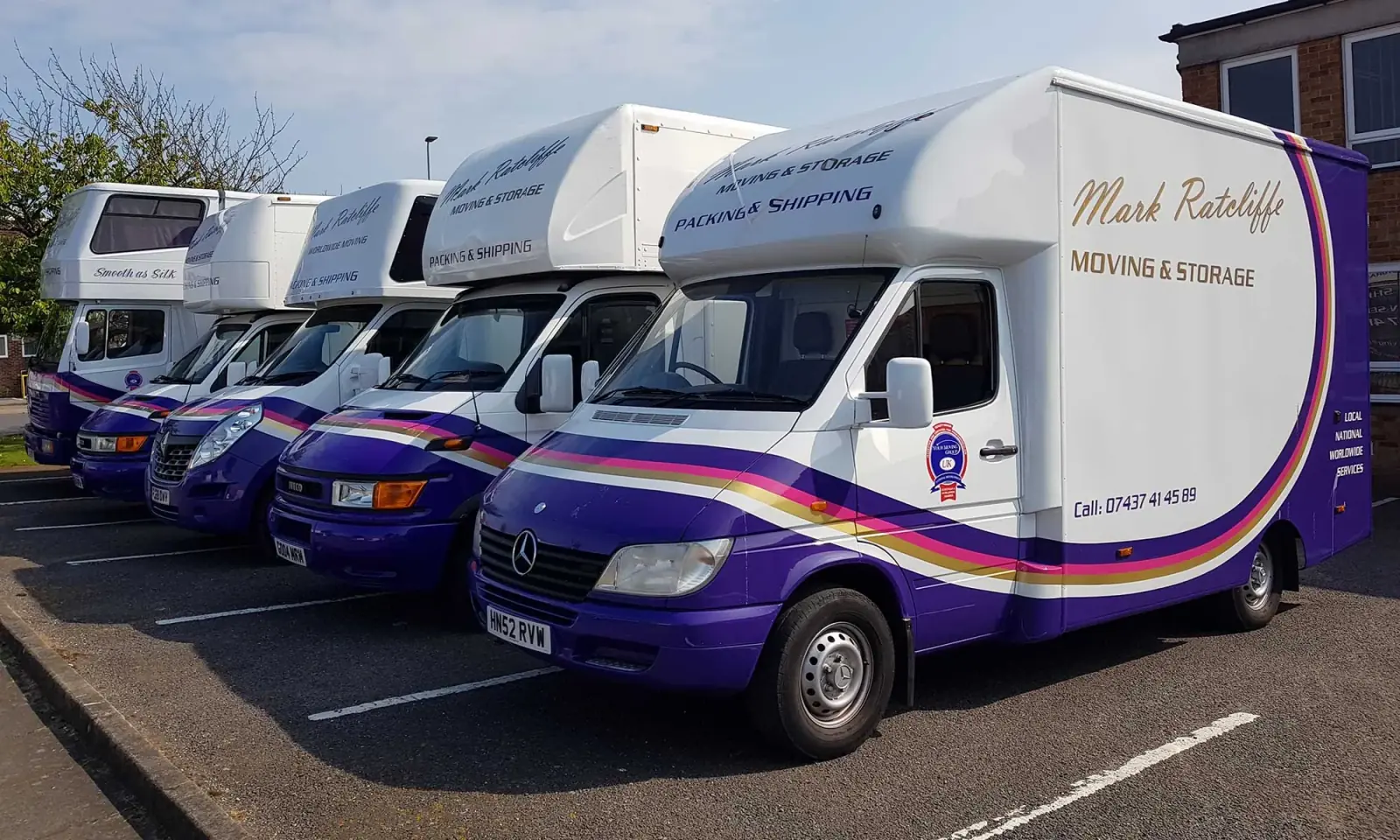
Storage in Crawley is run out of our crate store at 5 Kelvin Way, RH10 9SP, on the Manor Royal estate between the town centre and the Gatwick spur of the M23. It is one of two stores we keep in Sussex, and it exists for a fairly unglamorous reason: the northern half of the county was being asked to send its furniture thirty-odd miles down to the coast and thirty-odd miles back again for the sake of a few weeks in store. For a household in Ifield, Copthorne or Pound Hill that is most of a working day of vehicle time that nobody was getting any value from.
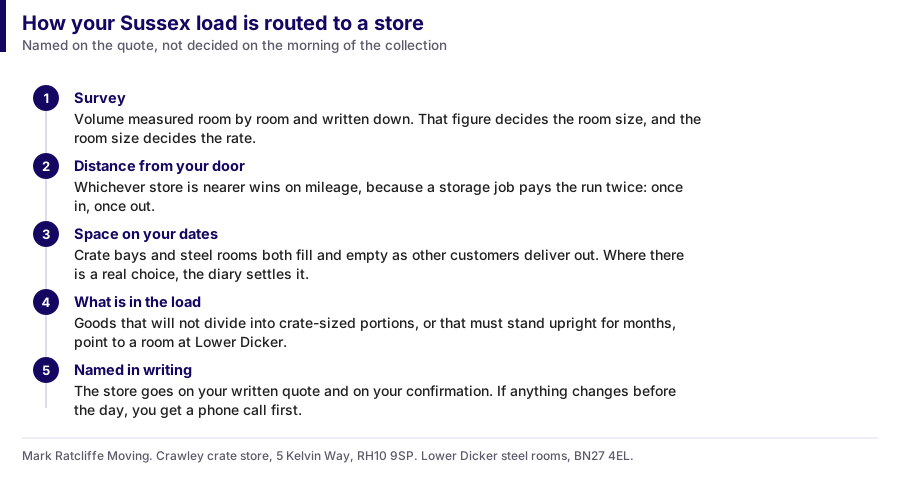
Here is the part we would rather you heard now than on the morning of the collection. A Sussex load goes into Kelvin Way or into our Lower Dicker store near Hailsham — whichever is nearer to your address and has room free on your dates. We tell you which one before anything leaves the house, it goes on your paperwork, and it does not change afterwards without us ringing you first. Two stores is the reason the diary works. One store is how you end up being told no in the week you needed a yes.
What is the same whichever way your load routes:
The rest of this page is the detail behind those five lines: what a crate actually is, which towns we run to from Kelvin Way, how the routing decision gets made and when you hear it, and what the whole thing costs on the Sussex rate card, which is printed further down in full with the collection charges beside it. If you are moving house in the town as well as storing, our Crawley removals page covers the move itself, and the Lower Dicker building is described on the Prestige steel storage rooms page.
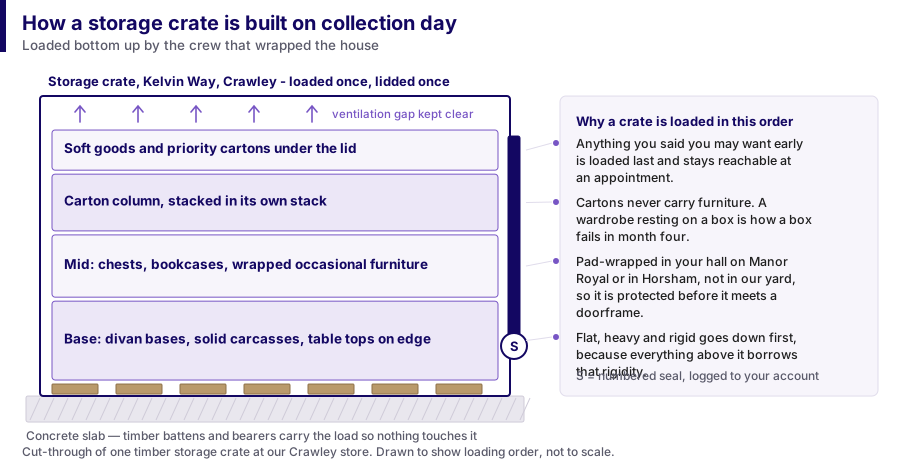
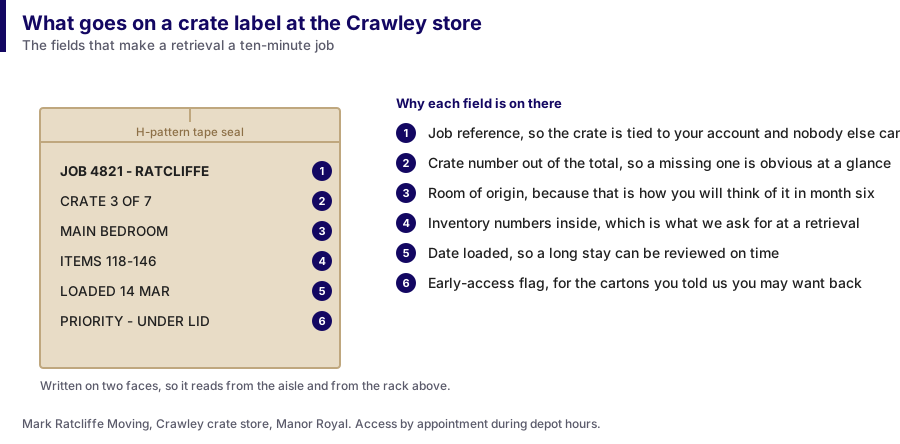
Crawley is a crate store. Your goods go into timber storage crates, each one taking around 250 cubic feet of packed household goods, which is the unit the removals trade has measured in for well over a century. The crates are loaded by the crew that wrapped your furniture, lidded, labelled against your job reference and stacked in a racked warehouse. Nothing is tipped into a communal pile and nothing shares a crate with another customer’s belongings.
Lower Dicker works slightly differently: there your goods go into an individual steel room of their own rather than into crates. Both are managed, containerised storage in the proper sense of the word — loaded by us, sealed, inventoried, and opened again only with you or by your instruction. The practical difference is mostly about how a load is broken down. Crates suit anything that can be sensibly divided into container-sized portions, which is most households. A very large or very awkward load — a long-case clock, a grand piano, a nine-foot sofa that will not come apart — is often better in a room where it can simply stand.
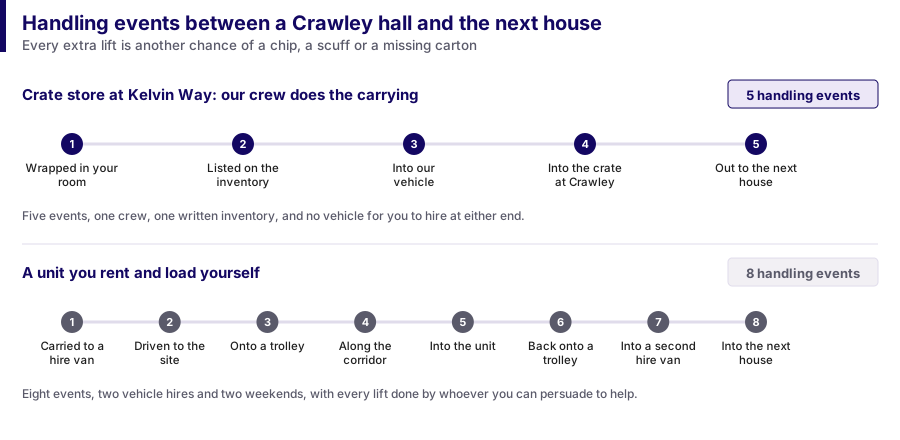
Unlike a self-storage site, where you rent an empty unit by the month and supply the labour, the trolley and the van yourself, nobody in a crate store expects you to carry anything. That is the whole design of it. The four formats people are actually choosing between in this part of Sussex look like this:
| Format | What it physically is | Who handles your goods | How you reach them again |
|---|---|---|---|
| Crate store, Kelvin Way, Crawley | Timber crates of about 250 cubic feet, lidded and racked in a warehouse. | Our crew, from your hall to the crate and back out again. | By appointment in depot hours. A crew member brings the crate down and opens it with you. |
| Steel storage rooms, Lower Dicker | An individual room of your own, sized from your inventory. | Our crew, same inventory, same wrapping standard. | By appointment in depot hours, with the room opened in front of you rather than by anyone else. |
| A unit you rent and load yourself | An empty room on an industrial estate, rented by the month. | You do, twice, with a hired vehicle at each end. | Whenever the site is open, which is the genuine advantage of the format and worth saying plainly. |
| A container dropped in a yard | A steel shipping container standing outside, often unheated and unlit. | Usually you, or a driver who never sees the inside of it. | Only when someone can get a vehicle alongside it, which in winter mud is not always the day you asked. |
Most of the argument between those formats is about handling events rather than about buildings, and that argument is worked through properly on our containerised storage in Sussex page. What matters for Crawley specifically is that both of our Sussex options are the managed kind: the goods are wrapped once by the people who will carry them, and the number of times a chest of drawers is picked up between your bedroom and the next one is four, not nine. If it is furniture in particular you are worried about, how we prepare and store furniture goes piece by piece through what survives a stay in store and what does not.
Kelvin Way sits at the top of the county, which makes it the obvious store for the whole Gatwick belt and most of the Weald. The table below is how the routing usually falls. It is a working guide rather than a rule — availability on your date is the other half of the decision, and the section after this one explains how the two get weighed against each other.
| Town or area | Postcode district | Store we would normally route to | What the collection usually involves |
|---|---|---|---|
| Crawley: Three Bridges, Pound Hill, Maidenbower, Tilgate, Ifield | RH10 and RH11 | Kelvin Way, minutes away | Short run, so a part load can go in and the vehicle can come back for the rest the same day. |
| Crawley Down, Copthorne, Turners Hill, Worth | RH10 | Kelvin Way | Lane access and narrow verges; we check turning and parking at survey rather than on the day. |
| Gatwick, Horley and the airport perimeter | RH6 | Kelvin Way | Often short-notice work tied to a posting or a contract end, and often outside office hours. |
| East Grinstead, Forest Row, Ashurst Wood | RH18 and RH19 | Kelvin Way | Older properties, stairs and restricted frontages. Crew size is set from the access survey. |
| Horsham, Southwater, Billingshurst | RH12, RH13 and RH14 | Kelvin Way | Straightforward A264 run. Larger houses here, so carton counts tend to run high. |
| Burgess Hill, Hassocks, Hurstpierpoint | RH15 and BN6 | Either store, decided on availability | Almost exactly between the two. The date, not the mileage, usually settles it. |
| Haywards Heath, Lindfield, Cuckfield, Balcombe | RH16 and RH17 | Either store | Same again. We name the store on the quote so it is settled in writing before you book. |
| Uckfield, Crowborough, Heathfield | TN6, TN21 and TN22 | Lower Dicker | A short run down the A22 to the steel rooms, with Crawley used when Lower Dicker is full. |
| Eastbourne, Hailsham, Polegate, Bexhill | BN20 to BN27 and TN39 | Lower Dicker | Our home ground. Crawley only comes into it for an unusually large load. |
| Brighton, Hove, Lewes, Worthing | BN1 to BN14 | Either store | Coast road or the A23 north. Volume and date decide which way the vehicle turns. |
Those are collection areas, not a boundary fence. We work the whole county and beyond it, and the full picture is on our West Sussex areas covered page. The town pages carry the local access detail that matters on the day — removals in Horsham, removals in East Grinstead, removals in Burgess Hill and removals in Haywards Heath all describe parking, stairs and lane widths we have already dealt with.
One local note that surprises people from outside the area. Crawley’s neighbourhoods were built to a plan, which means a great many of them have rear parking courts, shared drives and bollarded footpaths between the road and the front door. A vehicle that can park outside a Victorian terrace in Horsham sometimes cannot get within fifty feet of a house in Bewbush. That is a crew-size question and a trolley-run question, and it is far cheaper to answer it at survey than to discover it at eight in the morning.
The routing decision is made when we quote, not when the vehicle is loaded. Three things go into it, in this order.
Then we tell you. The store is named on the written quote, and it is named again on the confirmation you get when you accept. If something changes between the quote and the collection — a bigger load than surveyed, or a crate bay that filled up in the fortnight in between — you get a phone call before the day, not a surprise on the paperwork afterwards. We have never yet had a customer who minded which building their sofa was in. We have had customers who minded very much about being told after the event.
The advantage of the arrangement is the bit that is easy to miss while you are reading a paragraph about logistics. Two stores across one county means a shorter run from most Sussex addresses, more chance of a room being free in the week you actually need one, and a genuine answer when you ring in July asking for space on Friday. A single-site operator has to say no to that call. We can usually say yes, and say which building.
For a combined job — the removal and the storage on one contract, one inventory and one point of contact — the way that fits together is set out on our removals and storage in Sussex page. If you want to arrive at the conversation already knowing roughly how much space you need, the volume calculator turns a room list into a cubic-foot figure in about five minutes, and the room sizes it lands on are the same ones printed in the rate card below.
This is the Sussex rate card, and it applies at Kelvin Way and at Lower Dicker equally. Every figure includes VAT, and £5,000 of cover is included in the price rather than sold alongside it. The nett column is there because VAT-registered businesses reclaim and ask for it.
| Room | Typically holds | Per week | Per week nett | Per 4 weeks | Collection or delivery, each way |
|---|---|---|---|---|---|
| 30 sq ft | One room, boxes | £18 | £15.00 | £72 | £240 |
| 50 sq ft | Studio or 1-bed flat | £27 | £22.50 | £108 | £390 |
| 75 sq ft | 2-bed flat | £36 | £30.00 | £144 | £550 |
| 100 sq ft | 2-bed house | £45 | £37.50 | £180 | £720 |
| 150 sq ft | 3-bed house | £63 | £52.50 | £252 | £990 |
| 200 sq ft | 4-bed house | £80 | £66.67 | £320 | £1,290 |
| 250 sq ft | 5-bed house or business stock | from £95 | from £79.17 | from £380 | Quoted on survey |
All prices include VAT (the nett column is what a VAT-registered business reclaims against). £5,000 of cover is included in every price. First 4 weeks half price when we collect for you.
A few things the table does not say out loud.
Storage is billed by the week with a one-week minimum, and part weeks are not prorated anywhere in this trade — three days and six days cost the same. Past about a month, billing usually moves to four-week periods paid in advance, which is the fourth column and is simply four times the weekly figure. Nothing compounds and there is no separate management charge.
The collection or delivery column is a vehicle-and-crew charge, each way, and it is the figure most people forget when they compare a managed store against renting an empty unit. A 100 sq ft load collected, stored for four weeks and delivered back out is £180 of storage plus two movements of the goods; the two movements are the part you would otherwise be doing yourself, twice, at weekends, with a hired vehicle and somebody’s brother-in-law. For a small load in the RH postcodes that charge is at the bottom of the range, because the run from Kelvin Way is short.
Working out which row you are on is a volume question rather than a floor-plan question. Seven cubic feet of properly packed goods fits into one square foot of floor once a crate or a room is stacked to height, so a load surveyed at 700 cubic feet needs about 100 sq ft of floor and lands on the 100 sq ft row. The room you need is decided at survey; the figures above are what that room costs once it is decided.
The current Sussex offer is simple: first 4 weeks half price when we collect for you, which is worth having if your dates are flexible. What moves a storage bill up and down in general — duration models, handling charges, the line items to make any quote show you — is pulled apart properly on how storage is really priced in Sussex, and the site-wide price list sits on our removals and storage pricing page.
A West Sussex collection for storage is not a different job from a house move; it is the first half of one, ending at a warehouse instead of at a new address. It still needs an access survey, a crew sized to the property, wrapping materials on the vehicle and an inventory written as the goods come out.
What is specific to this end of the county is the access. Crawley’s estates were planned rather than grown, so the problems are consistent and predictable: rear courts, bollards, resident permit bays that fill by half past eight, and blocks where the nearest legal stopping place is a hundred yards from the front door. Horsham and East Grinstead throw up the opposite problem, which is genuinely old property — narrow staircases, low door heads, and first-floor windows that turn out to be the only way a wardrobe ever got in. Around the airport, the constraint is usually time rather than space, because a posting ends on a fixed date and the flight is already booked.
The order of the day itself is the same at every address. Materials off the vehicle, a walk-through with you to agree what is going and what is staying, soft goods and cartons out first, furniture wrapped in the room it stands in, dismantling where a piece will not travel assembled, then loading in the order the crate or the room wants rather than the order the rooms happen to be in. You sign the inventory before the vehicle leaves. The hour-by-hour version of that, including what the crew needs from you before they arrive, is on our door-to-store collection and storage service page.
Two things genuinely help on the day, and neither costs anything. Clear a parking space the evening before if your road permits it, because a vehicle that has to trolley an extra fifty yards on every trip is a vehicle on site considerably longer. And decide in advance what you want to be able to reach while the goods are in store, because those cartons get loaded last and stacked by the door rather than buried at the back of a crate. If you are doing your own packing before we arrive, preparing furniture for a stay in storage is worth ten minutes of reading, particularly the part about why plastic film is a transit material and not a storage one.
Access at all of our sites is by appointment during depot hours, and a crew member brings your goods out to you. That is the policy, it is the same at Crawley as it is at Lower Dicker, and we would rather state it plainly on the page than let you find out when you turn up on a Sunday. If letting yourself in at any hour you please is what your situation needs, a rented unit is the honest answer and we will say so on the phone.
What an appointment actually looks like: you ring or email with a couple of working days’ notice, ideally with the inventory numbers of what you want rather than a description of the box. A crew member pulls the crate or opens the room, you take what you came for, and it is re-lidded or re-sealed in front of you and logged. There is no charge for coming to look at your own goods, and no charge for a retrieval agreed in advance as part of a normal working day.
Why we run it this way rather than handing out access to a warehouse floor is not really a security argument, although that is part of it. It is a chain-of-custody argument. Every movement of your goods is recorded against your job reference, which is how an inventory stays meaningful over months rather than becoming a list of things that were once true. That discipline — written survey, numbered inventory, condition recorded at each handover — is what BS 8564, the British Standard for overseas moving services, actually obliges a firm to do on an overseas job. We keep Sussex storage on the same paperwork because there is no sensible reason to run two systems for one warehouse. Our membership of the British Association of Removers and the cover position are set out on our BAR membership page, and the small print of declared values, exclusions and what is included in a storage charge is on our terms, conditions and cover details.
One practical point about long stays. A crate that has not been opened for eight months is stacked and racked accordingly, so retrieval takes a little more arranging than one that went in last week. If you already know you will want to dip into the goods regularly, tell us at survey and we will load and place accordingly, which usually means Lower Dicker and a room rather than Crawley and a crate. How a stay past six months is reviewed, and what changes when it does, is covered on long-term storage in Sussex.
A large share of Crawley storage is not really about storage at all. It is about a gap: a completion date that moved, a rental that ends three weeks before the purchase completes, a renovation that has to happen before the furniture can go in, or a relocation that starts before the housing is sorted out.
The shape of those jobs is consistent. We empty the outgoing property on the date it has to be empty, everything goes into store on one inventory, and the goods come back out on the date that finally sticks — sometimes to a different town entirely from the one they left. Moving from Crawley to the coast, or from Brighton up to the Gatwick belt, is the single commonest version. Having a store at each end of that journey is not a marketing point; it means the goods sit at whichever end the delivery is going to happen from, and the second run is the short one.
Three patterns we see over and over in this part of Sussex:
For moves that cross the county line, our Redhill removals page covers the Surrey side of the same corridor, and a smaller part load — a single room, a flat clearance, a few pieces into store — is often better handled as a man and van job out of Horsham than as a full removal. Either way the storage side is identical, and so is the rate card.
Kelvin Way is on Manor Royal, which is one of the larger business estates in the South East, so a fair proportion of what comes into the Crawley store is not household goods at all. Office contents between leases, exhibition stock, trade samples, contractor kit between sites, and archive boxes that have to be kept for a statutory number of years but cannot justify floor space at commercial rents.
Three things businesses ask that households do not.
Can you collect without shutting us down? Usually yes, and usually outside core hours. An office decant that has to happen between six on a Friday and Monday morning is a normal job rather than an exceptional one, and it is planned as such: numbered crates by department, a floor plan for the far end, and IT equipment handled separately from furniture.
Can we get one box back at short notice? Yes, with a couple of working days’ notice and an inventory reference. This is why the labelling at intake matters more for a business load than for a household one: a carton labelled “accounts” is useless in month seven, and a carton labelled with a department, a box number and a date range is not.
What about the data? Records containing personal data stay your responsibility as controller while we hold them as processor, which means the arrangement needs writing down rather than assuming. Retention periods, the GDPR position and what we will and will not do with a records archive are covered properly on our business storage page, which carries the full statutory retention table with the legislation cited row by row.
For the move itself — the fit-out gap, the phased delivery back in, the desks that have to be in place before the staff return — our office and commercial removals service is the page to read alongside this one. And for the seasonal end of the market, students at the universities within reach of the M23 corridor use the same collection-and-store arrangement over the summer; that is set out on student storage in Sussex.
Not every storage problem should be solved by us, and pretending otherwise wastes a phone call for both of us. Four situations where we would point you elsewhere.
You need to get at the goods constantly. If the answer to “how often will you want something out” is weekly, a managed store is the wrong shape. Every visit has to be booked and staffed, which is fine twice and tiresome twenty times. Somebody running stock out of a unit should be renting a unit.
You want to do it yourself to save money. Perfectly reasonable, and for a genuinely small load it is cheaper. The crossover point comes sooner than people expect once you count two vehicle hires, the fuel, the weekend and the risk of doing your back in, but if you have a van, a friend and a free Saturday, the arithmetic may well be on your side.
It is really a clearance, not a storage job. A fair number of enquiries turn out to be a house full of things nobody intends to unpack, heading into store because the decision is hard. Paying weekly for that is a slow way to lose money. Downsizing before the load goes anywhere is usually the honest answer, with a clearance crew for what does not survive the decision.
You want to store something we will not take. Fuel, gas bottles, paint, fireworks, anything living, anything perishable and anything that would constitute a fire or contamination risk to another customer’s goods in the same building. We will tell you at survey rather than at the door.
Where it does fit — a household or an office that needs its goods looked after for a few weeks or a few years, by the people who packed them, without anybody hiring a vehicle — Crawley and Lower Dicker between them cover the county properly. We have been running Sussex moves since 2017, the reviews behind the Crawley and Lower Dicker profiles are from people who used exactly this service, and what our Sussex customers wrote afterwards is a better guide to the experience than anything we could write here. When you are ready, the online removals and storage quote form reaches the same diary as the phone.
At 5 Kelvin Way, Crawley, RH10 9SP, on the Manor Royal estate between the town centre and the Gatwick spur of the M23. It is a crate store: your goods are loaded into timber storage crates by our crew, lidded, labelled to your job reference and racked in a warehouse. It is not a site you let yourself into — access is by appointment in depot hours, and a crew member brings your goods out to you.
Not necessarily, and we will tell you which store before anything is collected. A Sussex load goes into Kelvin Way or into our Lower Dicker store near Hailsham, whichever is nearer to your address and has room free on your dates. The store is named on your written quote and again on your confirmation, and if anything changes between quote and collection you get a phone call rather than a surprise. Two stores is why we can usually find space in the week you need it.
No. Both Sussex stores are on the same rate card, so a 100 sq ft load is £45 a week including VAT wherever it sits, with £5,000 of cover included in that figure. The only thing that varies with distance is the collection and delivery charge, which is quoted from your address, and that is the figure a shorter run from Crawley tends to improve rather than worsen.
Sussex rooms start at £18 a week including VAT for 30 sq ft, which is one room of furniture and boxes. A studio or one-bedroom flat at 50 sq ft is £27, a two-bedroom house at 100 sq ft is £45, and a three-bedroom house at 150 sq ft is £63. Every figure includes VAT and includes £5,000 of cover. Collection and delivery are charged separately, each way, and the full card with those figures is printed on this page.
Yes, and from Burgess Hill, Crawley Down, Copthorne, Turners Hill, Horley, Billingshurst and the villages between them. Horsham, East Grinstead and the RH10 and RH11 parts of Crawley route to Kelvin Way as a matter of course. Haywards Heath and Burgess Hill sit almost exactly between the two stores, so those are decided on availability and named on the quote.
One week is the minimum and storage is billed by the week, so three days and six days cost the same — part weeks are not prorated anywhere in this trade. Past roughly a month, billing normally moves to four-week periods paid in advance, which is simply four times the weekly rate. There is no separate management fee and nothing compounds.
Yes to both, by appointment during depot hours with a couple of working days’ notice. Give us the inventory number rather than a description of the carton and it is quick. There is no charge for looking at your own goods, or for a retrieval agreed in advance as part of a normal working day. If you expect to want things out regularly, say so at survey — that usually points towards a room at Lower Dicker rather than a crate at Crawley.
Yes. Office contents between leases, exhibition and trade stock, contractor equipment and records archives all come into the Crawley store, and collections outside core hours are normal rather than exceptional. Records containing personal data need the processor arrangement writing down, and the retention periods and GDPR position are set out on our business storage page.
Fuel, gas bottles, paint and solvents, fireworks and ammunition, anything living, anything perishable, and anything that would be a fire or contamination risk to another customer’s goods in the same building. Valuables such as cash, deeds and jewellery should stay with you rather than go into a crate. We raise all of this at survey, not at the door on collection day.
From the blog
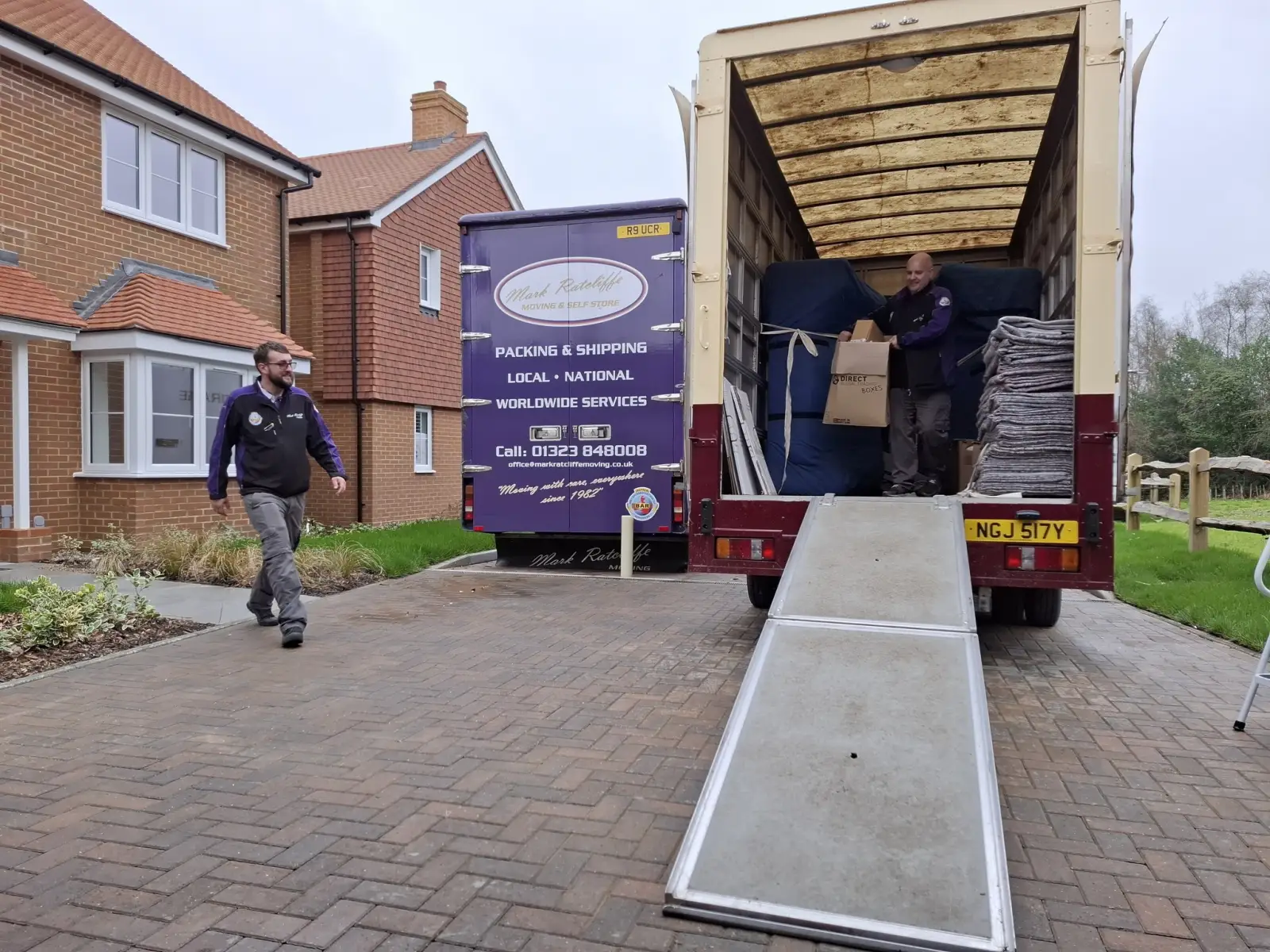
Storage between house moves costed by week and month, container storage vs self storage, and the point where storing costs more than replacing.
Planning to put furniture into storage? Learn how to properly prepare your items to prevent damage while in storage.
Need to reduce the amount of stuff before moving? Learn effective decluttering and downsizing strategies that actually work.
Tell us the address, roughly what is going into store and the dates you are working to. We will name the store — Kelvin Way in Crawley or Lower Dicker near Hailsham — on the written quote, along with the room size and the collection charge from your door. Sussex rooms start at £18 a week including VAT with £5,000 of cover in the price, and the current offer is first 4 weeks half price when we collect for you. Survey by video or in person, and one point of contact from the collection to the day it all comes back out.