
Door-to-door removals from the UK to the Netherlands, run by road from our Lower Dicker depot with regular collections nationwide. Full loads and shared part-loads, export packing built for canal-house stairs and hoists, and the post-Brexit customs paperwork prepared properly before your vehicle leaves.

Removals to the Netherlands from the UK are among the most straightforward long-distance moves we run, and among the most commonly underestimated. The journey is short, the roads are excellent and the Dutch are famously organised — but the buildings are the narrowest in Europe, and a move into an Amsterdam canal house has more in common with a technical rigging job than with a house move in Sussex. We handle both ends: the packing and paperwork here, the hoist and the stairs there.
Most of our Dutch work is work-driven. Amsterdam draws the creative and technology sectors and is where the access challenges are greatest. Rotterdam is Europe’s largest port and a modern, rebuilt city with far easier delivery access than its neighbour. The Hague brings the international courts, the embassies and a substantial expatriate community, so relocations there often come with a corporate or institutional relocation package attached. Utrecht sits in the centre of the country and suits families who want space and a short commute, and Eindhoven is the technology hub around Philips and the Brainport cluster. We also run to Groningen, Haarlem, Delft, Leiden and the smaller towns without any difference in service.
The whole country is compact enough that the delivery leg is rarely the constraint. Amsterdam to Maastricht is a shorter drive than London to Manchester, which is why we quote the Netherlands as a single destination rather than pricing by region.
Dutch canal houses were taxed on their width, so they were built tall, deep and impossibly narrow, with staircases that are effectively ladders with pretensions. Nothing substantial goes up them. What the Dutch did instead, for four centuries, was hoist furniture in through the windows — which is why so many houses still have a hijsbalk, the projecting hook beam at the top of the gable.
Modern practice is an external furniture lift rather than a rope and pulley, but the principle is unchanged: sofas, beds, wardrobes and appliances go in through a window. That has real consequences for your move. Window openings and the beam’s rated load set a hard limit on what will physically fit, the lift has to be positioned on the street or the canalside, and in some municipalities the parking space must be reserved in advance.
We survey specifically for this. Measure the window, check the beam, confirm the street can take a lift — and be honest with you before you ship it if a piece of furniture is simply not going to go in.
The Netherlands is in the EU and the UK is not, so since Brexit a Dutch move is a formal import. The relief that matters is the verhuisboedelvrijstelling — the removal-goods exemption — which normally allows you to bring used household effects in free of duty and import VAT when you are transferring your normal residence. The usual conditions apply: you must have lived outside the EU for at least twelve months, have owned and used the goods for at least six months, and import them within twelve months of establishing residence.
Practically, Dutch customs want a numbered inventory with values, evidence of your Dutch address, and proof you are genuinely relocating rather than importing goods for someone else. Registering with your municipality and obtaining a BSN is part of establishing that residence, and the timing of it against your shipment is worth thinking about before you book. Alcohol, tobacco and vehicles are excluded from the standard relief. The Dutch tax and customs administration publishes the current conditions, and we prepare the paperwork with you before your vehicle leaves the depot.
The Netherlands is one of our quicker European routes. From collection, a typical door-to-door move completes in 5–8 days, matching the figures we publish across our European removals service. The crossing is short, the motorway run from Calais or the Hook is straightforward, and the country is small enough that the final leg adds little.
A sole-use load, going direct with no transhipment, sits at the fast end of that range. A shared part-load waits for the scheduled departure, which is the trade-off that keeps the price down. The genuine variables are peak-season demand in late summer, port conditions, and access arrangements at the Dutch end — if a furniture lift and a reserved parking space are needed, those have to be booked and that can set the delivery date rather than the transport.
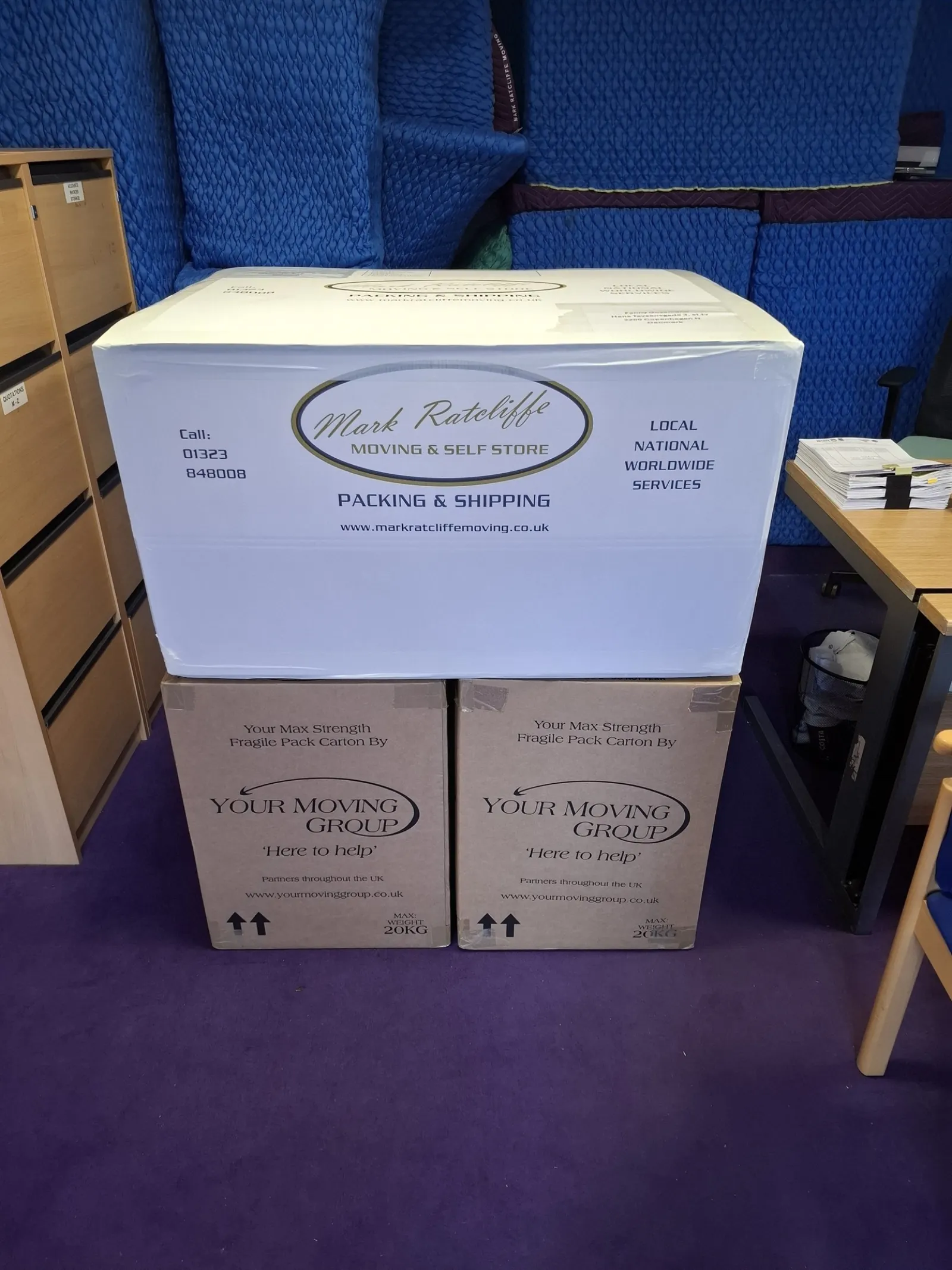
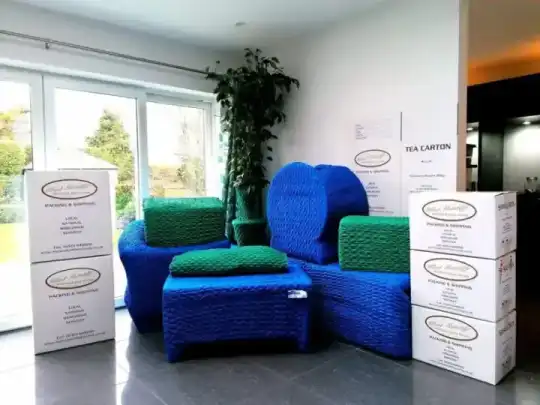
We are a family-run Sussex firm, established in 2017, and we do international work week in, week out. The crews who pad-wrap your furniture here are the ones preparing it for a hoist there, and we pack to a standard that assumes a window entry rather than hoping for a lift. Where something needs a purpose-built box — a marble top, a mirror, a piece of art — our custom crate service builds it. If you would rather not pack at all, our full packing service covers the house; if you are doing the boxes yourself, we deliver export-grade materials beforehand.
We are a member of the British Association of Removers Overseas Group and work to the BS 8564 standard for international moves. See our customer reviews, or call 01323 848 008 and talk it through with Mark.
Since Brexit, UK nationals need permission to live and work in the Netherlands rather than arriving freely, and for most people that means an employer-sponsored route through the IND. Get that settled before anything else, because the rest of Dutch administrative life is a chain and this is the first link.
Once you arrive, you register at the gemeente — your local municipality — usually within five days, and you are issued a BSN, the citizen service number. Nothing much works without it. Your employer needs it to pay you, banks want it, health insurers want it, and it is the basis for DigiD, the login that fronts almost every Dutch government and healthcare service. Register early; appointment slots in the bigger cities can run weeks out. The Immigration and Naturalisation Service is the authority on the permission side.
Like Switzerland, the Netherlands runs compulsory private health insurance rather than a tax-funded service, and like Switzerland it backdates. You are generally required to take out zorgverzekering within four months of becoming insurable, and cover is backdated to your start date — so putting it off produces a bill, not a saving. Basic cover is standardised by law and every insurer must offer it; they compete on price, service and top-up policies.
The other thing to do early is register with a huisarts, the local GP, who acts as gatekeeper to almost all specialist care. In Amsterdam and Utrecht popular practices close their lists, so this is worth doing in your first weeks rather than when you first need a doctor.
Housing is the hard part. The Dutch rental market, especially in Amsterdam, Utrecht and increasingly Eindhoven, is genuinely tight, and good properties go within days. Expect to move quickly, to provide employment and income documentation, and to pay a deposit alongside the first month. Many arrivals take a short-term let first and search properly from inside the country — which has a direct bearing on your move, because it usually means your household goods need somewhere to wait.
That is worth planning for rather than discovering. Our Lower Dicker storage can hold everything in the UK until you have an address to deliver to, which is almost always cheaper than paying for storage at the Dutch end, and considerably cheaper than a failed delivery.
Schools divide into Dutch public schools, which are free, good and taught in Dutch; bilingual and international streams; and full international schools, which are expensive and often over-subscribed. Dutch schooling suits younger children well. There is also a well-known tax facility for qualifying skilled migrants that reduces taxable income for a period — the terms have been amended more than once in recent years, so treat any figure you read online as out of date and check the current position with your employer or an adviser rather than assuming.
We are movers rather than relocation advisers, and we would rather point you at the right authority than guess. What we do handle is making the shipping fit around all of it: a delivery date that follows your housing, not one that gambles on it.
These are the rates we quote from, not a teaser figure with the extras stripped out. A shared load to the Netherlands starts at £95 per cubic metre with a 3 m³ minimum, and a dedicated vehicle — yours alone, no transhipment — starts at £2,550. Typical transit is 5–8 days.
| Your home | Typical volume | From |
|---|---|---|
| Studio or single room | 10 m³ | £950 |
| One-bedroom flat | 18 m³ | £1,710 |
| Two-bedroom house | 30 m³ | £2,850 |
| Three-bedroom house | 45 m³ | £4,275 |
| Four-bedroom house | 62 m³ | £5,890 |
| Five-bedroom house or larger | 85 m³ | £8,075 |
These are the prices you pay. International removals are zero-rated for UK VAT, so unlike a domestic house move there is nothing to add on top. Import duty or VAT levied by the destination country, where your goods do not qualify for transfer-of-residence relief, is separate and is payable there rather than to us.
Above roughly 55 m³ a dedicated vehicle usually beats the shared-load rate. We will tell you when that crossover applies to your move rather than let you overpay for groupage. Volumes above are typical rather than measured; the survey sets the real figure and the quote is then fixed in writing. Our free volume calculator gives you a cubic-feet number in a couple of minutes without needing to speak to anyone.
Included as standard
Priced separately
| Service | Price from | What it covers |
|---|---|---|
| Full export packing | £38 per m³ | All materials included. Typically £1,100–£1,400 for a three-bed house. |
| Fragile-only packing | £22 per m³ | China, glass, pictures and electronics. You do the rest. |
| Unpacking at destination | £18 per m³ | Boxes emptied, contents placed, cartons removed. |
| Transit insurance | 2.5% of value | £75 minimum. All-risks cover on a valued inventory. |
| Storage in transit | £4.50 per m³ per week | £25 weekly minimum. Individual steel rooms, 24-hour CCTV. |
| Upright piano | £395 | Skid trolley, crating and specialist straps. |
| Grand piano | £695 | Legs removed, side-crated and blanket-boxed. |
| Custom timber crating | £185 per crate | Art, marble, mirrors and antiques. ISPM-15 compliant timber. |
| Shuttle vehicle | £280 | Where the lorry cannot reach the door — common in Italian ZTL zones and Swiss old towns. |
| Long carry over 20 m | £95 | Per property, per move. |
| Second delivery address | £180 | Within 25 km of the primary address. |
| Vehicle shipping | On application | Cars, motorcycles and trailers via our specialist partner. |
For the full eight-route comparison across France, Switzerland, Spain, Italy and the Benelux, see our European removals rate card.
Typically 5–8 days door to door from collection. The crossing is short and the run from Calais or the Hook is straightforward, and the country is compact enough that the final delivery leg adds very little. A sole-use load going direct sits at the fast end; a shared part-load waits for the scheduled departure, which is what keeps the cost down.
Through the window, on an external furniture lift. Dutch canal houses were taxed on their width, so the staircases are famously narrow and nothing substantial will go up them — which is why so many houses still have a hijsbalk, the projecting hook beam at the top of the gable. We survey for it specifically: window dimensions, the beam, and whether the street or canalside can take a lift. If a piece genuinely will not fit, we tell you before you ship it rather than after.
Normally not, under the verhuisboedelvrijstelling — the removal-goods exemption — which covers used household effects when you are transferring your normal residence. The usual conditions are that you have lived outside the EU for at least twelve months, have owned and used the goods for at least six months, and import them within twelve months of establishing residence. Alcohol, tobacco and vehicles sit outside it. We prepare the documentation with you before departure.
All of them. Amsterdam, Rotterdam, The Hague, Utrecht and Eindhoven are the most frequent, and we also run to Groningen, Haarlem, Delft, Leiden and the smaller towns. The Netherlands is compact enough that the delivery leg is rarely the constraint, which is why we quote it as a single destination rather than pricing by region.
Yes. The Hague brings the international courts, the embassies and a large expatriate community, so a good share of that work arrives with a relocation package attached. We are set up for what those require: an itemised valued inventory, a fixed delivery window agreed in advance, and invoicing directly to an employer or relocation management company.
The BSN is the Dutch citizen service number, issued when you register with your local gemeente after arrival — usually within five days. Almost nothing works without it: your employer needs it to pay you, banks and health insurers ask for it, and it underpins DigiD, the login for most government and healthcare services. Appointment slots in the bigger cities book out weeks ahead, so arrange it early.
Through the window, on an external furniture lift. Dutch canal houses were taxed on their width, so staircases are famously narrow and nothing substantial goes up them — which is why so many houses still have a hijsbalk, the projecting hook beam at the gable. We survey for window dimensions, the beam and whether the street or canalside can take a lift, and if a piece genuinely will not fit we tell you before you ship it.
Often not, and it is worth an honest conversation at survey. Amsterdam and Utrecht properties are smaller than their British equivalents and many arrivals take a short-term let first while they search. Shipping a full three-bedroom house into a temporary flat usually means paying to move furniture twice. Storing part of it in the UK until you have a permanent address is frequently the cheaper route.
You generally have four months from becoming insurable to take out zorgverzekering, and like the Swiss system it backdates to your start date, so waiting does not save money. Basic cover is standardised by law and every insurer must offer it; they compete on price and top-ups. Register with a huisarts — the local GP who gatekeeps specialist care — in your first weeks, because popular practices close their lists.
Yes, and usually more easily. Rotterdam is a modern, rebuilt city with far better vehicle access than Amsterdam, The Hague and Utrecht are straightforward, and Eindhoven is open and low-rise. The Netherlands is compact enough that the delivery leg is rarely the constraint, which is why we quote it as a single destination rather than pricing by region.
Call us for a free, no-obligation quote, or use our online form. Whether it is a shared part-load or a whole house, we have handled the route before and we will handle yours with care.