
A collection and storage service where you never touch a van. We come to your door across Sussex, Surrey and Kent, wrap and inventory everything, and take it straight into sealed storage — no hire vehicle, no lifting, no driving to a unit.

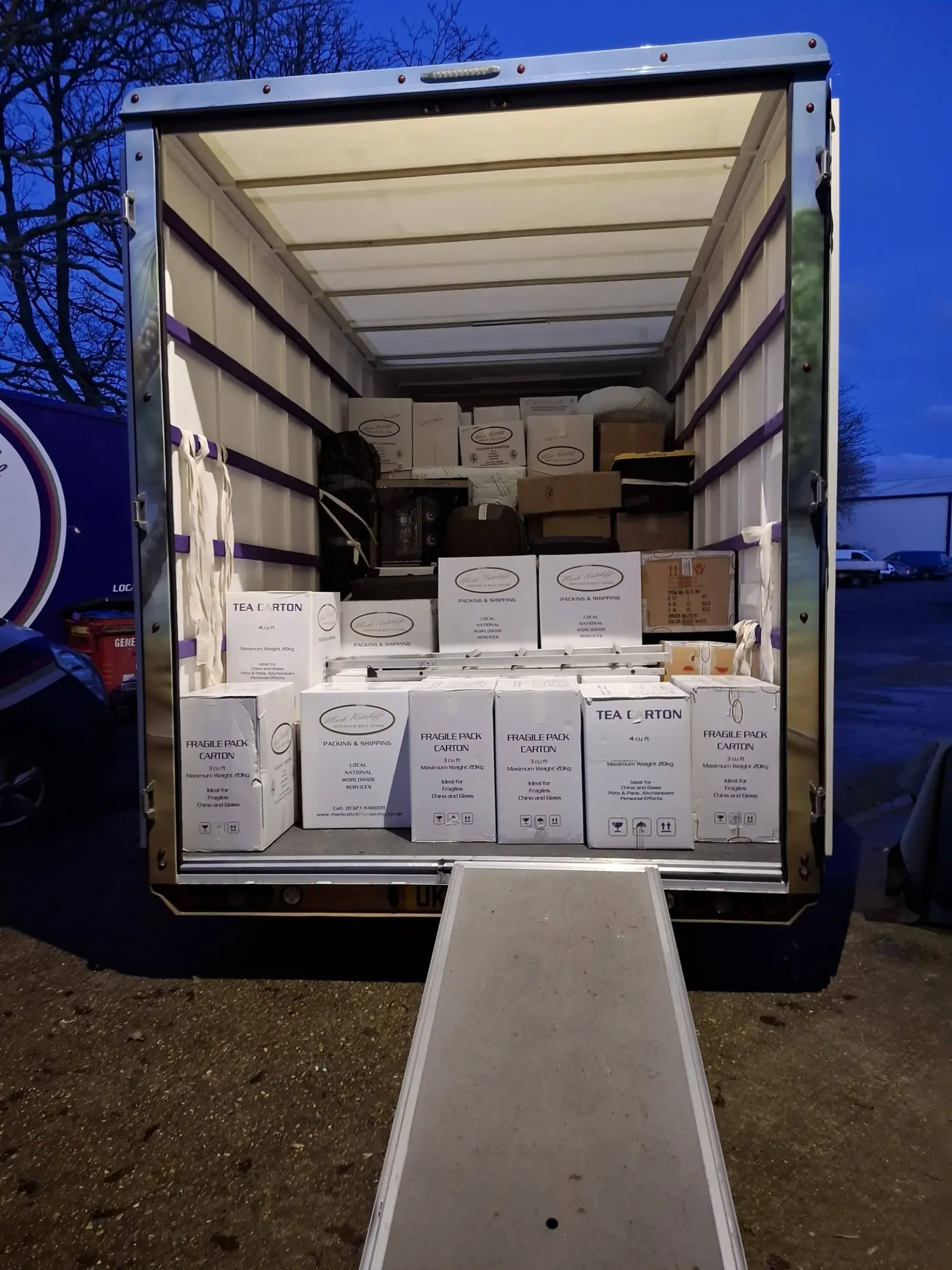
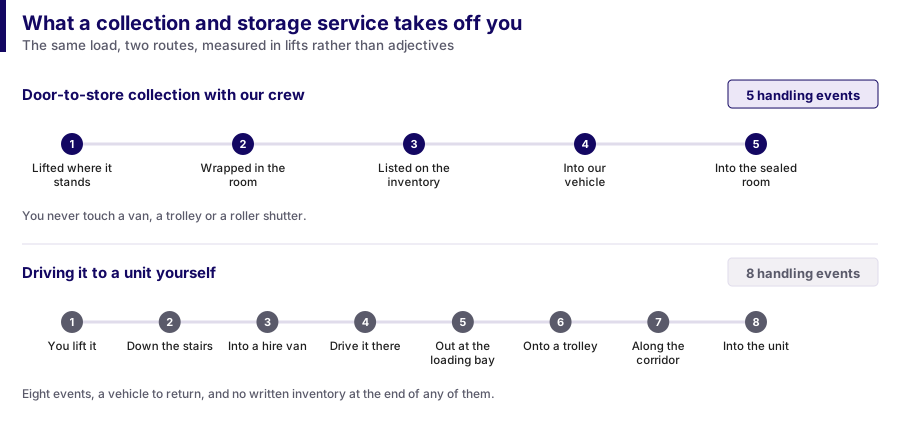
A collection and storage service means one thing in practice: you never touch a van. We arrive at your door in Sussex, Surrey or Kent, wrap your furniture where it stands, write an inventory on the spot, load it ourselves and drive it to a sealed steel room at our Lower Dicker depot. You are not hiring a vehicle, not carrying a sofa down a staircase, and not driving to a unit with a trolley.
One firm does both halves on one inventory, and the contractual case for buying them together is set out on our combined removals and storage service in Sussex rather than repeated here; this page is about the day we turn up.
The doing-it-yourself version is a van hire, a deposit, a fuel charge, a day of lifting, a drive to an industrial estate and a second day to get it all back out again. We will not labour the point, because plenty has been written about it already. What is worth your attention is what a professional collection day actually involves, because that is where the difference between a good store and a bad one is decided.
The room at the far end is described in full on our Prestige steel storage rooms at Lower Dicker. Everything below is what happens before the door on that room closes.
Almost every collection day that overruns was decided before the van left the depot. Volume is easy to estimate and rarely the problem. Access is the problem, and it is the thing a survey exists to find.
A survey takes thirty to forty-five minutes, in your home or over video. We are measuring goods, but we are also measuring the route out: the width of the front door, the turn at the bottom of the stairs, where a seven-and-a-half tonne vehicle can legally stop, and how far a crew has to carry from that point. If a shuttle vehicle or a lift booking is needed, it goes into the quote from the start rather than appearing as a surprise on the morning.
Here is what we actually look at, by property type, and what each finding changes about the day.
| Property type | What we check at the survey | What it changes on collection day |
|---|---|---|
| Terraced street, permit or pay-and-display | How close a Luton or seven-and-a-half tonne can legally stop, bay suspension lead time with the council, carry distance from the door | A suspension is applied for weeks ahead, or we plan a shuttle from a legal stopping point. Carry distance adds crew hours, so it is priced in advance |
| Flat on the third floor or above, with a lift | Internal lift dimensions, whether the building lets you book it, protection panels, notice the managing agent requires | We book the goods-lift slot in writing. Anything longer than the lift diagonal is planned for the stairs instead, and we tell you which pieces those are |
| Flat on the third floor or above, no lift | Stair width, number of turns, headroom under the landing, whether handrails come off | Extra crew and a longer day. Some sofas and wardrobes are dismantled that would otherwise travel whole |
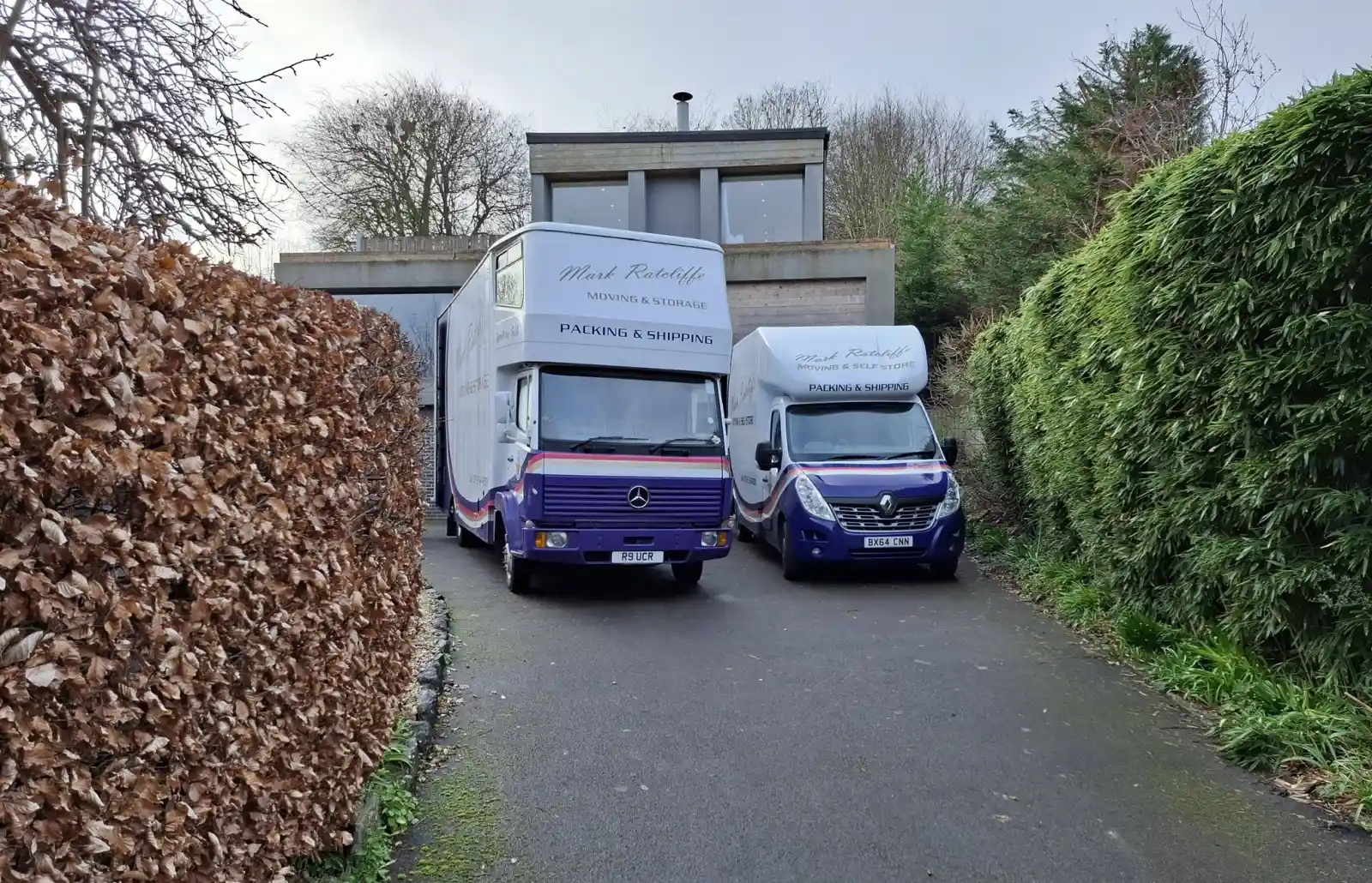
| Rural lane or farm track | Lane width, overhanging branches, turning circle at the end, how firm the ground is after rain | The large vehicle stays on the metalled road and we shuttle with a smaller van. In winter this is the single most common reason a Sussex collection needs two vehicles |
| New-build estate | Unadopted roads, contractor skips, site traffic, whether there is a dropped kerb yet | A stopping point is agreed with the site manager in advance. Turning up and hoping is how a crew loses two hours |
| Listed or period property | Original doorway widths, stone thresholds, low beams, floors that will not take a trolley | Door jambs and thresholds are boarded and protected, trolleys stay outside, and specific pieces are dismantled rather than forced |
If you are moving out of something old and awkward, our notes on moving out of a listed building in Sussex go further into thresholds, beams and floor protection than we can here.
This is a genuine full-house collection into storage: a three-bedroom Sussex house, everything going into store, nothing going on to a new address. Times shift with access and volume, but the sequence does not.
| Time | What the crew is doing | What we need from you |
|---|---|---|
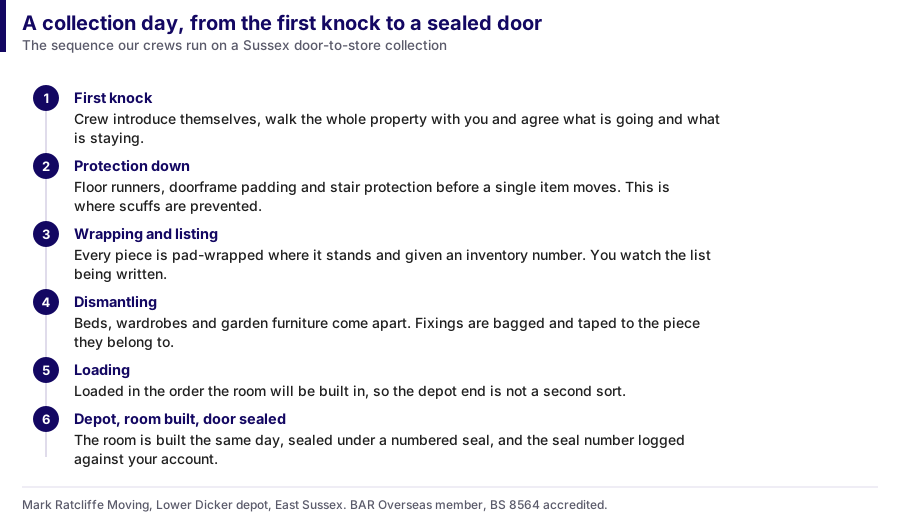
| 08:00 | Vehicle loaded at Lower Dicker with laundered blankets, cartons, straps, tail-lift trolleys, mattress bags and corner protectors. Inventory sheets printed against your reference. Route and parking checked | Nothing. This is our time, not yours |
| 09:00 | Crew arrives and walks the whole house with you, room by room, agreeing what goes and what stays. Floor runners and door protection go down before anything is lifted | Be there for the walk-round, and have anything that is staying put in one room or clearly marked |
| 09:30 | Pad-wrapping begins in the room each piece stands in. Drawer fronts taped, corners protected, beds and wardrobes dismantled as the crew reaches them | Keep the route from each room to the front door clear. Pets and small children somewhere else in the house |
| 11:00 | First load goes out to the vehicle. Every carton and every wrapped item gets its inventory number written on two faces, so it can be read from an aisle later | Stay reachable for questions. You do not need to stand and watch |
| 13:00 | Loft, garage, shed and outbuildings. This is the part that overruns on more days than every other part of the job put together | Loft emptied to floor level beforehand. A crew in a loft is a crew not loading a van |
| 15:00 | Final walk-round with you. Every cupboard and wardrobe opened, every room checked, inventory read back and signed. Your copy is left with you | Walk it with us. Signing at the door is the last moment anything can be corrected easily |
| 16:00 | Vehicle back at Lower Dicker. The load goes off the vehicle and into your own room, not onto a communal holding bay | Nothing |
| 16:45 | Room layout photographed, door sealed against your unique customer reference, inventory filed against the account | You get confirmation that the room is sealed, with the reference |
Two things in that table are worth pulling out. The first is that wrapping happens in the room, not at the tailgate: a piece that is carried bare and wrapped outside has already taken its knocks on the way. That method is set out properly on our packing services page for Sussex homes, and it is the same method whether goods are going to a new house or into store.
The second is that the room is sealed the same day for a local collection. Goods do not sit on a vehicle overnight or wait in a holding area for a slot, because the vehicle needs to be empty, washed and re-stocked for the next morning anyway. The exception is a long-distance run, which is covered further down.
This is the question the national collection-and-store brands are quietest about. Several of them operate through franchise networks or contracted hauliers, so the people who collect from your door, the people who hold the goods and the people who bring them back can be three different employers on three different pay structures.
Ours is one company from the doorstep to the door seal. The people who knock are employed by Mark Ratcliffe Moving, driving our vehicle, on a job sheet that carries their names, and the firm that owns the vehicle owns the room the load ends up in. Nothing is handed to a franchisee or a contracted haulier at either end, so there is no second company’s paperwork to reconcile against ours and no gap in the chain where each party assumed the other had checked.
Crews start from the depot at 08:00 rather than meeting you at your address. That sounds like a detail and is not: loading the vehicle at the depot is what gets the right blankets, the right covers and the right wardrobe cartons onto it for your list specifically, rather than whatever happened to be left in the back from yesterday.
The practical consequence is continuity. The crew that wrapped your dining table knows which fixings are in which bag and which leg was already loose. Where the diary allows, the same crew handles the redelivery, and we try hard to make that happen on a store that has been sealed for months. We will not promise it as a policy, because holidays and sickness exist and a promise we cannot always keep is worth nothing.
The kit is ours too, which sounds trivial and is not. Blankets are laundered in-house between jobs, so nothing arrives at your house smelling of someone else’s garage. Vehicles are inventoried and re-stocked at the depot every night, so a crew does not run out of mattress bags at three in the afternoon and improvise. The firm is a member of the British Association of Removers Overseas Group and works to BS 8564, the British Standard for overseas moving services, which is what puts an audited procedure behind the collection-day paperwork rather than a habit. If you want to read what people say about the crews specifically rather than about the company, that is on our customer reviews page.
If you are storing something where the handling standard matters more than the hourly rate — art, a collection, a house full of inherited furniture — our white-glove moving and handling service adds item-level inventory with photographs and a signed condition report before anything is touched.
An inventory is the only document that connects the house you emptied to the room you eventually open. Written badly, it is a liability. Written properly, it is the thing that lets you ring us in eight months and ask for the box with the Christmas decorations without anyone opening five rooms to find it.
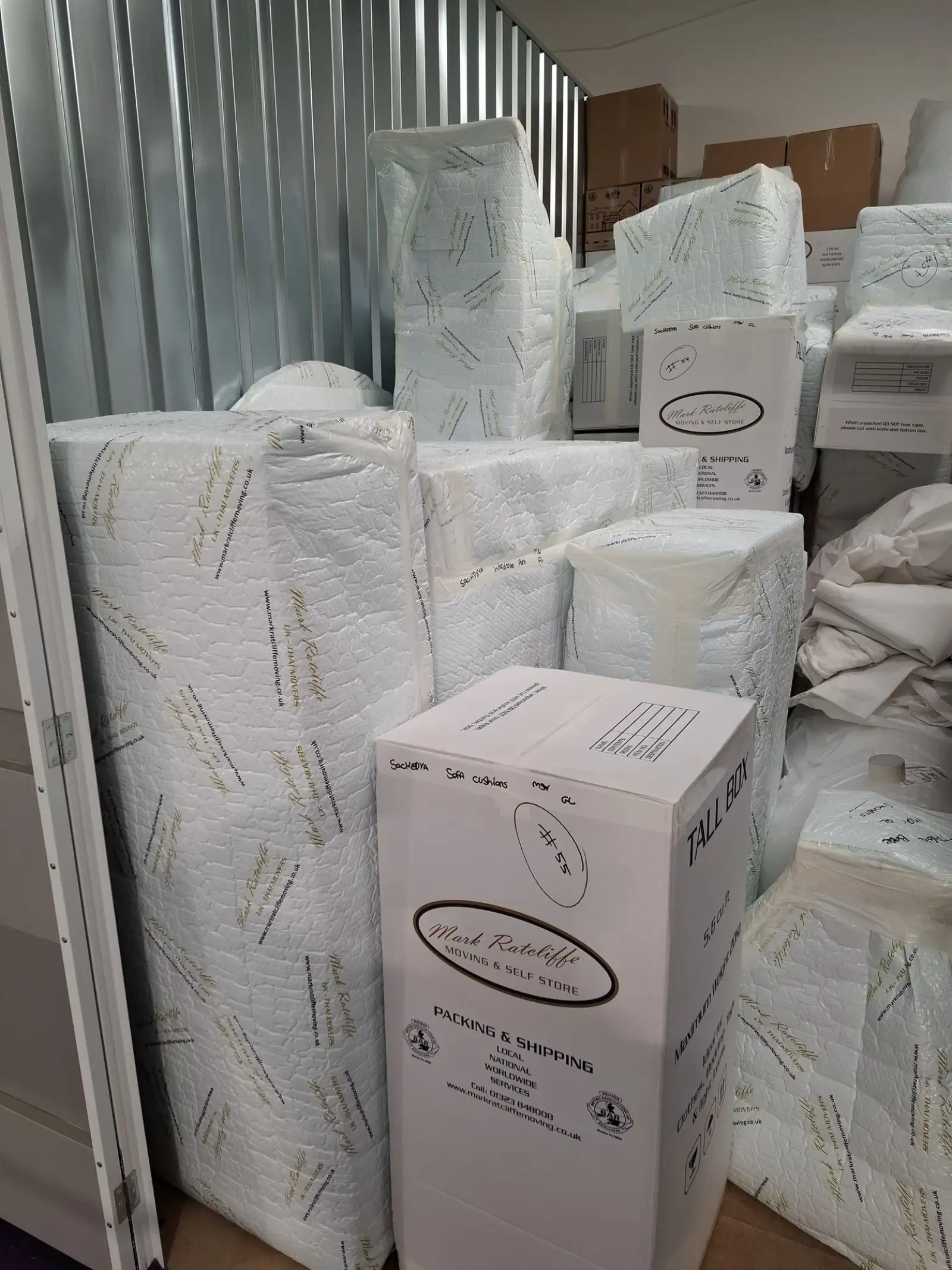
Ours is compiled at the point of load, not typed up afterwards from memory. Each carton and each wrapped item gets a number. The number goes on two faces of a carton, because a box stacked in a room can only be read from one direction and you do not know in advance which one. Items get a short description as well as a number, so the sheet says “oak dining table, four legs off, top pad-wrapped” rather than “table”.
You get a copy before we drive away, and we read it back at the final walk-round. That is deliberate. Corrections made at your door take a minute. Corrections made a fortnight later, from a depot, involve someone breaking a seal.
The layout of the room is photographed once it is loaded, which is what makes a later part-retrieval straightforward rather than archaeological. If anything is added to or taken out of the room during the storage term, the inventory is updated and the photograph is retaken.
One honest warning about inventories generally, ours included. A line that reads “box of sundries” describes nothing, so it protects nothing. If there is anything in the load you would want to claim for, it needs to be listed as itself, and that decision has to be made on collection day rather than afterwards. What cover applies while goods are in our care is set out in our terms, conditions and insurance details, and it is worth ten minutes before you sign anything.
This is the practical reason most people choose a collecting remover over a box-collection service. Services that collect crates and cases cannot take a bed apart, and will not carry a wardrobe. We do both, on the way in and again on the way out, and the fixings are our responsibility rather than yours.
The rule we work to is simple: take apart what has to come apart to leave the house safely, and nothing else. Every extra dismantle is an extra rebuild, and every rebuild is a chance for a cam lock to strip. What follows is how the common pieces are handled.
| Item | Taken apart on collection? | How it travels and stores | Put back together on redelivery? |
|---|---|---|---|
| Divan base and bed frame | Yes, as standard | Frame split, slats bundled and taped, headboard pad-wrapped separately. Fixings bagged, labelled and taped to the headboard | Yes, rebuilt and levelled in the room you want it |
| Solid timber wardrobe | Yes — doors off, hanging rail out | Doors pad-wrapped and faced together, carcass wrapped whole, rail bagged with its brackets | Yes |
| Flat-pack wardrobe or chest, chipboard or MDF | Only if it will not come out whole | Carried whole wherever the stairs allow, because cam-lock furniture rarely survives a second build | We will attempt it, and we will tell you at the survey if we think it will not hold |
| Dining table | Legs off where the fitting allows | Top pad-wrapped, corners protected, stored on edge on battens rather than flat under a stack | Yes |
| Corner or modular sofa | Split at the factory joint | Each section pad-wrapped and stored upright on end where the section shape allows, which is also the best use of room height | Yes, re-joined and squared up |
| Garden furniture, trampoline, swing frame | Yes | Dismantled, cleaned and dried before anything goes into a sealed room. Fixings bagged per unit | Yes, subject to weather on the day |
| Upright or grand piano | No — never dismantled | Specialist board, skates and a four-person lift, wrapped and stored upright off the floor | Positioned, not rebuilt. Tuning is a separate trade |
| Wall-mounted television bracket | Yes, if the bracket is yours | Taken off the wall and bagged with its own fixings, set with the television | Refitted only where the new wall construction is known and sound |
Pianos have their own crew, their own kit and their own page, because getting one wrong is expensive in a way nothing else on this list is — see our piano moving service. The same applies to anything with age and value on it, which is covered on our antique furniture moving service.
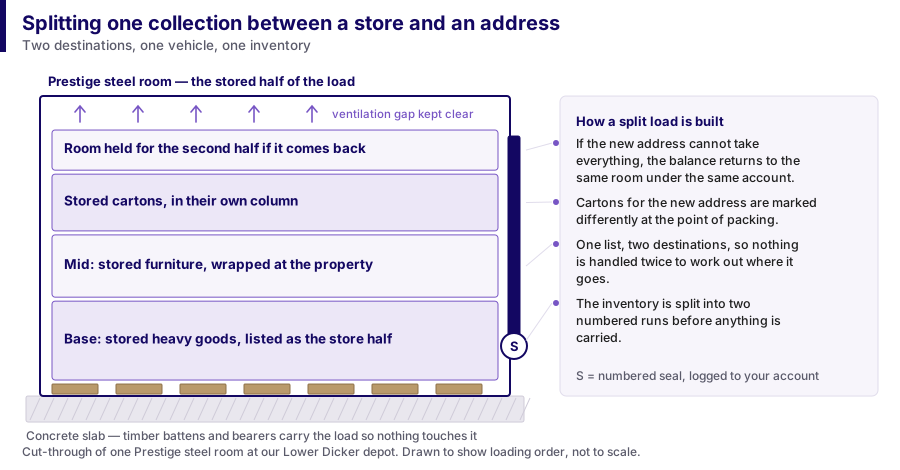
The single most common real collection is not a whole house into store. It is a house where two thirds is going into store and one third is going straight to a rental, a relative or a smaller new home. It is also the scenario that decides how a van is loaded, and it has to be settled at the survey rather than on the driveway.
We write two inventories from one walk-round, against one reference, and the crew colour-codes as it wraps. The store load goes on first, hard against the bulkhead, and the delivery load goes on last so it comes off first. Load it the other way round and the crew ends up standing in a driveway unloading the store portion onto the pavement to reach the sofa that is going upstairs, which is exactly the double handling this service exists to avoid.
Two collection addresses on one day works the same way. A common version in Sussex is a parent’s house and a rented flat, both emptying in the same week, both going into the same room. One reference, one room, two collection stops, one set of paperwork.
The third version is the declutter split, where some of the house is going into store, some is being sold or given away, and some genuinely needs to go. We can only do the first of those three as part of a collection, but we can do the third as a separate job — our house clearance service across Eastbourne and Sussex handles the part nobody wants to think about, and doing it before collection day rather than after is what keeps the stored volume honest.
Business collections split the same way, usually into stock that has to stay retrievable and furniture that can go deep. That has its own page, because the retrieval rules are different — see business storage in Eastbourne and Sussex. A student collection is usually one room out of a shared house, sharing a vehicle with three other rooms, which is set out on our student storage across Sussex and Brighton.
Storage is at Lower Dicker, near Hailsham on the A22 in East Sussex. That is where every stored load ends up. Our second depot at Coulsdon in Surrey is an operating base for crews and vehicles, and there is no storage there, so a Surrey or south London collection still finishes its day heading south.
That geography changes how far ahead you need to book, and it changes whether the room is sealed on the day of collection or the following morning. Nothing else about the method changes.
| Where we collect from | How the collection day runs | Notice we normally ask for |
|---|---|---|
| East Sussex — Eastbourne, Hailsham, Polegate, Lewes, Uckfield, Hastings | Single day, loaded and into the sealed room the same afternoon | Shortest of all. Often the same week outside August and month-ends |
| West Sussex and Brighton | Single day, back into store the same day for most household loads | Several days in a normal week |
| Surrey and south London | Worked from the Coulsdon base, then the load runs down to Lower Dicker to be stored | Around a week, longer in peak season |
| Kent | Single day for most of the county. The far east coast makes for a long day and sometimes an early start | Around a week |
| London north of the river | Parking and building access set the timetable, not the volume. Bay suspensions and goods-lift slots are arranged first | Two to three weeks where a council suspension is needed |
| Norfolk, the Midlands, Wales, the West Country | A two-day run. Loaded and sealed on the vehicle, which stays overnight in the alarmed and CCTV-covered yard at Lower Dicker, then into your room the next morning | Planned into the diary well ahead — these are scheduled runs, not call-outs |
| Scotland and the far north | A dedicated run, usually planned alongside another job travelling in the same direction | The longest lead time of anything we do |
A town-by-town view of what we cover, with the local detail for each, sits on our areas covered across Sussex, Surrey and Kent. The depot’s own town is written up on our Hailsham removals page, which is the closest thing we have to a home fixture.
For a small collection — a few items rather than a house — a full crew and a seven-and-a-half tonne vehicle is the wrong tool and we will say so. That job is usually our man and van service in Eastbourne with a store at the end of it.
Seven things account for most of the lost hours on a collection day. Here they are, in rough order of how often they bite, with what we changed in the way we survey and book because of each one.
The loft. This is the champion, by a distance. A crew allocated forty minutes for a loft can lose two hours to it, because the stuff in a loft has never been sorted and the decisions all have to be made standing on a joist. We now ask, in writing, for lofts to be emptied to floor level before the day, and we explain why rather than just requesting it.
Parking arranged late. Councils need lead time for a bay suspension, and the lead time is longer than most people expect. Booked late, the fallback is a shuttle from wherever the vehicle can legally stand, which adds crew hours to a day you have already priced. We raise parking at the survey now, not at confirmation.
Somebody else has the lift. Managing agents allocate one goods-lift slot at a time, and a neighbour moving on the same morning is not a rare event. We get the slot confirmed by the building in writing before the date is fixed.
A half-finished self-pack. If you are packing yourself and you are not finished when we arrive, the crew either waits or starts packing, and a collection day quietly becomes a pack day. We carry cartons on every vehicle, so it is recoverable, but it is not free time. If you know you will only get through part of it, book the part you will not reach — that is our partial packing service for Sussex homes, and it is a far better outcome than a crew standing in a kitchen.
Appliances not drained. A fridge or freezer that has not been defrosted, drained and dried for at least a day arrives wet, and wet appliances do not go into a sealed room. They get held back, which means a second visit or a second decision on the day.
The piece that came in before the extension. Occasionally something genuinely cannot leave the way it arrived, because a wall went up afterwards or a staircase was replaced. There is no clever answer to this on the morning. It is either dismantled further than anyone would like, or it stays. Finding it at the survey rather than at eleven o’clock is the whole point of surveying.
Completion moving mid-load. It happens, and it is the reason storage and removals sit on one contract here. If your date moves while the van is being loaded, the load goes into store and comes back out when the date is real. The playbook for that is on our storage while moving house in Sussex page.
None of this is a problem when it is planned. All of it is a problem when it is discovered on the morning. This is the list we give customers a week out.
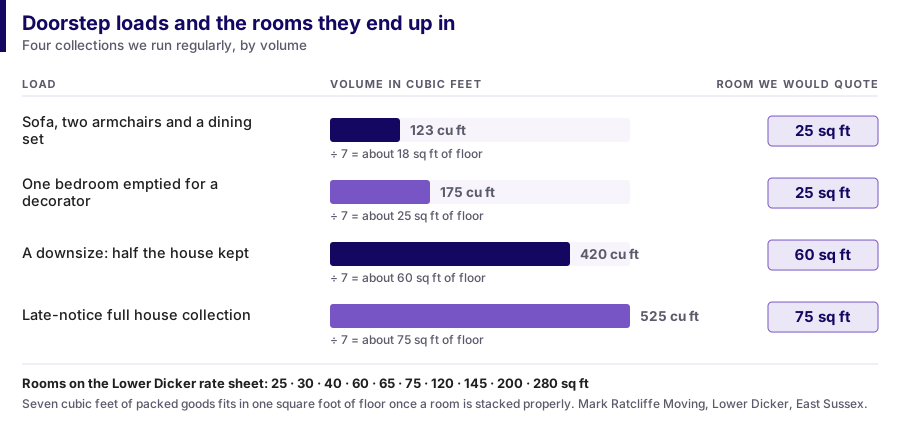
The one thing you cannot do in advance is know exactly how much room you will need, and it is the thing everyone wants to know first. As a planning figure we work on roughly seven cubic feet of packed goods for every square foot of floor in a storage room, which is why a room is quoted from your volume rather than from the number of bedrooms you had. You can get a volume for your own house from our storage volume and cost calculator in a few minutes, and the way a storage quote is built from that volume is unpicked on what storage actually costs in Sussex.
If you want to see what the finished result looks like before you commit, the format is described on our containerised storage in Sussex page, how individual pieces are treated in store is on furniture storage near Eastbourne, and if you would rather we packed the contents as well as collected them, that job is packing and storage as one service. For the things you can usefully do yourself before we arrive, our guide to preparing furniture for long-term storage is the practical one.
For the walk-round at the start and the inventory signing at the end, yes, or someone you have authorised in writing. In between you do not need to stand and watch, and plenty of customers go to work for the middle of the day. What we cannot do is decide on your behalf whether something goes or stays.
Yes, with written authority from you naming that person. We will ask them to walk the property and sign the inventory exactly as you would, because that document is what governs the whole storage term. Give them your list of what stays before the day.
We do it. Beds, solid wardrobes, dining tables, corner sofas and garden furniture are dismantled on collection and reassembled on redelivery, with fixings bagged and labelled to the piece. The only things we leave whole are flat-pack items that will come out intact, because cam-lock furniture often does not survive a second build.
Yes, and it is a normal part of the work in Brighton, Hove and Eastbourne seafront conversions. We survey the staircase first for width, turns and headroom, put extra crew on the day, and identify in advance which pieces need to be dismantled to come down at all.
In East Sussex, often the same week outside August and month-end Fridays. Surrey, Kent and London need longer, and anywhere that requires a council bay suspension needs two to three weeks because the council sets that clock, not us. Long-distance runs are planned into the diary well ahead.
Yes. Two stops, one reference, one storage room and one inventory is a common arrangement, usually a family home and a rental emptying in the same week. We survey both addresses so the vehicle and crew are sized for the combined load rather than the larger one.
Collection is a handling event and it is quoted as its own line, along with the crew, the vehicle and the redelivery at the other end. It is set out in the written quote before you book rather than appearing afterwards, and it is worth asking any provider the same question, because a free collection with a charged return is a common way to present a cheaper headline.
For a Sussex collection, nothing happens in between — the vehicle returns to Lower Dicker and the load goes straight off it into your own steel-walled room the same afternoon, which is then sealed against your reference and photographed. On a long-distance two-day run the load stays strapped and sealed on the vehicle overnight in the alarmed, CCTV-covered yard and goes into the room the next morning.
Yes. Surrey and south London are worked from our Coulsdon base, Kent is a single-day run for most of the county, and Norfolk, the Midlands, Wales, the West Country and Scotland are planned collection runs rather than call-outs. Every stored load comes back to Lower Dicker, because that is where the storage is.
From the blog
Need to reduce the amount of stuff before moving? Learn effective decluttering and downsizing strategies that actually work.
Clearing the family home for a care home move: what fits one room, dividing possessions between siblings, charity routes and storage.
What not to move and what it costs to move it anyway: charity or the tip, council bulky waste, and the items a removal crew cannot carry.
Tell us the address, the rough volume and the week you need to be out, and we will survey it in person or by video, price the collection and the storage together, and hold a date. Call 01323 848 008 or 07437 414 589, or email office@markratcliffemoving.co.uk and we will come back with a written quote rather than a figure on the phone.