
Storage in Croydon for households moving in Central and South London. We collect, pad-wrap and inventory, and your things go into our Mill Lane store rather than travelling to the coast — so the collection is a London job and the redelivery is too.

Storage in Croydon, from our crate store on the Mill Lane Trading Estate at CR0 4AA, is built around one assumption: that a household moving in Central or South London does not want to hire a van, drive it across town, and carry its own wardrobe up a flight of stairs at a storage site on a Saturday.
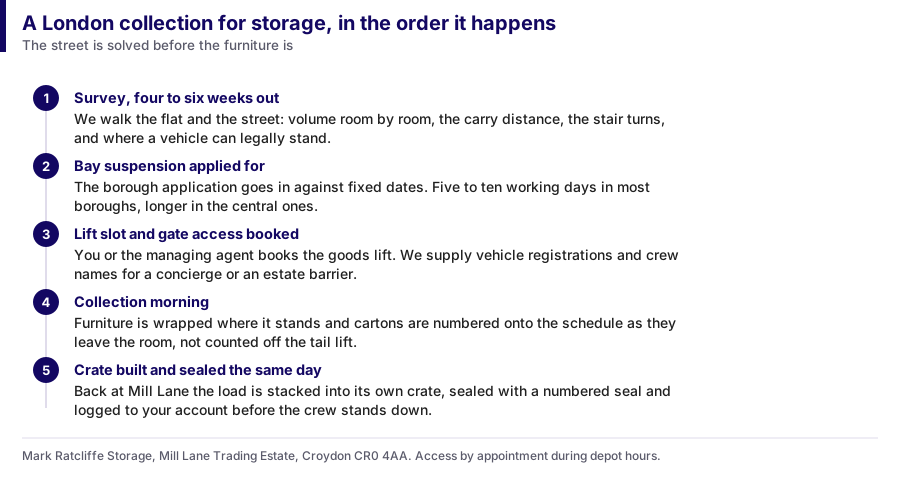
So we do the whole thing. A crew comes to the flat or the house, wraps the furniture where it stands, writes an inventory as the goods leave the room, loads, and takes everything back to Mill Lane. It is stacked into crates there, the crates are sealed and numbered against your account, and they are not opened again until the day we bring them back to you.
The store trades as Mark Ratcliffe Storage and it is a working part of our London operation rather than an overflow yard. Croydon was chosen for the simple reason that it is the point where South London stops being expensive to stand a vehicle in and starts being quick to get out of. A Clapham collection reaches it in well under an hour on an ordinary weekday; a Purley one reaches it in ten minutes.
That matters more than it sounds. London goods stored in London are collected on a London day and delivered on a London day. Nothing is driven to the Sussex coast and back, so your redelivery is not waiting on a vehicle that is somewhere else, and a part retrieval does not turn into a two-county round trip. Our East Sussex store at Lower Dicker, described on the Prestige steel storage rooms page, exists for Sussex and Kent work and is a genuinely separate operation.
The discipline behind the London work is the same one the firm is audited on elsewhere. Mark Ratcliffe Moving is a member of the British Association of Removers Overseas Group and holds BS 8564 accreditation, which covers overseas moving services; the survey method, the inventory format and the wrapping standard that came out of that work are what a London collection is run to.
What follows is the operational detail rather than a sales pitch: exactly which areas we collect from, what goes wrong on a London loading day and how far in advance it has to be fixed, how a flat converts into a room size, what a room costs per week, and where this service is the wrong purchase.
The catchment is Central London and South London. That is not a marketing radius drawn on a map — it is the area a crew can reach, load and return from inside a working day, which is the only definition that means anything when you are paying for the day.
The table below is the working version of it. The run times are door-to-store on an ordinary weekday, and they are the figures we plan crew days against rather than a best case at six in the morning.
| Where we collect | Postcode districts | Typical run back to Mill Lane | What usually sets the collection window |
|---|---|---|---|
| Croydon, Addiscombe, Thornton Heath, South Norwood | CR0, CR7, SE25 | 10–15 minutes | Almost always a same-day return to store, so a small flat can be collected and sealed inside one working day. |
| Beckenham, Penge, Bromley, Shortlands | BR1, BR3, SE20 | 20–25 minutes | Residents’ bays and narrow Edwardian frontages; a suspension is worth having on anything bigger than a studio. |
| Streatham, Norbury, Tooting, Mitcham | SW16, SW17, CR4 | 20–30 minutes | The A23 corridor. Loading is controlled for most of the day, so the window is set around the restriction rather than your preference. |
| Wimbledon, Merton Park, Raynes Park, Colliers Wood | SW19, SW20 | 25–35 minutes | Converted houses with shared front paths. The carry distance decides the crew size more often than the volume does. |
| Dulwich, Herne Hill, Sydenham, Forest Hill, Crystal Palace | SE21, SE22, SE23, SE24, SE26, SE19 | 20–35 minutes | Hills and half-landings. Large wardrobes and corner sofas frequently have to be dismantled to clear the turn. |
| Brixton, Camberwell, Peckham, Nunhead, East Dulwich | SW2, SE5, SE15 | 30–40 minutes | Estate access and barrier codes; the concierge or estate office needs the vehicle registration in advance. |
| Clapham, Battersea, Balham, Stockwell | SW4, SW8, SW11, SW12 | 35–45 minutes | Victorian conversions with communal stairs. Lift bookings do not exist here — everything comes down by hand. |
| Kennington, Vauxhall, Elephant and Castle, Bermondsey | SE1, SE11, SE17 | 35–45 minutes | New-build blocks with booked goods lifts and a fixed loading bay slot, usually an hour or two at a time. |
| Lewisham, Blackheath, Catford, Greenwich | SE3, SE6, SE10, SE13 | 35–45 minutes | River crossings set the timing. An early start is worth more here than an extra pair of hands. |
| Fulham, Parsons Green, Putney, Wandsworth | SW6, SW15, SW18 | 40–50 minutes | Terraces with no frontage at all. A suspension is the difference between a 5 metre carry and a 40 metre one. |
| Chelsea, South Kensington, Earls Court, Notting Hill | SW3, SW5, SW7, W8, W11 | 45–60 minutes | Permit-only bays throughout. Nothing is quoted here until the borough has confirmed the suspension dates. |
| Westminster, Pimlico, Marylebone, Fitzrovia, Bloomsbury | SW1, W1, WC1 | 50–65 minutes | Red routes, timed loading and porterage. These jobs are planned around the restriction hours first and the furniture second. |
North of the river we work the central boroughs rather than the whole city. Westminster, Marylebone, Fitzrovia, Bloomsbury, Kensington, Chelsea, Notting Hill and Fulham are all ordinary jobs for us; Enfield, Barnet and Romford are not, and we would rather say so than quote a day we cannot hold.
South of the river the coverage is continuous, from Bermondsey and Greenwich across to Wandsworth and Putney, and down through Streatham, Norwood, Beckenham and Bromley into the Croydon and Purley postcodes around the store itself.
It is worth being clear about one thing, because people ring the wrong address. Our Coulsdon removals depot at CR5 2HT is crews and vehicles only — there is no customer storage there and nothing is kept in it. Everything described on this page happens at the Mill Lane crate store at CR0 4AA, and that is the address a delivery, a survey or a visit is booked to.
If the move is out of London rather than within it, the storage still sits in Croydon while the chain sorts itself out, and the delivery leg goes wherever the new house is. That pattern is common enough that we wrote it up in detail in our guide to moving from London to Sussex, and the outbound counties are covered on our Surrey removals page, our Bromley removals page and our Beckenham removals page.
The lifting is almost never the problem. On a London job the expensive variable is the twenty metres between the front door and the back of the vehicle, and every hour lost there is an hour you are paying a crew to walk.
A national storage chain never has to think about this, because the customer brings the goods to them. We have to solve it before the date is even offered, which is why our survey looks at the street before it looks at the sofa.
| What gets in the way | Who arranges it | Lead time it genuinely needs | What it costs you if it is left to the day |
|---|---|---|---|
| A parking bay suspended outside the front door | We apply to the borough; you confirm the address, the dates and the vehicle length | Five to ten working days in most boroughs, longer in Kensington and Westminster | The vehicle stands where it can and the difference becomes a long carry, charged as porterage |
| A red route frontage | We check the loading window against the published restriction before we offer you a date | Settled at survey | There is no legal place to stand. The job has to start outside the restricted hours, which usually means an early morning |
| A controlled parking zone with residents-only bays | Borough dispensation or a visitor permit, applied for in your name | Three to ten working days | A penalty notice on our vehicle and a crew that keeps moving it instead of loading |
| A booked goods lift in a managed block | You or your managing agent books it; we supply insurance details if the building asks | Two to four weeks in a well-run block | The load comes down the stairs, which roughly doubles the hours for anything above the second floor |
| An estate barrier or gated development | Concierge or estate office notified, with vehicle registration and crew names | Forty-eight hours | The vehicle is held at the gate while somebody tries to find a key holder on a Saturday |
| A Victorian stairwell with a half-landing turn | Measured at survey; wardrobes, bed frames and larger sofas are dismantled and bagged | Settled at survey | The item does not come out. It either stays in the flat or it goes out of a window on a hoist, which is a separate quote |
| A weight, width or height limit on the access road | A shuttle vehicle is planned in from the start | Settled at survey | The pantechnicon cannot reach the address and the whole day is spent transferring loads by hand |
| A school street or a timed road closure | The collection window is set outside the closure | Settled at survey | The crew arrives to a closed road and waits, on your time |
Three of those rows account for most of the damage to a London schedule.
The first is the bay suspension. Boroughs differ wildly — some will turn an application round in under a week, some in the central boroughs want considerably longer and will charge per day per bay. We apply for it as part of the job and we need the dates fixed to do it, which is the real reason a London collection is harder to move at short notice than a Sussex one.
The second is the goods lift. In a managed block the lift is a shared resource with a booking sheet, and a slot given away on the morning cannot be got back. If your building has a concierge, the single most useful thing you can do after booking the collection is to ring them and get the lift written down.
The third is the staircase. A Victorian conversion with a tight half-landing will not pass a modern king-size divan, a three-seat corner unit or a full-height wardrobe, and no amount of crew will change that. We measure the turn at survey and plan the dismantling in, which is ordinary work for us — fixings are bagged and taped to the piece they came off so the reassembly at the other end is not a puzzle. Where an item genuinely will not come out intact, our custom crating service is sometimes the answer for the valuable ones.
None of this is difficult when it is planned. All of it is expensive when it is discovered at eight in the morning with a crew standing on the pavement. The rest of the moving-day sequence is set out in our storage while moving house page, which covers the chain-delay version of the same day.
Storage is sold by volume, and volume is the one thing nobody can estimate by eye. People look at a one-bedroom flat and picture a garage; the flat is usually about 280 cubic feet once it is packed, which is a good deal less than the garage and a good deal more than the boot of a car.
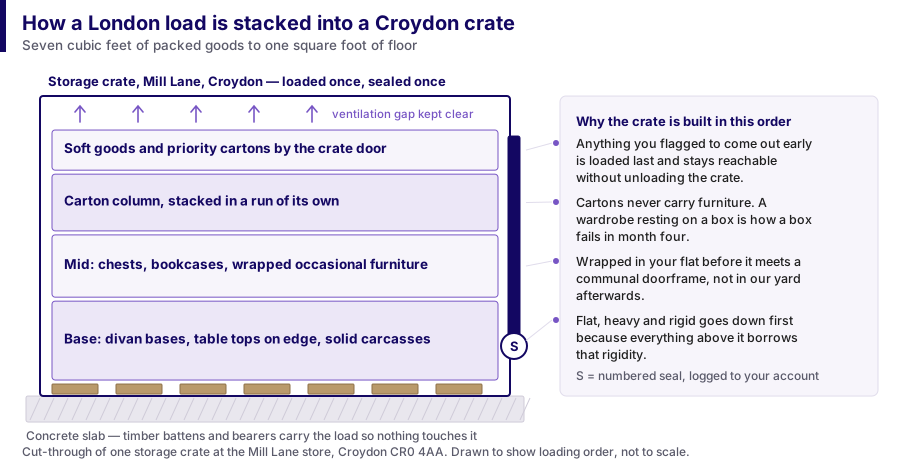
The arithmetic we use is straightforward and we publish it because it is the number that stops arguments at survey. Seven cubic feet of properly packed goods fit into one square foot of floor once a store is stacked to height. Divide your cubic footage by seven and you have the floor area; the room we quote is the smallest one on the sheet that genuinely takes it.
| What we were asked to store | Volume at survey | Floor at 7 cu ft per sq ft | Room we would quote | Per week inc VAT |
|---|---|---|---|---|
| One room emptied for building work in a Bloomsbury flat | 120 cu ft | 18 sq ft of floor | 30 sq ft | £22 |
| A studio cleared into store while a lease gap runs | 175 cu ft | 25 sq ft of floor | 30 sq ft | £22 |
| A one-bedroom Clapham flat, wardrobes and sofa included | 280 cu ft | 40 sq ft of floor | 50 sq ft | £33 |
| Two bedrooms and a sitting room from a Battersea maisonette | 420 cu ft | 60 sq ft of floor | 75 sq ft | £44 |
| A Kennington flat plus a home office and two bicycles | 520 cu ft | 75 sq ft of floor | 75 sq ft | £44 |
| A three-bedroom Dulwich terrace, garden store excluded | 840 cu ft | 120 sq ft of floor | 150 sq ft | £77 |
| A four-bedroom Beckenham house with the loft cleared | 1,250 cu ft | 179 sq ft of floor | 200 sq ft | £98 |
| A five-bedroom house in Wimbledon, whole contents | 1,650 cu ft | 236 sq ft of floor | 250 sq ft | from £115 |
Two things are worth reading off that table rather than skimming past.
The first is how flat the curve is at the small end. A single room cleared for building work and a whole studio both land in the same 30 sq ft room, because the room is sized by the stack rather than by the door. If you are somewhere between the two, the smaller room is usually the right call and we will say so.
The second is where the jumps happen. Between a two-bedroom flat and a three-bedroom house the volume roughly doubles, and that is the point where people who guessed at the survey get caught out. It is also the point where sorting out what you are genuinely keeping pays for itself several times over, which is the whole argument in our guide to preparing furniture for storage.
If you would rather work it out yourself before ringing anyone, the storage volume calculator walks through it room by room, and the underlying pricing logic — volume, duration, handling and access — is set out on our storage costs page. A survey still beats both, and for a London flat it is usually a twenty-minute visit.
Here is the London rate card, in full, with nothing held back for the phone call. These are the rates for goods stored at the Croydon crate store, and they are higher than our Sussex rates for the ordinary reason that London property and London working days cost more.
| Room | Typically holds | Per week | Per week nett | Per 4 weeks | Collection or delivery, each way |
|---|---|---|---|---|---|
| 30 sq ft | One room, boxes | £22 | £18.33 | £88 | £450 · shared run £225 |
| 50 sq ft | Studio or 1-bed flat | £33 | £27.50 | £132 | £560 · shared run £295 |
| 75 sq ft | 2-bed flat | £44 | £36.67 | £176 | £890 |
| 100 sq ft | 2-bed house | £55 | £45.83 | £220 | £1,050 |
| 150 sq ft | 3-bed house | £77 | £64.17 | £308 | £1,490 |
| 200 sq ft | 4-bed house | £98 | £81.67 | £392 | £1,990 |
| 250 sq ft | 5-bed house or business stock | from £115 | from £95.83 | from £460 | Quoted on survey |
All prices include VAT (the nett column is what a VAT-registered business reclaims against). £5,000 of cover is included in every price. Pay 26 weeks upfront and save 10% on storage.
Read the card with four things in mind.
For comparison, the same seven rooms at our Sussex stores start at £18 a week rather than £22, and a Sussex job is quoted on that card instead. Which card applies is decided by where the goods are collected from and where they are stored, not by where you happen to be moving to — London goods go to Croydon on the London card, Sussex goods go to our containerised storage in Sussex on the Sussex one.
Business customers should note that the nett column is the figure a VAT-registered business reclaims against. The commercial version of this service, including archive and stock, is set out on our business storage page.
The weekly rate buys the space. Getting your things into that space, and back out of it again, is a crew and a vehicle for most of a day, and it is quoted as its own line each way.
That is not a hidden charge — it is on the rate card above, in the right-hand column, at £450 each way for a 30 sq ft London load and rising with the size of the job. It is written as two separate movements on purpose, because the two ends of a storage booking are frequently not the same job at all.
A collection is a known quantity. The address is surveyed, the access is solved in advance, the goods come out in a planned order and the crate is built at the store the same afternoon. A redelivery, months later, can be to a different address, a different borough, a different floor and a different set of parking rules — and quite often to a house rather than a flat. Rolling both into one figure at the start would mean guessing at the second one, and a guess on a London delivery is never a small guess.
Billing them separately has three practical consequences worth knowing before you book.
Redelivery needs notice. In practice that is a few working days for a small load and about a week for a house, longer in the last fortnight of the month when everyone in London completes at once. We hold a provisional slot as soon as you have a target date and re-point it when the date moves, which it usually does — and we would rather re-point it four times than be asked for a vehicle on a Friday afternoon in August.
The end-to-end version of this, where the removal and the storage are one booking rather than two, is set out on our removals and storage page, and the collection mechanics themselves on our collection and storage service page.
There is a cheaper way in at the small end, and it is on the rate card rather than kept for people who ask.
The two smallest London rooms — 30 sq ft and 50 sq ft — can be collected on a shared run instead of a dedicated vehicle. Rather than sending a crew and a vehicle to your address for the day, your goods travel with another London job going the same way. The collection price drops from £450 to £225 for a 30 sq ft load, and from £560 to £295 for a 50 sq ft one.
What you give up is control of the date. A shared run goes when there is a second job to share it with, which in practice means we offer you a window of a few days rather than a day of your choosing, and the arrival time inside that day is approximate. If your collection has to happen on a fixed Tuesday because the tenancy ends on the Wednesday, this is not the option for you and we will say so.
It suits four situations particularly well.
It does not suit a completion-day collection, a job that needs a bay suspension on an exact date, or anything where a lift slot has been booked in a managed block. Those three all need a guaranteed vehicle on a guaranteed morning, and the saving is not worth the risk of losing the slot.
The shared run applies to the two smallest rooms only. From 75 sq ft upward the load fills a vehicle in its own right and there is nothing to share, so the collection is quoted as a dedicated day on the card above. If you are close to the line, it is usually worth asking us to survey rather than assuming — a 50 sq ft load with a shared collection and a 75 sq ft load with a dedicated one are a long way apart on the total, and the deciding factor is often three or four cartons.
Every price on the card above includes £5,000 of cover on your goods while they are in store. It is inside the weekly rate rather than offered to you afterwards, and it applies at Croydon exactly as it does at our Sussex stores.
It is worth understanding what that figure is and what it is not, because storage cover is the part of a quote people skim and then rely on.
What it covers is loss or damage to your goods while they are in our custody — in transit on the collection, while they sit sealed in the crate, and on the delivery leg. Fire, flood, theft, and physical damage caused in handling are the ordinary claims. The store is alarmed and monitored, goods are raised off the slab on battens rather than stood on concrete, and each crate is sealed with a numbered seal logged against your account so a crate that has been opened cannot pass unnoticed.
What it is not is a valuation of your house contents. £5,000 is a sum insured for the load, not a promise that any single item is worth that. Four things sit outside it in the ordinary way, and none of them are unusual in the trade:
If the load is worth more than the included figure, tell us at survey and we will set the cover against the declared value on the storage agreement before anything is collected. Doing it afterwards is always harder. The full wording, including the claims procedure and the time limits on notifying us, is in our terms and insurance details, and it is genuinely worth ten minutes of your time before you sign.
Access at Mill Lane is by appointment during depot hours, and it works like this: you tell us what you need, we book a slot, and a member of the crew brings the goods out to you. You do not walk into the storage area and you do not open the crate yourself — a sealed crate is opened by staff, against your instruction, and re-sealed with a new numbered seal afterwards.
That is a deliberate trade and it is worth being straight about it. It is the same policy at every one of our sites, and it is the single biggest difference between this service and the unit you rent from a chain. What you lose is the ability to turn up on a whim at nine on a Sunday evening. What you gain is that nobody else can turn up either, that every movement in and out of your crate is logged, and that the person handling your wardrobe does this for a living.
The inventory is what makes retrieval work at all. Every carton is numbered as it leaves your flat and written onto a schedule, with a short contents summary and a handling flag. Months later, that schedule is how one box comes out of a sealed crate without the other forty being unloaded onto the floor. If you already know that something will be wanted early — a box of documents, a suitcase, the children’s winter coats — tell the crew at collection and it is loaded last and kept by the door.
Three kinds of appointment come up regularly:
When the goods come back out for good, they come out in reverse order — the last things in are the first things off, which is how the crate was built in the first place. If the new place is not ready for all of it, we deliver what fits and keep the rest, and if you want it unpacked and the debris taken away, our unpacking service covers that end of the day.
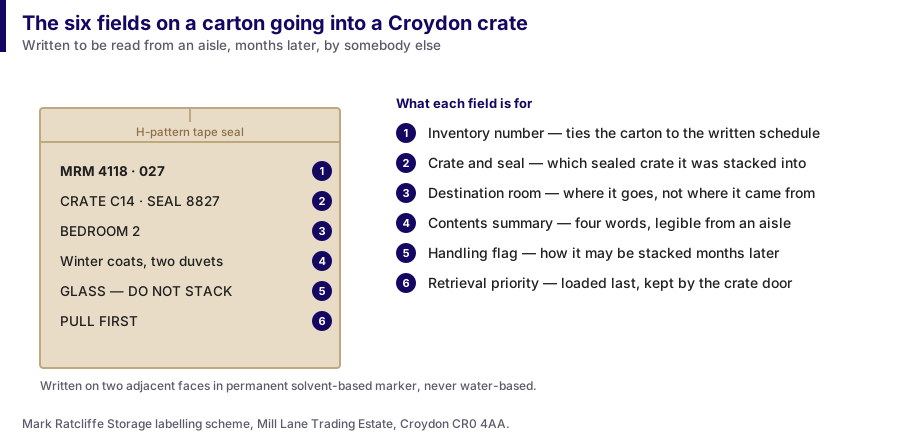
A sealed crate that nobody opens for six months is an excellent place for furniture, cartons and soft goods. It is a poor place for several things people quite reasonably assume they can store, and a dangerous place for a few.
Refusing them is not caution for its own sake. One aerosol tin in a warm crate is a problem for everybody else’s goods in the building as well as yours.
Two grey areas come up often enough to be worth naming. Fridges and freezers store perfectly well provided they are defrosted, dried and left with the door wedged open, which is how we load them. White goods that have not been drained will leak into whatever is under them.
And mattresses go in standing on edge, bagged, never flat under a stack of furniture — a mattress carrying a wardrobe for four months does not recover. Pianos, safes and anything genuinely heavy are a specialist job in their own right and are handled by the crews described on our piano moving page, while fine furniture and pieces with a history are covered on our antiques moving page.
If part of the load is honestly not worth storing, it is cheaper to deal with it on collection day than to pay to keep it for a year. Our clearance service can take it away on the same visit, and a surprising number of London bookings shed a room’s worth of volume that way before anything reaches the store.
There is a version of storage that is a better fit than ours, and pretending otherwise would be a waste of your afternoon.
If you need to reach your own goods often and without notice — a market trader loading a van at dawn, a builder pulling tools every morning, an online seller picking single items daily, a band with kit to move twice a week — then a unit you hold the key to is simply the right product. Most self storage operators sell exactly that, there are several sites within a few miles of Mill Lane, and none of them would pretend our appointment-based access suits you either.
The same is true if the load is genuinely tiny and you have a car. Half a dozen boxes does not need a crew, a survey and a crate; it needs a friend with an estate car and an afternoon.
Where the managed model wins is the opposite profile: a large load, a low access frequency and a high cost of handling. A whole flat going into store between completions. A house held for six months while a purchase unpicks itself. Furniture parked while a renovation runs over. In those cases the lifting is the expensive part, not the floor space, and paying a firm that already owns the vehicles, the blankets, the crates and the inventory beats renting an empty room and then hiring somebody else to fill it.
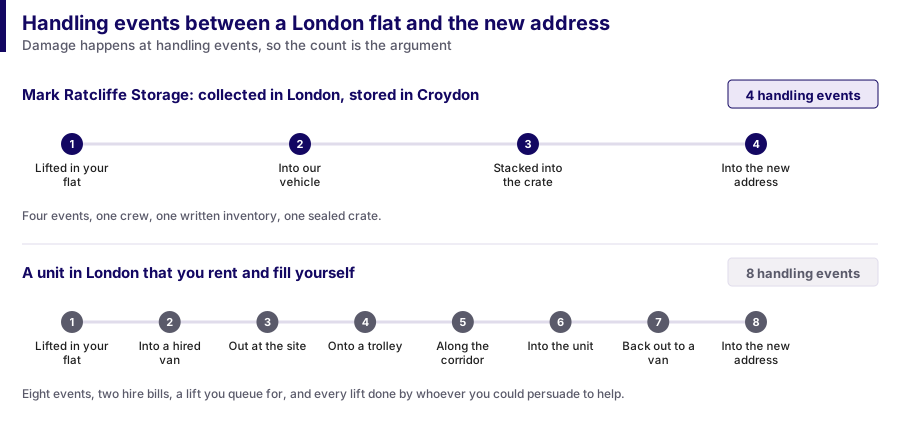
The handling count is the whole argument. Through us, a sofa is lifted in your flat, loaded, stacked into the crate, and lifted again at the new house. Through a unit you fill yourself, it is lifted in your flat, loaded into a hired van, unloaded at the site, trolleyed along a corridor, lifted into the unit, and then the whole sequence runs again in reverse. That is four handling events against eight, and damage happens at handling events.
The quiet advantage is continuity. One firm surveyed the job, wrote the inventory, sealed the crate and will bring it back, so when a carton is queried there is one schedule and one phone number rather than a storage operator pointing at a van hire company. Longer stays shift onto a different footing again, with condition reviews and a re-inventory, which is set out on our long-term storage page; and if what you are really storing is furniture rather than boxes, the wrapping detail is on our furniture storage page.
If you are not sure which of the two you need, describe the job to us and we will tell you honestly. We turn work away on this basis most months, and it costs us nothing compared with a customer who resents the booking by the third week.
At the Mill Lane Trading Estate, Mill Lane, Croydon, CR0 4AA, trading as Mark Ratcliffe Storage. Please note that our Coulsdon site at CR5 2HT is a removals depot for crews and vehicles — there is no customer storage there. Surveys, deliveries and appointments for stored goods are all at the Mill Lane address.
Rooms start at £22 a week including VAT for 30 square feet, which holds about 210 cubic feet, and run to £98 a week for 200 square feet; 250 square feet and above is quoted from £115 a week on survey. Collection or delivery is charged separately each way and starts at £450 for a 30 square foot London load. £5,000 of cover is included in every price, and the full card is published further up this page.
To Croydon. Goods collected in Central or South London are stored at the Mill Lane crate store and are quoted on the London rate card. They are not driven to our East Sussex store, which serves Sussex and Kent collections. Keeping London goods in London is what makes a part retrieval or a changed delivery date workable rather than a two-county round trip.
Yes, by appointment during depot hours. Ring or email, tell us what you need, and we will book a slot and have a crew member bring the goods out to you. We do not offer unaccompanied entry to the storage area and crates are opened by staff against your instruction, then re-sealed with a new numbered seal logged to your account.
Yes. We apply to the borough for a bay suspension or dispensation as part of the job, and we need your address and the dates fixed to do it. Most boroughs want five to ten working days; Kensington, Chelsea and Westminster want longer and charge more. If the frontage is a red route we check the published loading window before offering you a date, which sometimes means an early start.
Usually 75 square feet. A two-bedroom flat with a sitting room surveys at roughly 420 cubic feet once it is packed, and at seven cubic feet per square foot of floor that lands on the 75 square foot room at £44 a week. A one-bedroom flat is normally 50 square feet and a three-bedroom house normally 150. A twenty-minute survey settles it properly.
A few working days for a small load and about a week for a house. The last fortnight of any month is tighter because London completions bunch there, and August and the run-up to Christmas are tighter again. We hold a provisional slot as soon as you have a target date and re-point it when the date moves, so give us the date you have rather than waiting for one you trust.
It is a consolidated collection for the two smallest rooms, where your goods travel with another London job going the same way instead of taking a dedicated vehicle. A 30 square foot collection drops from £450 to £225, and a 50 square foot one from £560 to £295. You give up the choice of an exact day, so it suits a flexible collection and not a completion-day one.
Storage is billed weekly on a four-week cycle, and chains slip far more often than they hold, so the term is open-ended rather than fixed to the date on your paperwork. If a four-week booking turns into six months, nothing has to be re-contracted — the billing simply continues, and pay 26 weeks upfront and save 10% on storage is the published way to bring the rate down on a long stay.
From the blog
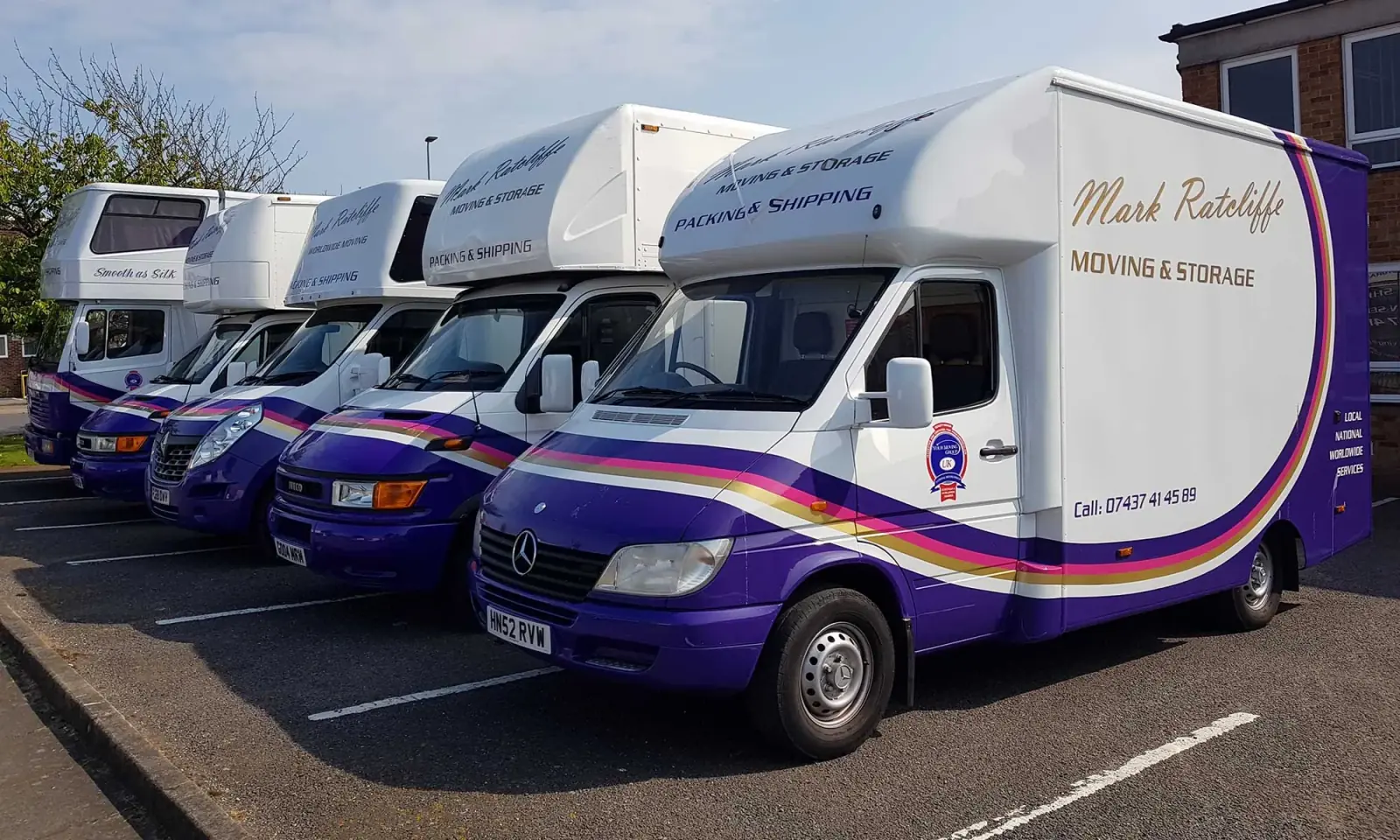
Storage between house moves costed by week and month, container storage vs self storage, and the point where storing costs more than replacing.

Planning to put furniture into storage? Learn how to properly prepare your items to prevent damage while in storage.
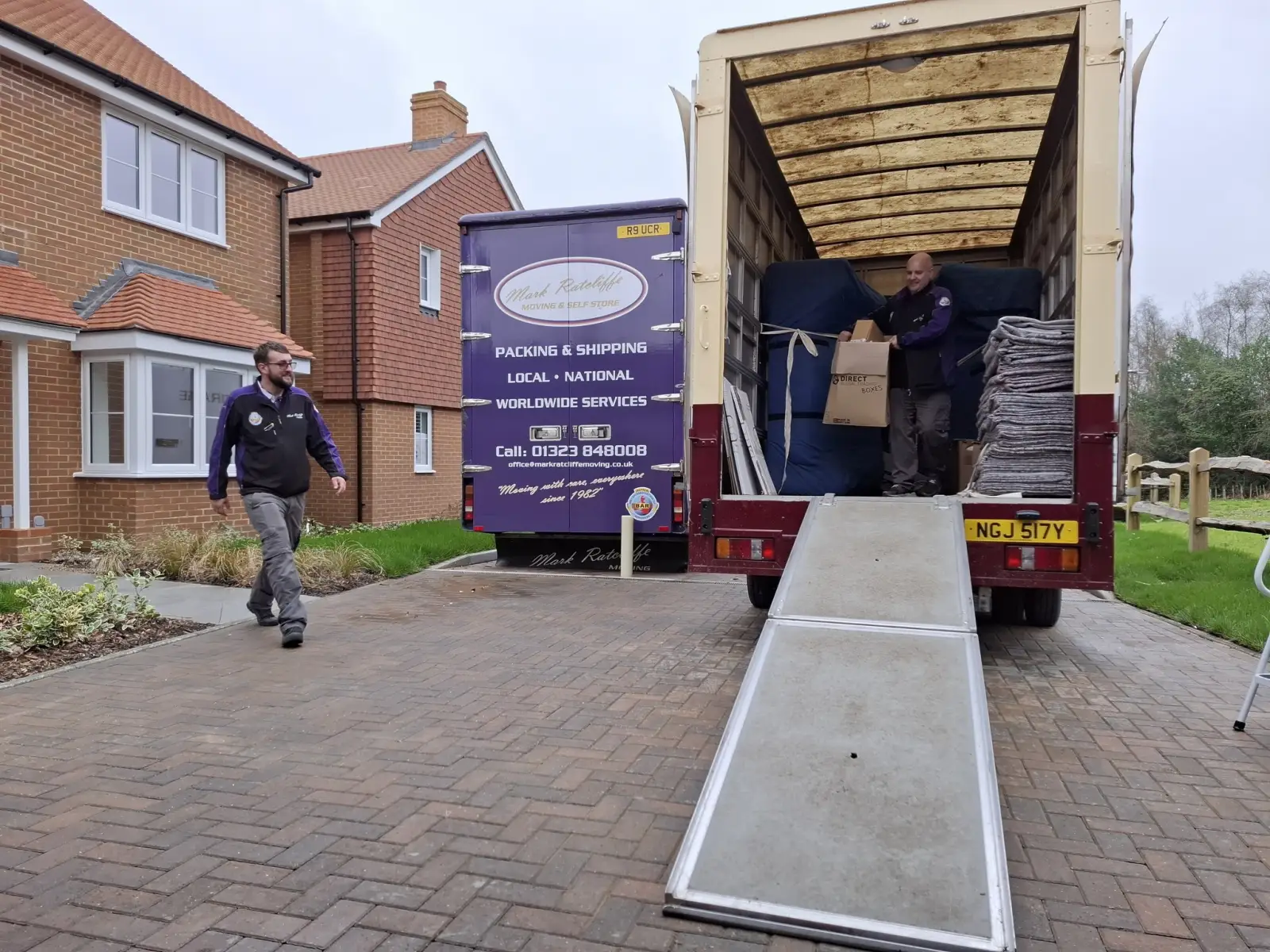
Making the big move from London to Sussex? Here's what to expect, how much it costs, and tips for a smoother transition.
Tell us where the goods are, roughly what there is and when they have to leave, and we will survey the address, solve the access and quote a room against the volume. Storage at our Croydon crate store on the Mill Lane Trading Estate, Mill Lane, Croydon, CR0 4AA starts at £22 a week including VAT for a 30 square foot room, with £5,000 of cover included and the published offer: pay 26 weeks upfront and save 10% on storage. Call 01323 848 008 or 07437 414 589, email office@markratcliffemoving.co.uk, or send the details through our online quote form. Mark Ratcliffe Moving is a family-run firm established in 2017, a member of the British Association of Removers Overseas Group, storing for Central and South London at Croydon and for Sussex and Kent at Lower Dicker.