
Long-term storage in Sussex for six months and well beyond. Sealed once, inventoried once, reviewed while it sits, and covered for the whole term — with an honest account of what does and does not survive a long stay in store.

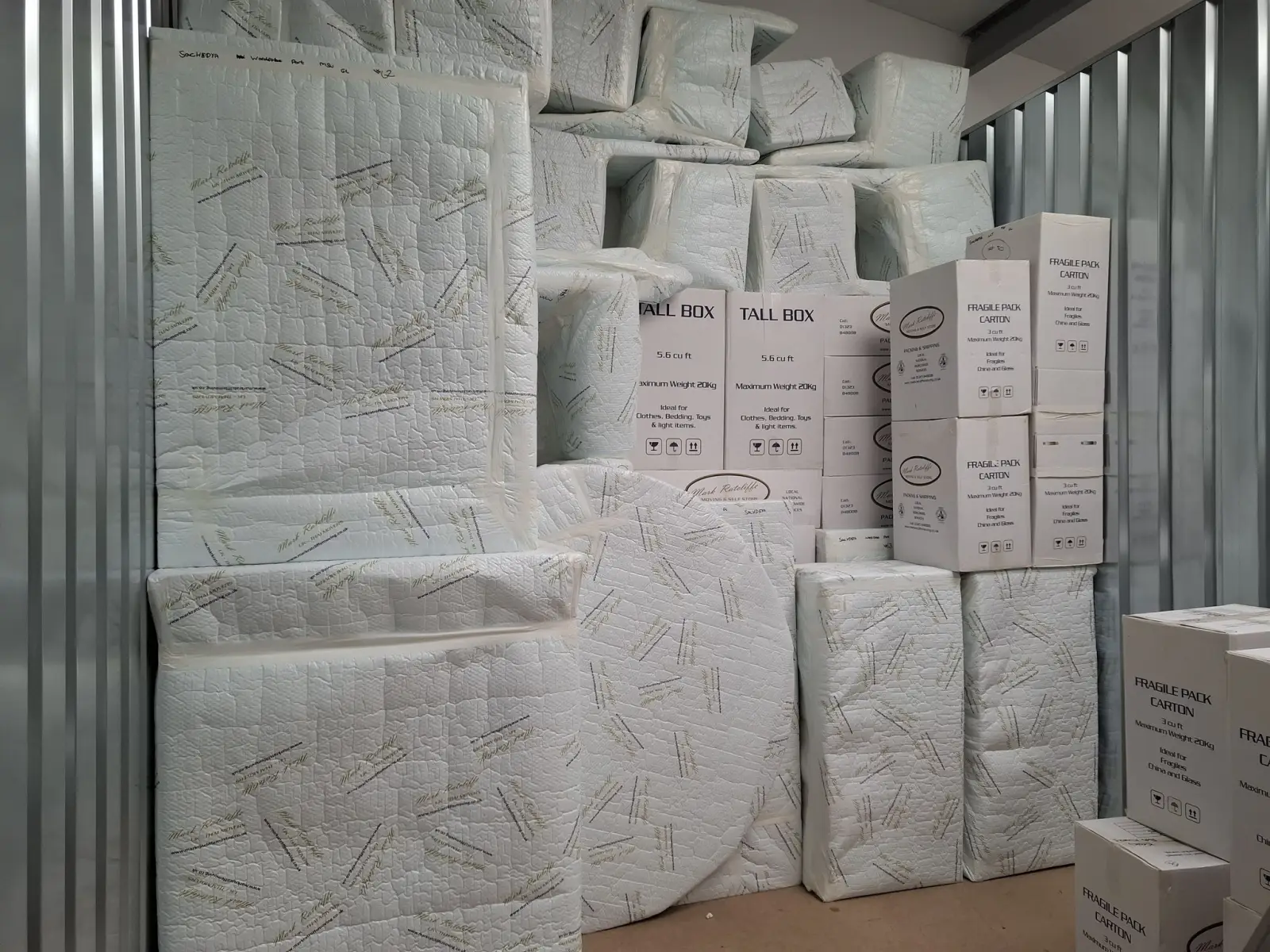
Long-term storage in Sussex is what we call a booking that is still with us at month six and shows no sign of ending. It is a different job from holding a household for a fortnight. The goods stop being cargo in transit and become an account we administer, and the questions change from “when can you collect” to “what is happening to my things while I am not there”. This page is written for people already past that line, or who know from the start that they will be.
The reason to use a remover rather than renting floor space is the same at two years as it is at two weeks, and it is structural. The crew who pad-wrap your sideboard in your hallway are the crew who load it, the crew who seal the room at our Lower Dicker depot, and the crew who bring it back. One firm, one inventory, one reference number. Nobody hands your possessions to a second contractor at any point, because there is no second contractor.
What a long stay adds on top of that is administration. Over eighteen months a storage account accumulates events: a renewal, a change of address, a request for one box, a declared value that no longer matches reality, sometimes a death or a separation that changes who is allowed to give instructions. Most Sussex firms sell you the room and go quiet. The list below is what we actually do for the duration.
If you are weighing up a gap of a few weeks rather than a few years, the costing for that sits in our guide to what a storage gap costs per week and per month, and the whole combined service is set out on our page for removals and storage handled by one Sussex firm.
Long stays are rarely a choice made in the abstract. They are almost always the by-product of something else that has no fixed end date, which is precisely why the booking cannot be written as a fixed term. In our experience six situations account for nearly all of them, and each one changes how we set the booking up.
The pattern that matters is not the reason itself, it is who will be giving instructions in eighteen months and whether they will be in the country. A forces posting and a probate estate look nothing alike emotionally, but operationally they raise the same question: if you cannot come to the depot, who can, and how do we know they are allowed to?
| Situation | Typical stay | What we set up differently | What we need from you at the start |
|---|---|---|---|
| Overseas posting, forces assignment or expat contract | The length of the tour, often two to three years | Written instructions accepted by email; redelivery date left open; export-grade wrapping where a shipment may follow | An overseas contact address and a UK nominee who can authorise a release |
| Probate and executor storage | From clearance until the grant and the estate settles | Inventory itemised more finely than usual so beneficiaries can identify pieces; nothing released without documented authority | The executor named in writing, and a note of who may and may not collect |
| Separation or divorce | Until the financial settlement lands | Single named account holder; no release to a second party without joint written instruction | Clarity on whose name the account is in, agreed before collection day |
| Major renovation, structural work or a listed building consent | Nine to eighteen months, and usually longer than the builder said | Part-retrieval planned into the room layout, because you will want things back in stages | A rough idea of which rooms come back first so we load accordingly |
| Buying abroad, or a sale completing well before a purchase | Open-ended, sometimes a year of house-hunting | Rolling arrangement rather than a term; the room stays sealed and undisturbed | Nothing beyond the survey — this is the simplest long stay to run |
| Downsizing where the family has not yet decided | Six to twelve months while children take what they want | Goods grouped by intended recipient at load-in rather than by room | The groupings decided before we wrap, not after |
A renovation stay is the one people misjudge most often. Builders quote in months and deliver in seasons, and a household that was supposed to come back in the spring is still with us in the autumn. If your move is part of a renovation, our notes on moving into and out of a listed building in Sussex cover the consent timelines that tend to cause the overrun. If the stay is a prelude to a shipment, read storing goods before an overseas shipment instead, because the sailing date rather than the calendar should drive the plan.
A sealed room is not abandoned. There is a schedule of things that happen at the depot and a shorter schedule of things we need from you, and both are worth knowing before you commit goods for a year. The table below is the sequence we work to. Nothing in it is a marketing promise; it is the internal rhythm of a long-stay account.
| Point in the stay | What happens at Lower Dicker | What we ask of you |
|---|---|---|
| Load-in day | Written inventory compiled, room layout photographed, door sealed against your reference, room logged to its rack position | Confirm the inventory is right before you leave. Corrections are easy now and awkward later |
| First fortnight | Room checked once on the daily warehouse inspection round. Any settling of a stack is corrected while the load is fresh | Tell us if you realise something you needed went in. It is far cheaper to retrieve in week two than in month ten |
| Month three | Routine perimeter, alarm and pest-control cycle continues as normal. Lithium tool and appliance batteries, if any were left in, are flagged for removal | Confirm your correspondence address, particularly if you have moved abroad since collection |
| Month six | The account is reclassified as long-stay. We offer a condition review and tell you honestly whether we think it is warranted | Decide whether you want a review, and update your declared value if anything has changed |
| Month twelve | Annual account review: declared value, cover, contact details, nominated persons and the storage rate are all looked at together and put in writing | Reply to the review. An unanswered review is the commonest cause of an out-of-date declared value |
| Months eighteen to twenty-four | Second condition review offered. Upholstery and anything raised on battens is the priority for a physical look | Consider whether everything still in there is still wanted. This is the natural decluttering point |
| Every subsequent year | The twelve-month review repeats on its anniversary. Rack position may change within the building; your room and reference do not | Keep one person nominated who can act if you cannot |
| Notice given | Room pulled to the loading bay, inventory reconciled against the original document, redelivery crew briefed on access at the destination | Give us the destination address and any access constraints as early as you can |
The one row people skip is the month-twelve review. It arrives as an ordinary email, it does not demand anything urgent, and it gets filed. Two years later the declared value is the figure you gave when your circumstances were different. We chase it, but we cannot set it for you.
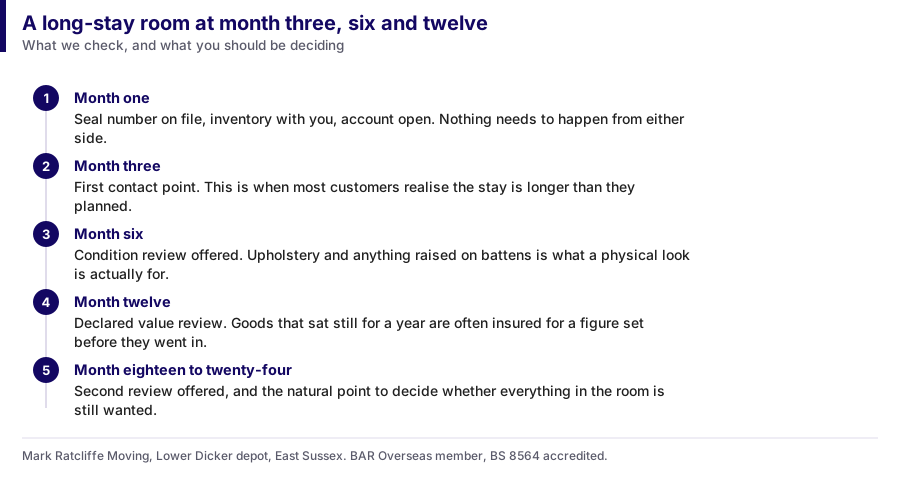
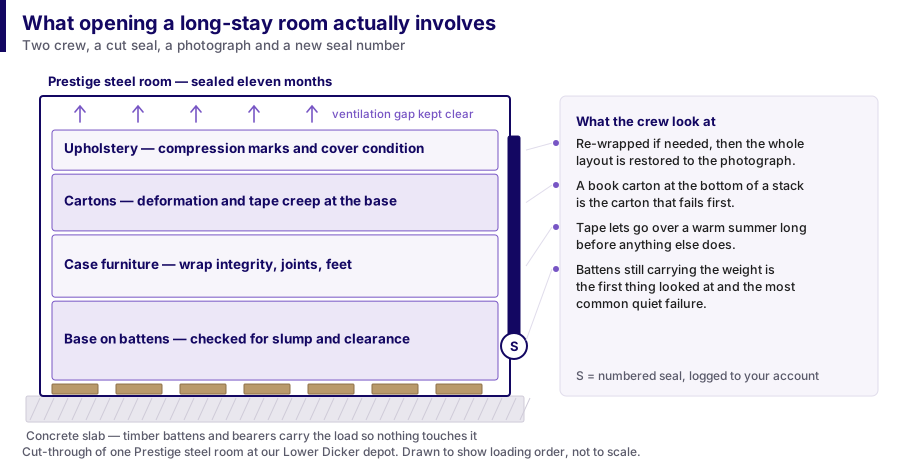
Here is the tension at the heart of long-term storage, and no competitor page we have read will say it out loud. The whole benefit of a sealed steel room is that your goods are handled twice on the way in and then left alone. Every time we break the seal to look at them, we give up a little of that benefit. Opening the room is not free of risk, it is not free of handling, and it is not automatically the right thing to do.
So we do not open rooms on a timetable for the sake of it. We offer a condition review at the six-month mark and again around the two-year mark, and we give you a straight recommendation either way. For a room of boxed books, kitchenware and flat-packed furniture, our advice is usually to leave it shut. For a room holding upholstery, leather, a piano, veneered antiques or anything that was stored in a hurry, a look is worth having.
When a review does happen, it runs the same way every time. Two crew attend, never one. The seal is cut and the number recorded against your reference. The room is photographed before anything moves, so the layout can be restored exactly. We look at the front of the load, lift and check the pieces the review was actually called for, check that battens are still carrying the weight and that nothing has slumped onto anything else, then re-wrap what needs re-wrapping, restore the layout, re-seal under a new number and write it up.
You get photographs and a short written note. If we found something, it says so plainly, including when the cause was how the piece went in rather than how it was stored. We have opened rooms and found a drawer front that was taped in a rush and has left a mark on a veneer, and we would rather tell you that than not.
What a review is not: a valuation, a conservation treatment, or a guarantee about the remaining years. If you want to know what you can do at your end before goods ever go in, our guide on how to prepare furniture for long-term storage yourself is the practical counterpart to this. The handling involved in a review is a chargeable event like any other, and it is quoted to you before it happens rather than appearing on a later invoice.
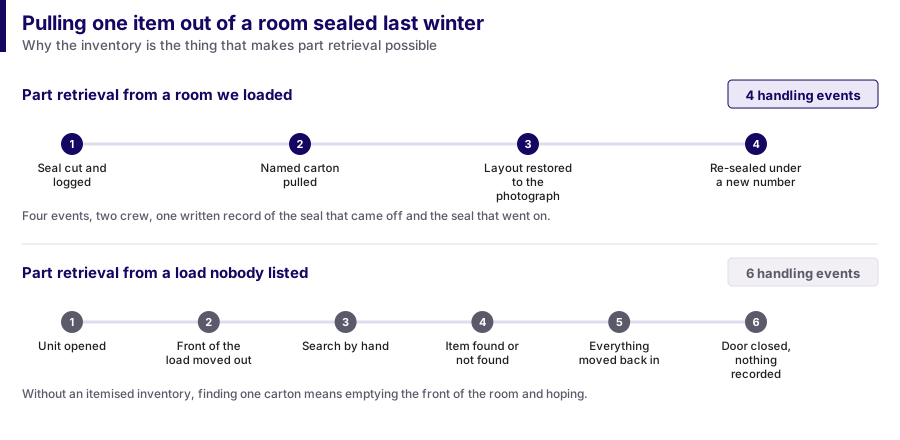
Part-retrieval is the single most requested thing on a long stay and the thing most providers handle worst. Somebody needs the folder with the boiler warranty in it, or a child’s cot that a sibling now needs, or a suit for a funeral. The room was packed eleven months ago by people who had no idea any of that was coming.
Whether we can get it out quickly is decided on packing day, not on the day you ring. Two things make the difference. The first is the inventory number written on two faces of every carton, so it is readable from the aisle without turning the box. The second is where the item sits in the room. A room loaded to make the best use of its cubic capacity is dense by design, and the sofa that went in first is behind everything.
So we plan for it when we know a stay will be long. If you tell us at survey that a renovation will come back in stages, or that the baby things may be wanted before the rest, we load those to the front and note it on the layout photograph. That costs nothing at the time and saves an afternoon of shuffling later. It is the single most useful thing a long-stay customer can tell us before we start wrapping.
The honest limitations are these. A retrieval needs notice, because your room has to be brought to the bay and a crew has to be free to do it, and the depot is running removals at the same time. Handling a room in and out is a real cost event on any account, ours included, and a room that gets opened monthly stops being a storage room and starts being an expensive stockroom. And if the item is at the very back of a full room, we are moving most of your household to reach it, which we will tell you before you commit to the visit rather than after.
The packing standards that make retrieval possible are a different job from packing for a van journey, and they are set out on our page for packing built for a sealed room rather than a van journey. If the goods coming out are furniture rather than cartons, furniture storage near Eastbourne covers how pieces are wrapped and racked so they can be moved without being unwrapped.
A long stay is an account, and accounts need administering. What we charge and how it is calculated belongs on one page and one page only: how a Sussex storage quote is put together explains the structure, which is volume multiplied by duration plus handling events, and why storage is sold by the cubic foot rather than by the square foot of floor. Everything below is about the mechanics of the account rather than the figures on it.
Structure first. A long stay is a rolling arrangement, not a fixed contract you are locked into. You are not signing away two years and you are not penalised for leaving sooner than expected, because the room is re-let the moment it is empty. What a longer commitment does change is the basis on which the room is quoted, and that is a conversation to have at survey rather than a discount to haggle over later.
Second, the annual review. Storage rates on a multi-year stay do not stand still, and any provider who implies otherwise is hoping you will not notice when they move. Ours are looked at on an annual cycle, any change is put to you in writing before it applies rather than appearing on an invoice, and it is never applied retrospectively. The review is also the moment we check your declared value, your address and your nominated contacts, because those drift far more than the rate does.
Third, the questions to put to anyone else you are considering, including any national operator with a published table. Ask how often the rate is reviewed and what notice you get. Ask what a part-retrieval costs and how much notice it needs. Ask whether redelivery is quoted now or later, and on what basis. Ask what the notice period is to take goods out permanently. Ask whether the price you have been shown includes cover and what the default limit is. A firm that answers all six in writing is a firm you can leave goods with for three years.
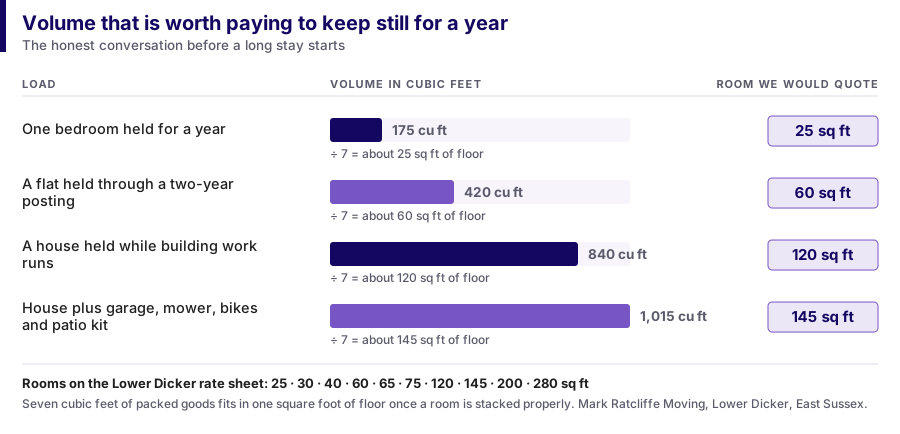
To size the room before any of that, our volume calculator works out your load in cubic feet. The conversion we use internally is seven cubic feet of packed goods for every square foot of room floor, so a household surveyed at 280 cubic feet needs about 40 square feet of floor, and the room it goes into is the 50 sq ft one, the smallest on our list that genuinely takes that volume. Rooms at Lower Dicker run from 30 sq ft up to 250 sq ft and above, and it is the cubic footage that decides which of them you need, far more than the number of bedrooms you are coming from.
Because the rate is the thing an annual review moves, it is worth seeing the whole ladder rather than one figure in isolation. These are our current Sussex storage rates, and they are the numbers your review letter will be written against:
| Room | Typically holds | Per week | Per week nett | Per 4 weeks | Collection or delivery, each way |
|---|---|---|---|---|---|
| 30 sq ft | One room, boxes | £18 | £15.00 | £72 | £240 |
| 50 sq ft | Studio or 1-bed flat | £27 | £22.50 | £108 | £390 |
| 75 sq ft | 2-bed flat | £36 | £30.00 | £144 | £550 |
| 100 sq ft | 2-bed house | £45 | £37.50 | £180 | £720 |
| 150 sq ft | 3-bed house | £63 | £52.50 | £252 | £990 |
| 200 sq ft | 4-bed house | £80 | £66.67 | £320 | £1,290 |
| 250 sq ft | 5-bed house or business stock | from £95 | from £79.17 | from £380 | Quoted on survey |
All prices include VAT (the nett column is what a VAT-registered business reclaims against). £5,000 of cover is included in every price. First 4 weeks half price when we collect for you.
The weekly column is the one that compounds over a long stay, so read it from the bottom up. A three-bedroom household sits in the 150 sq ft room at £63 a week including VAT, £252 per 4 weeks, with collection or delivery at £990 each way. The 250 sq ft rooms and above start at £95 a week and the collection is quoted on survey, because at that size it is a whole-house job rather than a van load. £5,000 of cover sits inside every one of those figures rather than being sold back to you later, and none of them is a teaser rate: the annual review can move the figure, in writing and never retrospectively, but the table is what you would be booking today.
Cover on a long stay works on a declared value: the total you tell us your goods are worth, which sets the basis on which they are covered while they are in our care. On a three-week gap between completions that figure is fresh and accurate. On a four-year stay it quietly stops being either.
Drift goes in both directions and both are a problem. Under-declaring is the common one. People give a cautious figure at a stressful moment, forget the contents of the loft went in too, and are then surprised at what a full-household claim would actually involve. Over-declaring happens with electronics and white goods, where a declared value set in 2023 for a television is generous by 2027 and you have been paying on it the whole time.
There is a third case that only appears on long stays. Antiques, certain mid-century furniture and some instruments move in value while they sit, and a piece declared at one figure at intake can be worth considerably more when it comes out. If you are storing pieces like that, tell us at survey rather than at redelivery, and treat the annual review as a genuine prompt to revisit the number. Our approach to handling that sort of thing is set out on our pages for antique and fine-furniture moving and piano moving across Sussex.
Two practical points people ask about. Goods in store are covered on a different basis from goods in transit, so the cover that applies on collection day is not automatically the cover that applies in month fourteen, and both need to be right. And if you are living overseas while your goods are here, check who is able to make a claim and what evidence would be wanted, because doing that from another continent under time pressure is nobody’s idea of a good week. The specifics for your booking are set out in your storage agreement, and the survey is where we go through them with you rather than leaving you to find them. Where the contents justify it, our white-glove service adds an item-level inventory with photographs and a signed condition report before anything is wrapped, which is the strongest evidence a multi-year stay can have behind it.
The cheapest retrieval is the one that never has to happen. Before we seal a room for a year, we walk the load with the customer and pull out the things experience says will be wanted, or that a long stay will simply ruin. Some of this is regulation, some is chemistry, and a fair amount of it is just having seen the phone call arrive eleven months later.
| What we pull out | Why a long stay is a problem | Do this instead |
|---|---|---|
| Passports, deeds, birth and marriage certificates, share certificates | Always wanted at the worst moment, and never in the box you expected | One folder that travels with you, never in the load, whatever the room looks like on the day |
| Prescription medication and anything with an expiry date | Expires unseen, and retrieval takes longer than a repeat prescription | Carry it. We will not knowingly seal medication into a room |
| Lithium-ion batteries in tools, e-bikes, scooters and laptops | Degrade badly on a long stay and are a fire consideration in a sealed building | Remove the battery, store the tool. Batteries do not come into the warehouse |
| Anything perishable, liquid, aerosol, fuelled or living | Absolute exclusion. Food attracts pests, liquids leak into other people’s loads, plants die | Use it, rehome it or dispose of it before collection day |
| Mattresses you were already unsure about | Three years in store rarely improves one, and it occupies real cubic feet the whole time | Be honest at survey. Store the bed frame, not the doubt |
| Large televisions and desktop computers | Technology moves faster than your storage term does | Store if genuinely wanted, but weigh it against what it occupies for three years |
| Children’s car seats and safety equipment | Manufacturer service life often expires during the stay | Check the date stamp before it goes in rather than after it comes out |
| Seasonal kit, sports equipment and the ski bag | The classic month-nine retrieval request, every single winter | Load it to the front and tell us at survey, or keep it with you |
| Warranty and service records for stored appliances | Needed to claim on a machine that is sitting sealed in the room | Photograph them and keep the paper with your documents folder |
| Anything nobody in the family has asked about in a year | A long stay quietly converts indecision into a standing commitment | Decide now. House clearance across Eastbourne and Sussex can take it on the same day we collect |
The last row is the one that saves people the most, and it is the conversation nobody has before a stressful move. If downsizing is what put you here, our notes on how to downsize before a move are worth twenty minutes before the survey rather than after it.
Long stays end in one of three ways: you come back and take everything, someone else takes it on your behalf, or the account stops being paid. All three are worth understanding at the start, and the third is the one every competitor page in Sussex avoids mentioning at all.
The ordinary ending is straightforward. You give notice, we agree a redelivery date, the room is brought to the bay and the inventory is reconciled line by line against the document written at load-in. A crew redelivers, unwraps in final position and takes the blankets away. Give us as much notice as you can, particularly for a summer date or a month-end, because those diaries fill first and a room that has waited two years should not then wait three weeks for a van.
Release to someone else needs authority we can rely on. That means a named nominee recorded on the account, or an executor evidenced by the grant, or a power of attorney. We will not release a household on the strength of a phone call from somebody who sounds convincing and knows your address, and on separation accounts we will not release to one party where the account was set up jointly. This frustrates people occasionally. It has also stopped goods going to the wrong person, which is the point.
Then the uncomfortable one. Storage is provided under trading conditions that give the company a lien over the goods while charges are outstanding, which in plain terms means we can decline to release them until the account is settled, and after a long enough period of non-payment and formal written notice goods can be sold to recover what is owed. That is standard across the industry and it is not something anyone enjoys. What we do differently is chase early and in plain language, because an account two months behind is a conversation and an account two years behind is a problem with no good ending. The specific notice periods and the process are set out in our terms, conditions and insurance details rather than buried.
If the ending you have in mind is a shipment rather than a redelivery, plan it around the sailing. Our international removals team and the page on European removals from Sussex both work backwards from a departure date, which is the opposite of how a storage notice period works.
Leaving a household with a firm for three years is a trust decision, and badges alone are not evidence. What matters is what the badge obliges us to do. As a member of the British Association of Removers Overseas Group we work to the association’s trading conditions, we are audited against them, and there is an independent dispute route that does not depend on our goodwill. Money paid in advance is covered by the association’s Advance Payment Guarantee if a member firm ceases trading before the work is done, within the cap and claim window the scheme sets. None of that is true of an unaffiliated operator with a yard and a padlock.
The quality standard behind the operation is BS 8564, published by BSI as BS 8564:2011, which governs how an overseas move is surveyed, documented and handled. On a long stay its practical effect is documentary: the inventory discipline, the written survey and the record-keeping that let us reconcile a room in year three against a document written in year one. We also hold 4.9 out of 5 across more than 120 reviews, and a fair number of those are from people whose goods were with us for well over a year.
The firm itself is family-run and has been moving Sussex households since 2017. Senior crew are enhanced-DBS-checked and there is a confidentiality clause in every contract, which matters more on a long stay than it does on a single day’s move. Over three years a household of yours gets inventoried, sealed, inspected, occasionally reopened and finally reconciled, and every one of those is somebody alone in a room with your furniture and the drawer of paperwork that came with it. You can read more about the family behind Mark Ratcliffe Moving and see what our Sussex customers say.
There are two depots, Lower Dicker in East Sussex on the A22 just north of Hailsham, and Coulsdon in Surrey. Storage is at Lower Dicker only, in the Prestige steel storage rooms at our Lower Dicker depot, and you are welcome to come and see the building before you commit a household to it for a year. Most long-stay customers do, and we would rather you did. Collection across Hailsham, Eastbourne and the wider county runs from there, and if you would rather not drive anything yourself, our collection and storage service brings the van to your door.
No. There is no upper limit and we have households that have been with us for years rather than months. The account is reviewed annually rather than expiring, so nothing forces a decision on you at a particular date.
No. A long stay is a rolling arrangement rather than a fixed contract, so you are not locked in and you are not penalised for ending sooner than you expected. A longer expected stay does change the basis on which the room is quoted, which is a conversation to have at the survey.
Yes. We offer a condition review at around six months and again near the two-year mark, and you get photographs and a short written note. We will also tell you honestly when we think the room is better left sealed, because every opening is another handling event.
Only with authority we can rely on: a nominee named on the account, an executor evidenced by the grant of probate, or a power of attorney. We will not release a household on the strength of a phone call, and on accounts set up jointly we need instructions from both parties.
We chase early and in plain language, because an account a couple of months behind is a solvable conversation. Storage is provided under trading conditions that give the company a lien over goods while charges are outstanding, and after prolonged non-payment and formal written notice goods can be sold to recover the debt. The full process is in our terms rather than hidden.
Yes, but it is a handling event rather than a free top-up, because the room has to be brought out and re-opened. If you know more is coming, tell us at the survey and we will size the room for the eventual load instead of the first one.
We re-wrap during a condition review where the wrapping has slipped or a blanket has compressed against a corner. We do not re-wrap the whole room as a matter of routine, because unwrapping and rewrapping a full household introduces more handling than it prevents.
Your goods stay in the same sealed steel room throughout, but that room’s rack position inside the building can change as the warehouse is reorganised. The room and your reference number never change, so the inventory and the location log always agree.
Yes, and it is one of the commonest long stays we run. We take written instructions by email so you are not tied to our phone hours, we keep the redelivery date open-ended, and if the goods are eventually going overseas rather than back into a UK home we can wrap to export standard at intake instead of packing the same load twice.
From the blog

Storage between house moves costed by week and month, container storage vs self storage, and the point where storing costs more than replacing.
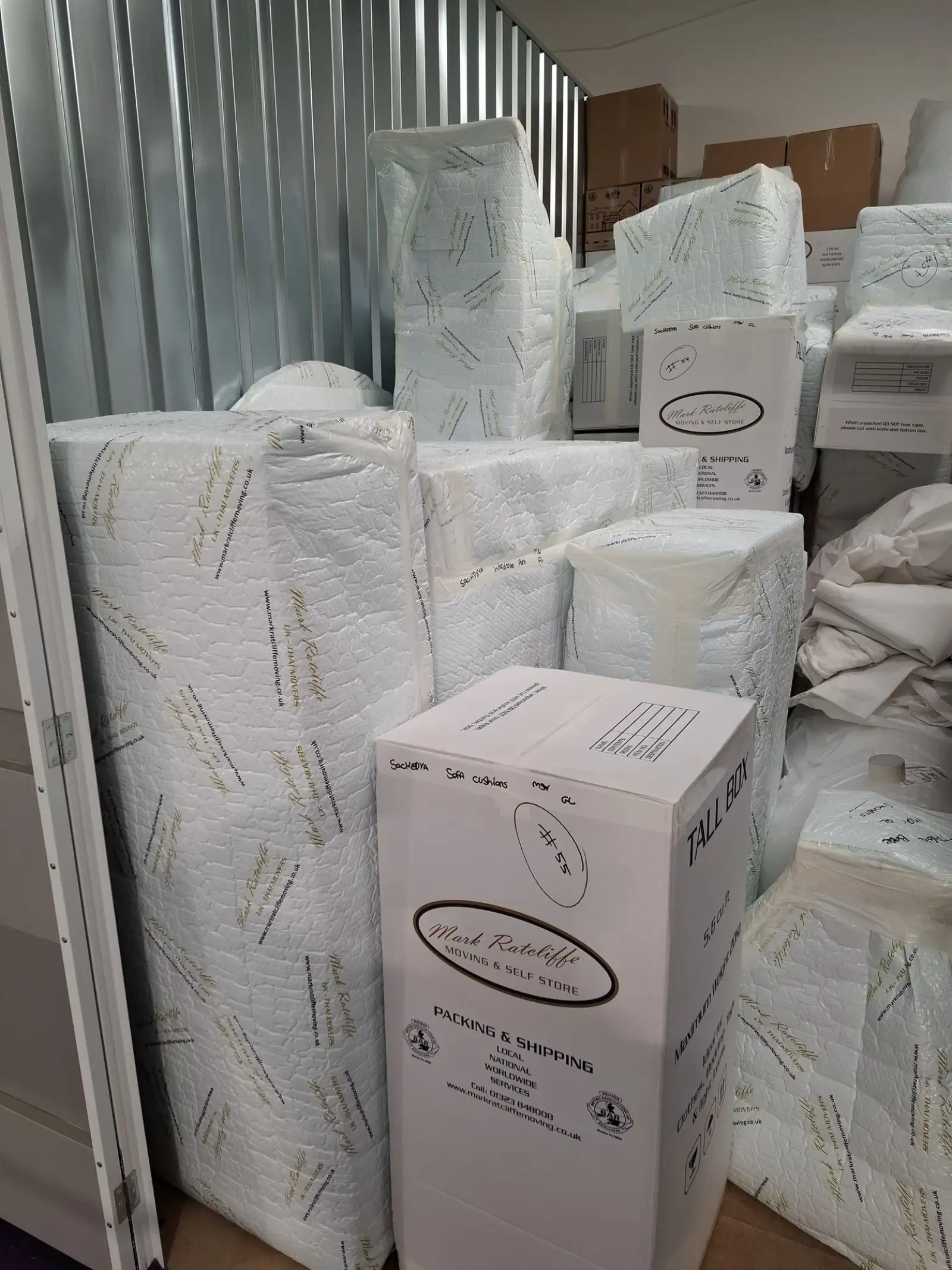
Planning to put furniture into storage? Learn how to properly prepare your items to prevent damage while in storage.

Important safety information – a complete list of items you are allowed and not allowed to store in self storage units.
A long stay is worth getting right at the start, because the decisions made on packing day govern the next three years. A survey takes thirty to forty-five minutes at your home or over video, and it produces a written quote, a room size based on your actual volume rather than your bedroom count, and a plan for anything you are likely to want back before the end. Call 01323 848 008 or 07437 414 589, email office@markratcliffemoving.co.uk, or send us the details through our online removals and storage quote form. You are also welcome to come and look round the Lower Dicker depot before you commit a household to it.