
What storage actually costs in Sussex, and why the headline figure is rarely the whole bill. How volume, duration, handling and access each move the price — and how to work out the room size you genuinely need before you ring anyone.


Storage costs in Sussex are built from three numbers rather than one, and the rate you get quoted on the phone is only the first of them. Volume sets the size of room you occupy. Duration sets how long you pay for it. Handling sets how many times somebody physically carries your sofa, and that third number is the one that separates a managed room from an empty space with a roller shutter.
The short version, before the detail. Take your cubic footage, divide it by seven for the floor area you need, and match that to a room size. Multiply by the weeks. Add one handling charge in, one handling charge out, and cover against a value you declare. That is the whole structure of an honest storage bill in this county, and anything else on the invoice is either a materials line or something you should have been told about in advance.
The quickest way to get the first of those three numbers is our storage volume calculator, which turns a room-by-room inventory into cubic feet and a room size. Work that out before you ring anyone and every conversation afterwards is shorter and more honest.
What follows is the method, not a price list. Work through it and you can take any storage quote in Sussex, ours or anyone else’s, and see precisely what it charges for and what it has quietly left off. That matters more here than in most parts of the country, because the two ways of buying storage locally are priced on completely different bases and look deceptively similar on a comparison sheet.
The structural point first. A storage operator sells you an empty space and leaves the movement of your possessions to you. We sell a managed service in which the same crew packs, collects, stores and redelivers on one inventory, so the goods are loaded once at your door and not touched again until they come out. That is the whole of our removals and storage service handled by one firm, and it changes the arithmetic rather than just the wording.
Every honest storage bill in this county is assembled from the same six components:
None of those disappear because a quote fails to mention them. They simply turn up later, usually on the day you want your things back.
Storage is sold to you in square feet and consumed by you in cubic feet. That gap is where most of the confusion about storage costs lives, and it is worth closing before you ring anybody.
A room is not a box you can fill to the ceiling. Stacks have to stand up on their own without leaning. Nothing heavy goes on anything crushable. There has to be enough room left to close and seal the door, and enough structure in the stack that the load does not settle over six months. Our working figure across every room size we run is seven cubic feet of packed goods per square foot of floor.
Turn that round and it becomes genuinely useful. If your inventory comes to 280 cubic feet you need roughly 40 square feet of floor, which puts you in the 50 sq ft room. If it comes to 1,000 cubic feet you need about 143, which is the 150 — not the 100. The conversion is the same whichever provider you use, so it is also the fastest way to check whether a room you have been offered is actually big enough.
These are the room sizes on our rate sheet at Lower Dicker, the volume each one genuinely takes at seven cubic feet per square foot, and the household each is normally quoted against:
| Room size | Working capacity | Approx. cubic metres | What that holds in practice |
|---|---|---|---|
| 30 sq ft | 210 cu ft | 5.9 cu m | One room, boxes |
| 50 sq ft | 350 cu ft | 9.9 cu m | Studio or 1-bed flat |
| 75 sq ft | 525 cu ft | 14.9 cu m | 2-bed flat |
| 100 sq ft | 700 cu ft | 19.8 cu m | 2-bed house |
| 150 sq ft | 1,050 cu ft | 29.7 cu m | 3-bed house |
| 200 sq ft | 1,400 cu ft | 39.6 cu m | 4-bed house |
| 250 sq ft or more | 1,750 cu ft | 49.6 cu m | 5-bed house or business stock |
Weekly, inclusive of VAT, with the nett figure beside it for businesses that reclaim. Collection and delivery are priced separately and each way, because plenty of people bring their own load in and only pay us to bring it back out.
| Room | Typically holds | Per week | Per week nett | Per 4 weeks | Collection or delivery, each way |
|---|---|---|---|---|---|
| 30 sq ft | One room, boxes | £18 | £15.00 | £72 | £240 |
| 50 sq ft | Studio or 1-bed flat | £27 | £22.50 | £108 | £390 |
| 75 sq ft | 2-bed flat | £36 | £30.00 | £144 | £550 |
| 100 sq ft | 2-bed house | £45 | £37.50 | £180 | £720 |
| 150 sq ft | 3-bed house | £63 | £52.50 | £252 | £990 |
| 200 sq ft | 4-bed house | £80 | £66.67 | £320 | £1,290 |
| 250 sq ft | 5-bed house or business stock | from £95 | from £79.17 | from £380 | Quoted on survey |
All prices include VAT (the nett column is what a VAT-registered business reclaims against). £5,000 of cover is included in every price. First 4 weeks half price when we collect for you.
The room costs what the room costs — it is the same building. What changes across the county line is the driving, so the weekly rate is identical to Sussex and only collection and delivery move.
| Room | Typically holds | Per week | Per 4 weeks | Collection or delivery, each way |
|---|---|---|---|---|
| 30 sq ft | One room, boxes | £18 | £72 | £290 |
| 50 sq ft | Studio or 1-bed flat | £27 | £108 | £470 |
| 75 sq ft | 2-bed flat | £36 | £144 | £660 |
| 100 sq ft | 2-bed house | £45 | £180 | £870 |
| 150 sq ft | 3-bed house | £63 | £252 | £1,190 |
| 200 sq ft | 4-bed house | £80 | £320 | £1,550 |
| 250 sq ft | 5-bed house or business stock | from £95 | from £380 | Quoted on survey |
All prices include VAT. £5,000 of cover is included in every price. Kent launch offer: first 8 weeks half price when we collect for you.
London runs on its own weekly rate because the collection is a different job: permits, loading restrictions, and a vehicle that is committed for far longer than a Sussex pick-up. The two smallest rooms can also go on a shared run, which is cheaper if your dates are flexible.
| Room | Typically holds | Per week | Per 4 weeks | Collection or delivery, each way |
|---|---|---|---|---|
| 30 sq ft | One room, boxes | £22 | £88 | £450 · shared run £225 |
| 50 sq ft | Studio or 1-bed flat | £33 | £132 | £560 · shared run £295 |
| 75 sq ft | 2-bed flat | £44 | £176 | £890 |
| 100 sq ft | 2-bed house | £55 | £220 | £1,050 |
| 150 sq ft | 3-bed house | £77 | £308 | £1,490 |
| 200 sq ft | 4-bed house | £98 | £392 | £1,990 |
| 250 sq ft | 5-bed house or business stock | from £115 | from £460 | Quoted on survey |
All prices include VAT. £5,000 of cover is included in every price. Pay 26 weeks upfront and save 10% on storage.
Two things about that table are worth saying out loud. The steps between rooms are not even, so a load measuring 540 cubic feet sits just over the 75 and is worth half an hour of dismantling to bring it back down into that room rather than paying for the 100. And most Sussex households we survey land on the 100 or the 150, which is the band to price first if you are ringing round for comparisons.
One thing about the list is worth flagging every time rather than letting anyone discover it on the day. The rooms come in fixed sizes — 30, 50, 75, 100, 150 and 200 square feet, with 250 square feet and above quoted on survey — so a load goes into the smallest of those that genuinely holds it, never into a size invented to match the sum. If your volume lands a few cubic feet the wrong side of a boundary, say so before collection day and we will look at what comes apart.
If you want the room walked through in person before any of this is theoretical, our Prestige steel storage rooms at Lower Dicker can be viewed during business hours. Most people come once, look at a sealed door, and never need to come back until collection day.
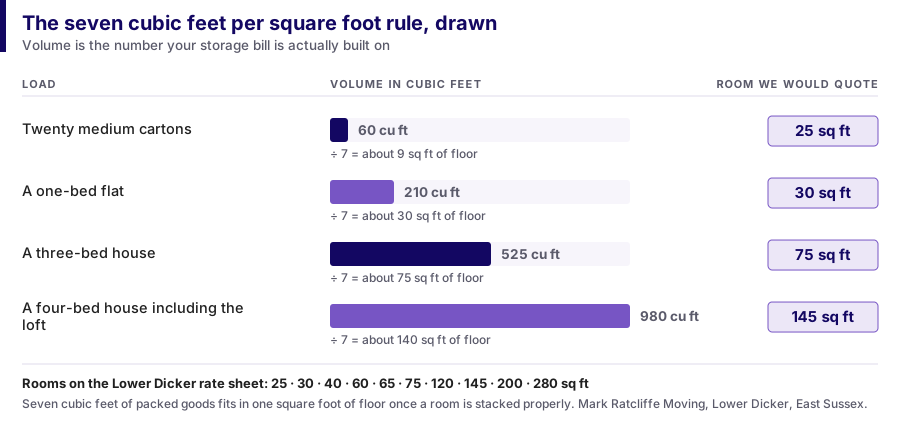
You can get close to your real volume in twenty minutes at the kitchen table, and doing so puts you in a far stronger position than ringing round for rates blind.
The method our surveyors use is deliberately crude, because crude is accurate enough. Ignore the small things entirely. Lamps, kettles, cushions and ornaments end up inside cartons, and cartons are counted separately. List only the items that are large enough to shape a stack, then count your boxes.
These are the pieces that actually set the number. The figures are the ones we work from on survey, and the same ones sitting behind the volume calculator linked at the top of this page:
| Item | Cubic feet | Why it matters to the total |
|---|---|---|
| Sofa, three-seater | 35 | The usual single largest soft item; a corner unit is half as much again |
| Sofa, corner unit | 50 | Rarely splits into sections as neatly as owners expect |
| Wardrobe, double | 35 | A triple is 50 and is the piece most likely to push a load into the next room size |
| Double bed, mattress and base | 42 | Counted as two items because they stack separately |
| Dining table, six-seater | 25 | Drops sharply once the legs come off; chairs are 5 each |
| Fridge-freezer, tall | 22 | Must be drained and dried before it goes in a sealed room |
| Chest of drawers, large | 20 | Travels with contents in place if the fronts are taped |
| Bookcase, large | 20 | Awkward rather than heavy; stacks poorly against soft goods |
| Washing machine | 8 | Small in volume, heavy in practice, always goes to the floor of the stack |
| Upright piano | 65 | Single biggest domestic item we store; see our piano moving service |
| Garden shed, flat-packed | 60 | The item most often forgotten at survey and most often regretted |
| Trampoline, medium | 50 | Pure volume for very little value – worth a hard think |
| Ride-on mower | 35 | Fuel drained, battery disconnected, no exceptions |
| Bicycle | 12 | Four bikes is the same volume as a small sofa |
| Standard medium carton | 3 | The unit everything else is counted in |
| Book carton | 1.5 | Small on purpose; books in a large box are unliftable |
| Wardrobe carton, tall | 6 | Hanging clothes; budget one per two feet of rail |
Add your large items, then add three cubic feet for every medium carton you expect to fill. Most households badly under-count cartons. A kitchen alone routinely runs to twenty-five, and the loft is almost always worse than anyone remembers. If you would rather buy boxes and count them as you fill them, our packing materials shop lists the carton sizes we use with the capacity of each.
Divide the total by seven and you have your square footage. That is the number to quote at every provider you ring, and it is the number that stops a sales conversation drifting into guesswork about bedrooms.
Five numbers turn an unanswerable question into a quotable one. Get them onto paper and any provider in Sussex can give you a firm figure in a single phone call, and you can hold three quotes side by side and see which one has left something out.
Here is the method on a real job. A three-bedroom house near Hailsham we cleared last winter came to 780 cubic feet once the loft and the garage were counted, about 120 more than the owner’s own estimate, and every bit of that overrun was in the loft. Divide 780 by seven and you get 111 square feet, so the 150 sq ft room rather than the 100. Nine weeks booked, extended to eleven when the chain moved. One collection, one redelivery to a village outside Lewes, one part-retrieval in week four for a folder of paperwork that should have travelled in the car.
Five numbers, one written figure, and nothing new appearing on exit day. It is also why we ask for the inventory before anything else. A quote built from a bedroom count is a guess with a decimal point on it.
Step three is the one people skimp on, and our week-by-week moving checklist is the fastest way to pin real dates down. For a straight comparison of what to look for in any provider before you commit, our guide to choosing a storage provider works through the questions in order.
Here is the part that makes a headline storage rate misleading, and it is the single most useful thing on this page.
Your goods have to get into the room and back out of it. Those are two separate pieces of physical work, they each cost money, and a storage rate quoted per week does not include either of them unless it says so. When you compare a low weekly figure from a storage operator against a higher one from a remover, you are frequently comparing a rate that excludes both movements against a rate that includes them.
The lifting has to happen either way. The only question is whether it sits in the quote or in your weekend, and our damage reports are blunt about which of those carries the risk: the overwhelming majority of the problems we are asked to look at on goods arriving from elsewhere happened during a movement, not during the months in between. If you want that work priced into the job rather than done by you, it is our collection and storage service that comes to your door.
A managed storage job carries eight charge lines in total, and every one of them is calculated from something you can check before you sign. These are ours, in the order they are incurred:
| Charge line | When it is incurred | What the figure is calculated from | What reduces or removes it |
|---|---|---|---|
| Handling in | Collection day, once | Crew hours and vehicle time at your address, set by volume and access | Clear parking, a ground-floor load, and being packed before we arrive |
| Wrapping and materials | Collection day, once | Storage-grade blankets, covers, corner protection and cartons actually used | Packing yourself to a storage specification, or reusing our crates |
| Storage | Per week, for as long as the room is reserved | Room size in square feet – your cubic footage divided by seven | Dismantling and a hard clear-out before the survey, not after |
| Part-retrieval | Each time something comes out mid-term | Labour to unseal, pick, restack and reseal the room | A clearly labelled access box packed at the door of the stack |
| Handling out | Exit day, once | De-stacking the room and loading back onto a vehicle | Nothing, realistically – it is real work and should be priced |
| Redelivery and mileage | Exit day, once | Distance from Lower Dicker to the delivery address, plus access at that end | A delivery address inside our core Sussex radius |
| Cover | Across the storage period | The replacement value you declare for the whole load | Declaring honestly – under-declaring saves little and costs a great deal |
| Rate review | Long stays only, on written notice | The review terms stated in the agreement before you sign | Asking for the review clause in writing at quote stage |
Each of those appears as its own line on our written quote, priced against your room size and your dates rather than folded into one headline figure. That is the point of publishing the basis rather than a slogan: take this table to any other provider in Sussex and ask them to fill in the same eight lines. The gaps in their version are the gaps in their price.
So when you audit a quote, resolve these four questions before you compare anything to anything:
Handling on a sealed room is a cost incurred once rather than repeatedly, which is the structural reason containerised storage in sealed steel rooms often wins on the total figure instead of a self-access unit at a self-storage site, while looking dearer on the weekly one. The handling arithmetic behind that claim is counted out on that page rather than repeated here.
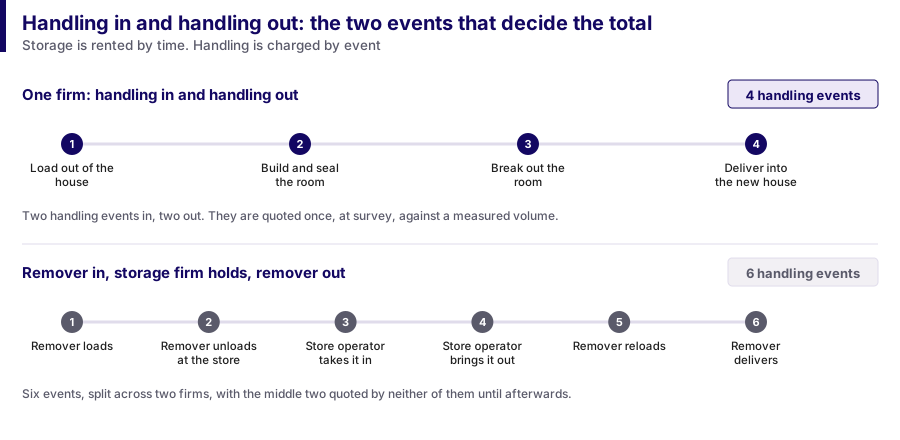
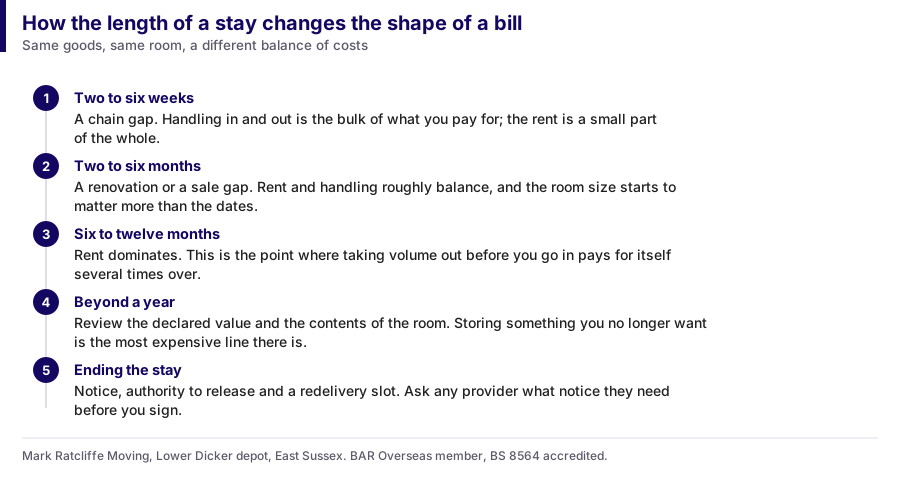
Duration does not just make a storage bill bigger. It changes which part of the bill matters.
On a short hold, the movements dominate. The wrapping, the collection and the redelivery are fixed pieces of work whether you store for nine days or ninety, so over a fortnight they are most of what you are paying for and the storage itself is close to a rounding error. Push the same load out to eighteen months and the relationship inverts completely: the movements become trivial against the accumulated storage, and the things that matter are the review clause, the declared value and whether anybody has looked at the goods since they went in.
That is why a firm that quotes you the same way for both is not being straight with you. Here is how the weighting actually moves:
| Length of stay | What dominates the bill | What barely registers | The question to ask |
|---|---|---|---|
| Under two weeks | Collection, wrapping and redelivery | The storage rate itself | Is there a minimum period that makes nine days cost the same as twenty-eight? |
| Two to eight weeks | Movements and storage roughly level | Cover, condition, review clauses | Am I billed for the days I use, or rounded up to whole months? |
| Two to six months | The storage rate | The movements | Does the rate step at a duration threshold, and when? |
| Six months to two years | Storage plus cover | Everything to do with collection day | Is there an annual price review, and how much notice of it do I get? |
| Beyond two years | Cumulative storage and the declared value | The original quote entirely | Who checks the goods, and is the declared value still right? |
The practical consequence is that you should ask for storage as its own line on the quote rather than rolled into a single figure, and you should ask on what unit it is billed. A load that sits for eleven days and is charged as a calendar month is a real cost and a common one.
For the actual money at each of those durations, our guide to what a storage gap costs per week and per month works two scenarios through end to end. If you already know you are past the six-month mark, long-term storage beyond six months covers how an account is managed over years rather than weeks.
Most of what goes wrong with a storage bill is not overcharging. It is a charge that was always going to apply, that nobody mentioned, arriving at the worst possible moment. The fix is to ask fourteen questions before you sign anything, and any provider worth using will answer all of them without hesitating.
Print this, take it to whoever you are comparing, and make them fill it in:
| Line item | What to ask | Why it moves the total |
|---|---|---|
| Basis of measurement | Am I buying cubic feet of goods or square feet of floor? | Floor area sold to you is always more than the volume you use |
| Minimum period | What is the shortest I can be charged for? | Turns a ten-day gap into a four-week bill |
| Billing unit | Daily, weekly or calendar monthly? | Decides what a chain slipping by nine days actually costs |
| Handling in | Is loading into the room included? | Frequently a separate charge at a self-access site, unlike a managed store |
| Handling out | Is unloading and loading back onto a vehicle included? | The charge people most often meet for the first time on exit day |
| Redelivery and mileage | Delivered to where, and what if the address changes? | Free collection rarely means free return |
| Part-retrieval | Can I take three boxes out without emptying the room? | A sealed room has to be opened, picked and resealed |
| Notice to access | How much warning do you need, and is a visit charged? | Managed storage trades unattended access for lower handling |
| Notice to vacate | How long before I take everything out permanently? | Determines whether you pay for a week you do not use |
| Cover basis | Against declared value, or a per-item cap? | Household policies usually lapse when goods leave the property |
| Excess | What do I pay on a claim, and per item or per claim? | A low premium with a high excess is not cheap cover |
| Rate review | Can the rate rise mid-term, and with what notice? | The figure you compared on day one may not be the figure in month fourteen |
| Materials | Are blankets, covers and cartons included or sold? | Storage-grade materials are not the same as transit materials |
| VAT | Is the figure shown with tax or without? | Trade quotes are often shown net and consumer ones gross |
Our own answers to that list sit in the written quote and in our terms and insurance details, before you commit rather than after. Cover is quoted separately against a value you declare, because rolling it into a headline rate is exactly how people end up under-covered without noticing. Anything the fourteen lines do not settle is usually answered in our removals and storage FAQs.
National storage averages are quoted constantly and they are close to useless in this county. Sussex sits inside the South East premium, and pretending otherwise just produces a quote nobody can honour.
Three things drive it. Industrial land between Brighton, Eastbourne and the Kent border is expensive and genuinely scarce, so warehouse floor costs more per square foot here than it does in the Midlands or the North. Labour costs follow the same curve. And the road network does the rest: the A27 and the A22 are the only two serious east-west and north-south routes through the area, which lengthens collection runs and puts real time into every job.
Geography shapes the handling cost too, in ways that only show up when a crew is standing outside your house. Central Brighton and Lewes have permit streets and no realistic parking for a large vehicle, so a shuttle run may be needed, which is why our Brighton removals page sets the parking and permit work out as its own job. Seafront flats in Eastbourne and Hastings have lifts that will not take a wardrobe. Rural addresses around the Downs have lanes a 7.5-tonne lorry cannot physically get down.
Access is the line that varies most between two addresses holding identical contents. We survey for it rather than assuming an average, and it is costed into the written quote from the start rather than turning up as an extra once the vehicle is on the street. That is why our figure for removals in Eastbourne and our figure for a Downland village twelve miles away are not the same for the same volume.
One local factor works in your favour. Our depot sits at Lower Dicker on the A22 just north of Hailsham, a short run from Eastbourne, Polegate and Uckfield and a straightforward one from Lewes, Brighton and Hastings. That postcode is why removals in Hailsham are the shortest collection runs we do. Short runs keep the handling element down, and the handling element is the part of a storage bill you have most control over. For a small load coming out of a flat, a man and van collection is often the cheaper way to get it into store.
Volume is the one variable you can still change after you have decided to store. Everything else is fixed by dates and geography. These five are the ones that reliably move the number, and they are drawn from what we watch happen on survey rather than from a list of general tips.
Dismantle whatever comes apart. A six-seater dining table with the legs off loses most of its footprint. A bed base stood on edge against a wall takes a fraction of the floor it takes flat. Flat-pack wardrobes, garden furniture and desks all collapse. We dismantle and reassemble as part of the job, and the volume saving usually exceeds what the labour is worth.
Do the loft and the garage first, not last. Every survey we do, the loft is worse than the owner said and the garage is worse than the loft. A flat-packed shed, a trampoline and four bikes come to more cubic feet than a three-piece suite. Decide on those before the survey, not on the morning of collection, or you will be paying for a bigger room than the house needed.
Use consistent cartons. Mixed supermarket boxes stack badly, settle unevenly and leave air gaps you are paying to store. Uniform double- and triple-wall cartons stack five high and square, which is worth a surprising amount of floor area across a whole load. They also survive six months in a sealed room, which cheap single-wall cartons do not.
Pack inside things rather than around them. Suitcases, blanket boxes, drawers and chest freezers are all containers you are already storing. Filled, they cost nothing extra; empty, they are pure wasted volume.
Have the survey after the clear-out, not before. A figure taken from a house you are still planning to thin out is a figure you will be quoted against. Our guide to downsizing before a move covers the sequencing, and our house clearance service handles what does not make the cut.
What we will not tell you to do is skimp on wrapping to save space. Blankets add very little volume and prevent most of the damage we see, and packing a load for a sealed room is a different specification from packing it for a two-hour van run. That difference is set out in full on our packing and storage service, and if you would rather hand the whole job over, a full packing service is quoted by room rather than by the hour.
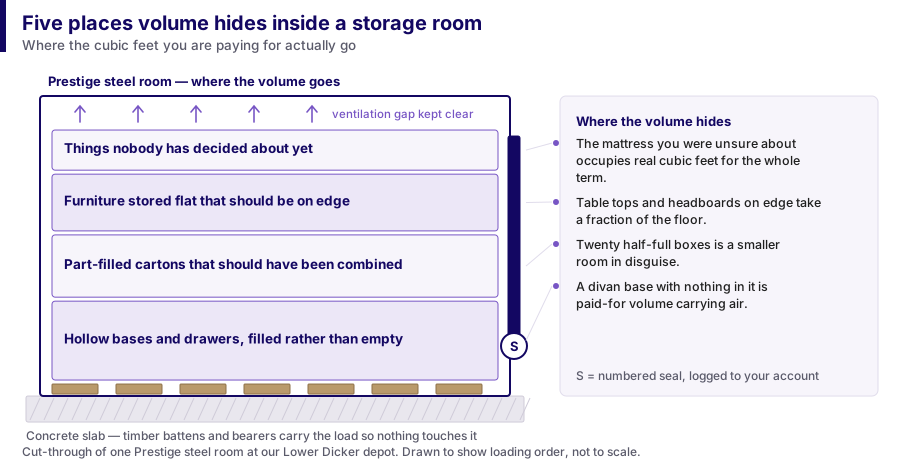
A survey takes thirty to forty-five minutes in the house, or about twenty on a video call. It exists to replace an estimate with a measurement, and it is free whether or not you go on to book.
The surveyor walks every room, including the loft hatch, the garage, the shed and the side return, and records each item against its volume. That produces a cubic footage. Divided by seven, that gives a floor area, which gives a room size. At the same time they record the things that decide the handling: parking, permit zones, stairs, lift dimensions, door widths, whether a shuttle vehicle is needed at either end, and anything that needs dismantling or specialist handling.
Then the honest part, which is the bit most providers leave out of their sales patter. The figure moves if the inventory moves. If the garage was locked on the day and gets added afterwards, the room size changes and so does the price. If a relative’s furniture joins the load a fortnight later, the same applies. We would far rather re-measure in advance than turn up with the wrong vehicle and a room that will not close.
Two other limits worth stating plainly. A room is reserved once it is booked, so a load that arrives smaller than surveyed does not shrink the room it was held in. And some things do not go into a sealed room at all, whatever you are willing to pay: fuel, gas cylinders, paint and chemicals, fireworks, ammunition, perishables, living things and cash. Batteries come out of anything staying more than a few months.
If you are storing because a chain has slipped rather than because you planned to, the survey usually has to happen at speed. Storage while moving house covers how we handle that compressed version, including what we can do inside a week. Commercial loads are surveyed on a different basis again, counted by pallet, rack and archive box rather than by room, and our office removals service sets out how that survey runs.
Mark Ratcliffe Moving has been a family-run Sussex remover since 2017, and we own and run our own storage rather than sub-letting space from somebody else and adding a margin to it. That is why a three-week hold and a three-year hold can be quoted off the same survey, and why the person who stacks your room is on our payroll rather than a subcontractor’s. How the firm is put together is set out on our about us page.
The commercial consequence is that no margin is stacked on somebody else’s floor space, and no second company takes a cut for lifting goods into a building it happens to own. One survey produces one figure covering the wrap, the carry, the room and the return, and that figure does not move because two halves of a job disagreed about whose fault a delay was.
It matters again when you query something. One account, one schedule, one phone number, and nobody explaining that the storage is theirs but the carrying was somebody else’s. Customers who compare our quote against a storage operator’s line by line usually find the difference sits in what each quote leaves out rather than in the storage itself, and several describe exactly that comparison in our customer reviews.
What you get in writing is a fixed-price quote with storage shown as its own line, the collection and the redelivery listed separately, and the £5,000 of cover that is included in the storage rate shown as included rather than left to be assumed, with any higher declared value priced on its own line. Money you pay in advance is covered by the British Association of Removers’ Advance Payment Guarantee, which comes with our BAR Overseas Group membership. That guarantee is last-resort cover if a member firm ceases trading before the work is done, capped and subject to a claim window rather than an open-ended promise, and it is not a remedy for a date moving or a job going badly. We are also assessed against BS 8564, the British Standard for overseas moving services (BS 8564:2011 in the BSI catalogue). What carries across to a Sussex job in store is the documentary half of it: a written survey, a numbered inventory, and condition recorded at handover. Our removals pricing page sets out how the moving side of the job is built.
Storage is at Lower Dicker, East Sussex, BN27 4EL, on the A22 just north of Hailsham. Our second depot at Coulsdon, Surrey, CR5 2HT handles moves across London and the Home Counties but holds no storage. Crate storage runs alongside it at Croydon (CR0 4AA) and Crawley (RH10 9SP), and whichever site a load goes to, it is booked against one inventory and one system.
To get a figure, ring 01323 848 008 or 07437 414 589, email office@markratcliffemoving.co.uk, or book a free written removals and storage quote. Bring your cubic footage if you have worked it out. It makes the conversation about ten minutes long instead of thirty.
Three things set it and no single figure covers every household: the room size your volume needs, the number of weeks you need it, and the handling at each end. Work out your cubic footage, divide it by seven for the floor area, and you will know which of our seven room sizes applies, from 30 sq ft for one room of boxes to 250 sq ft and up for a whole house or business stock. Our written quote then shows the storage, the collection, the redelivery and the cover as separate lines, so you can hold it against anybody else’s and see where the difference sits.
It is the working packing efficiency we plan every room against: one square foot of floor reliably holds about seven cubic feet of packed goods, once stacks are safe and nothing is crushed. So 280 cubic feet of belongings needs roughly 40 square feet of room, and 1,000 cubic feet needs about 143. Divide your cubic footage by seven and you have the floor area to ask for.
Almost always because they are measuring different things. One may be quoting a floor area with the two movements excluded, the other a managed service with collection, wrapping, storage and redelivery included. Ask both for the cubic footage they have assumed and whether handling in and handling out are in the figure, and the gap usually explains itself.
Not automatically, and this is the charge that catches most people. A storage operator sells space and leaves both movements to you; a remover storing on your behalf usually prices the collection and the redelivery as their own lines. Never compare a weekly rate against another weekly rate without first establishing which of them includes the carrying.
Yes, often by a whole room size. A dining table with the legs off, a bed base on edge and a dismantled flat-pack wardrobe between them can take tens of cubic feet out of a load, and volume is what sets the room you pay for. We dismantle and reassemble as part of the job rather than charging it as an extra.
Warehouse land in the South East is expensive and limited, labour costs more, and the road network through Sussex adds real time to every collection run. National average figures quoted online are drawn mostly from regions with much cheaper industrial space, so they read low here. Compare against local quotes rather than national averages.
Yes, by video survey, which takes about twenty minutes and is accurate enough to book against for most households. What we cannot do is quote reliably from a bedroom count alone, because two houses of the same size routinely differ by hundreds of cubic feet once the loft and garage are counted. If we have not seen the load, the figure is an estimate and we will say so.
Check, every time, because the trade convention differs from the consumer one. Storage of this kind is standard-rated, so the tax applies either way, but a figure shown net against a figure shown gross is not a like-for-like comparison. Our written quotes state clearly which is which.
Fourteen things, and they are set out as a table on this page. The four that cause the most trouble are the minimum period, the billing unit, whether redelivery is charged, and whether the rate can be reviewed mid-term. Any provider who will not answer those in writing is telling you something useful.
From the blog
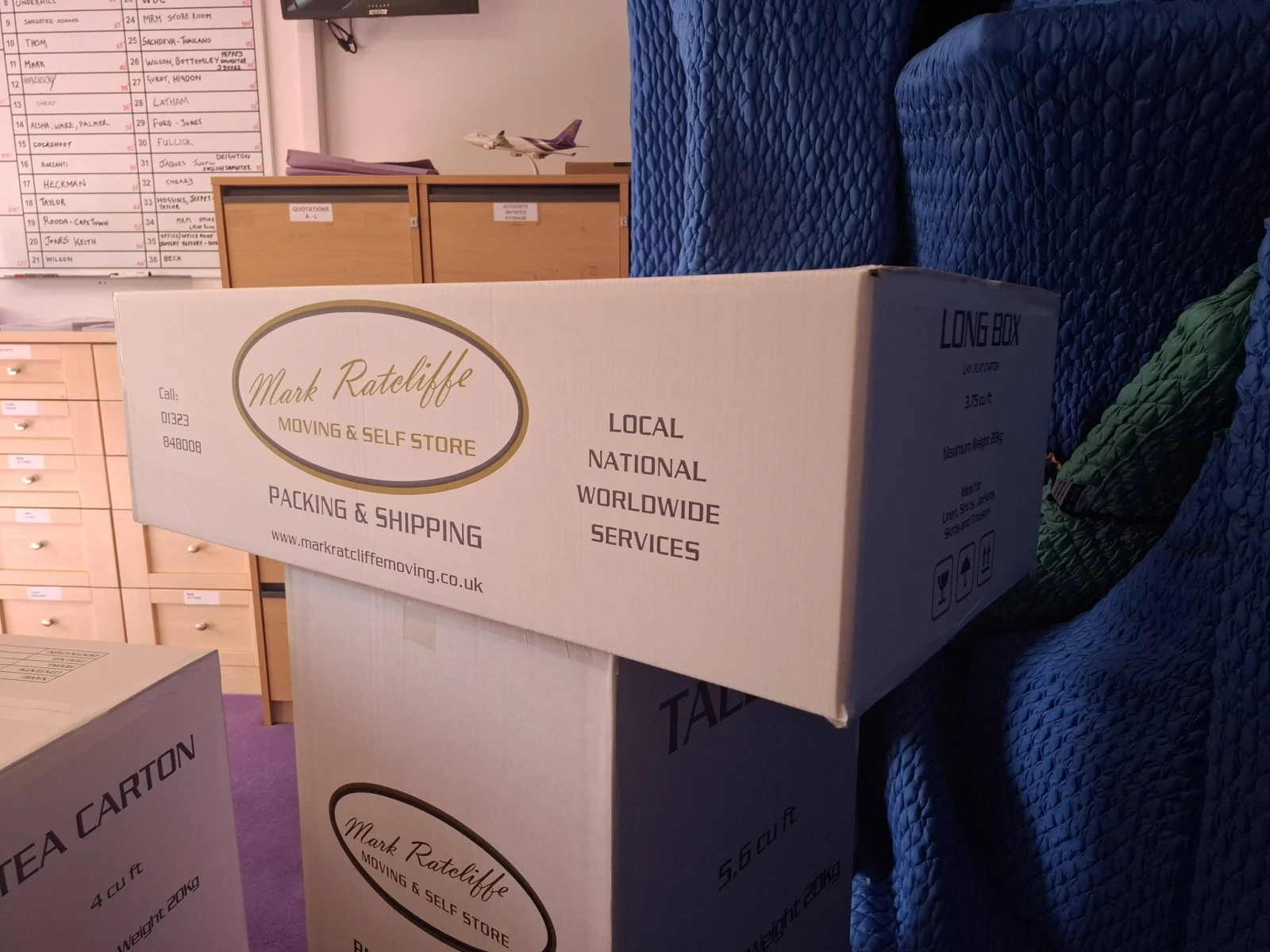
Storage between house moves costed by week and month, container storage vs self storage, and the point where storing costs more than replacing.

Get a clear breakdown of house moving costs in Sussex for 2026, including local moves, full packing, and storage options.
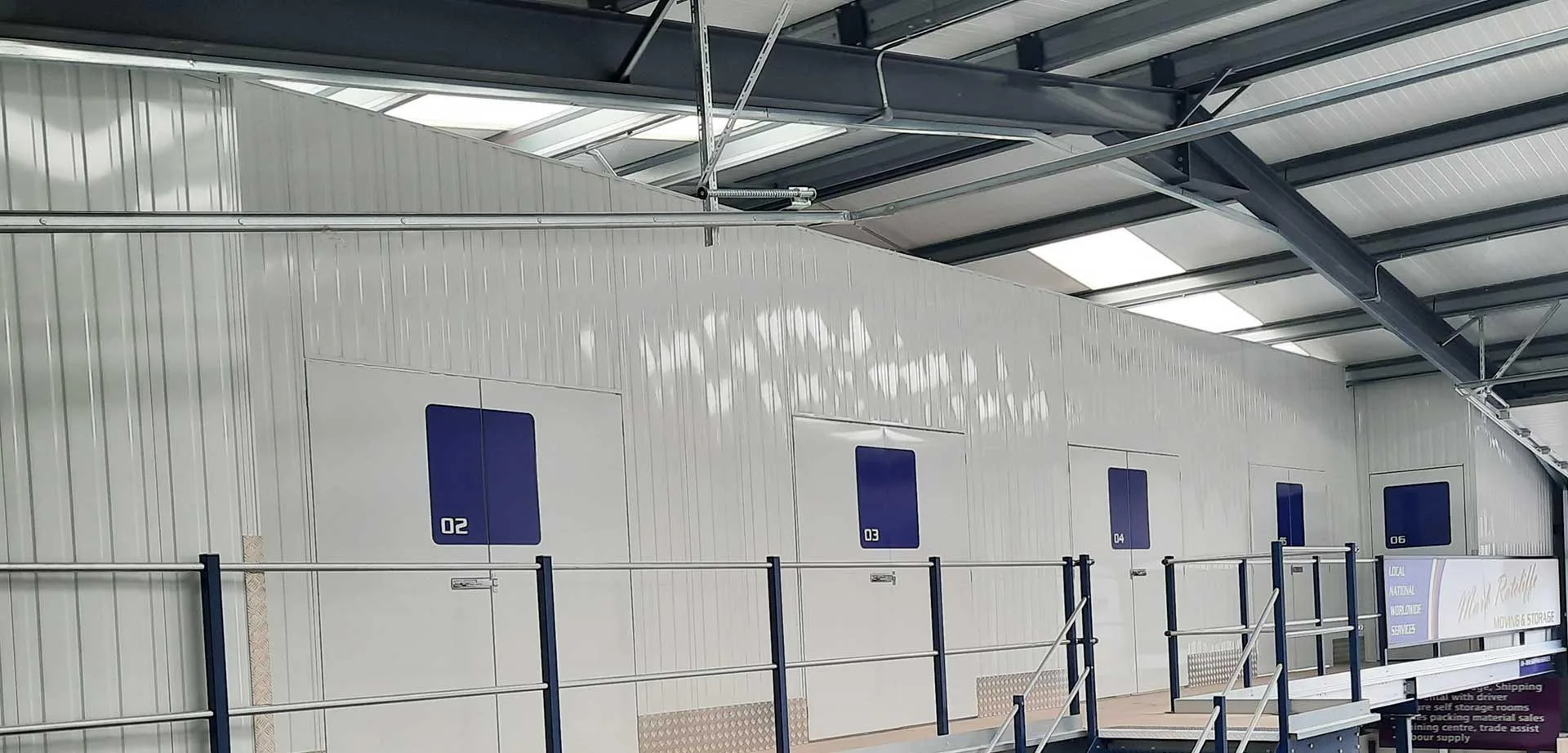
Practical ways to reduce the cost of your house move without cutting corners on quality or safety.
Work out your cubic footage, divide it by seven, and ring us with the number. We will give you a room size, a duration and a written figure with the collection, the storage and the redelivery each on their own line, and the £5,000 of cover shown as already included — the same eight charge lines set out on this page, filled in for your house. Hold it against anybody else’s quote and you will see exactly where the difference is. Surveys are free, in person or by video, and there is no obligation attached to either.