
Storage while moving house, for the gap nobody plans for. When a chain slips or completion moves, we collect, wrap and store your whole home at our Lower Dicker depot and put it back in the new house on the date that finally sticks.


Storage while moving house is almost never something anyone plans for. It becomes necessary somewhere between exchange and completion, usually on a Tuesday afternoon, when a solicitor rings to say the buyer at the bottom of the chain cannot complete on Friday after all. The van is booked. The house is packed. The keys to the new place are now a fortnight away, and you have already given notice on the old one. That week is what this page is about.
A gap between completions is not a storage problem. It is a logistics problem that happens to need a room at the end of it. The load still has to come out of a house on a fixed day, it still has to be wrapped and inventoried, and it still has to go back into a different house on a date that nobody can yet confirm. The room is the easy part.
What we do when a Sussex chain slips:
Most of this page is about surviving that week. One section of it is about what the week costs, and our whole Sussex rate card is printed there in full, with the Kent and London figures alongside it — every price including VAT, and cover included in each one. Below the table is the part you actually need before Friday: the shape of the bill and the handful of decisions that move it. If you want the same numbers run as two end-to-end scenarios, what a storage gap costs per week and per month works them through.
The single biggest determinant of how badly a completion gap goes is what happens in the hour after the phone call. Most of the damage is done by waiting for certainty before telling anyone. Certainty is not coming for several days, and every one of those days costs you options.
The call order that works, in our experience of picking up the pieces on Thursday nights:
What we need from you is smaller than people expect. Volume we can estimate from the original survey; if you never had one, the volume calculator will get you to a cubic-foot figure in about five minutes. Access we already have on file for the outgoing property. The only genuinely new information is the date situation, and “we do not know yet” is a perfectly workable answer. We plan around unknown dates far more often than known ones.
If you were not booked with us at all and you are ringing cold with four days’ notice, say so on the call. It changes which crew we look at and whether we are talking about a full removal or a smaller man-and-van collection to clear a flat in an afternoon. Out of hours, the online removals and storage quote form lands in the same diary for the morning. Put the date situation in the notes box. It is the first thing we read.
Once storage is in the plan, the move stops being one event and becomes two, separated by an unknown number of days. The table below is the sequence we actually work to, keyed to your original completion date rather than to a calendar. Print it, or work backwards from the date on your contract.
| Point in the timeline | What you do | What we do |
|---|---|---|
| Exchange day | Confirm the completion date to us the same day, in writing. | Convert the provisional booking to a firm crew and vehicle allocation. |
| Exchange, plus one working day | Tell us if storage is even a possibility, however remote. | Reserve a room of the right size rather than assuming one will be free. |
| Fourteen days out | Finish the loft, the garage and the shed. These are what overrun. | Confirm carton counts and drop materials if you are packing yourself. |
| Seven days out | Decide what you cannot live without for the duration of the gap. | Mark those items for last-on, first-off loading and flag them on the inventory. |
| Forty-eight hours out | Chase your conveyancer for the status of every link in the chain. | Confirm crew size, vehicle and depot arrival window with you by phone. |
| The night before | Set aside the keep-out bag, the documents and the phone chargers. | Load blankets, straps and spare cartons; brief the crew on the storage route. |
| Completion day, morning | Hand keys when your solicitor says to, not before. | Wrap, inventory and load exactly as for a normal move. |
| Completion day, afternoon | Sign the inventory before the vehicle leaves. | Run to Lower Dicker, load the room, seal it against your reference. |
| The day the new date is confirmed | Send us the date the moment your solicitor gives it. | Re-point the provisional redelivery slot and confirm it back in writing. |
| Redelivery day | Be at the new property for the inventory check-off. | Deliver, place, unwrap in position and reconcile against the load-in list. |
The row people skip is the seven-day one. Deciding what you need to live with for the gap is a fifteen-minute job on the Monday and an impossible job when a crew is halfway through the wardrobes. It is also the difference between a straightforward stay in store and three retrieval visits.
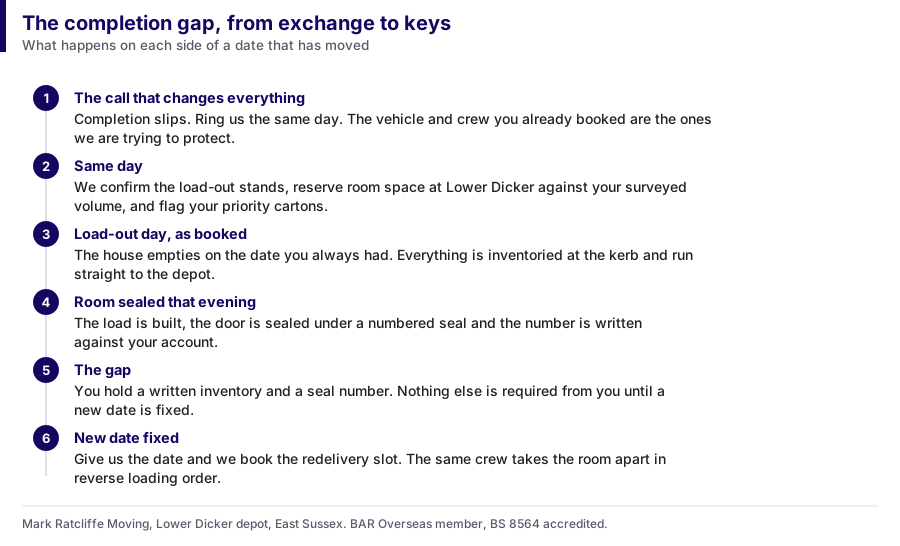
When a chain slips, the instinct is to cancel the removal. It is almost always the wrong call. If you have exchanged and you are handing keys over on the original completion date, the house has to be empty on that date whatever happens next. Cancelling the crew does not remove that obligation, it just leaves you performing it yourself.
So the booked day goes ahead, and the destination changes. Same crew, same vehicle, same written inventory — the only difference is that the load ends at our depot. Everything is pad-wrapped in the room it stands in, carried out once, stacked stack-safe and strapped, and then taken straight into a room sealed against your own reference. The depot sits at Lower Dicker, minutes from the market square on the same short run we make for removals in Hailsham and the villages around it, so a Sussex load can leave a house before lunch and be sealed in a room by mid-afternoon. If you want the hour-by-hour version of that day from the crew’s side, it is set out on our door-to-store collection and storage service page, and the rooms themselves are described on the Prestige steel storage rooms at Lower Dicker.
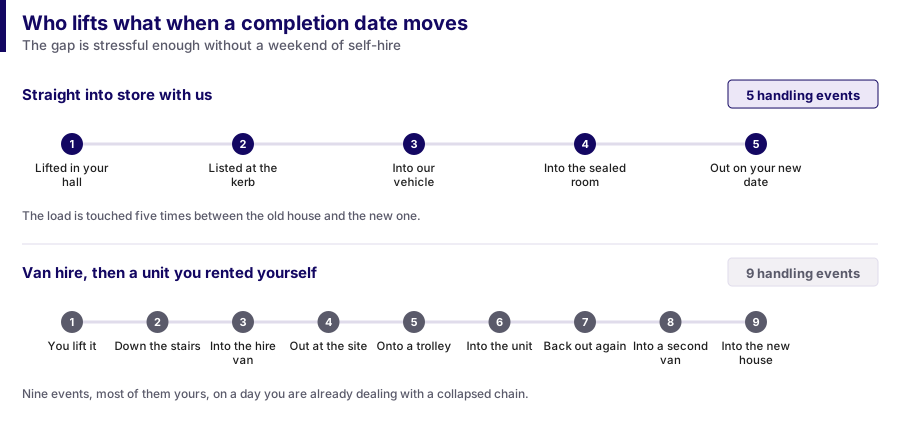
The thing worth being honest about is that a storage gap is two removals rather than one. You are paying for a load out and a load in, with a period of occupancy between them, and no arrangement makes that into a single event. What it should not be is two removals plus two inventories plus two firms plus a handover in a yard. Goods handled by one crew from the wardrobe to the sealed room and back out again are handled the minimum number of times, and every handling is an opportunity for damage. That continuity is the whole argument for removals and storage from one Sussex firm.
Two practical points about completion day itself. First, if the funds are merely late rather than the date being lost — keys at four instead of eleven — a vehicle can wait, but a loaded vehicle waiting is an expensive way to spend an afternoon and there is a point at which the load is better off going into store overnight and delivering first thing. We will tell you where that point is on the day rather than sit in a lay-by running the clock up.
Second, the slot you booked is held. That is our own contractual commitment when a date moves – we re-point the diary, and the deposit stays against your job rather than being treated as a cancellation. It is the reason a moved completion is an administrative task here rather than a renegotiation.
The BAR Advance Payment Guarantee is a separate thing, and it is worth being precise about what it does, because a lot of removals websites are not. It covers money you have paid in advance if the member firm ceases trading before the work is done, and the Advance Payment Guarantee scheme terms published by the British Association of Removers set out the cap and the claim window. It is insolvency cover, and it has nothing to say about a completion date slipping. The guarantee comes with our British Association of Removers Overseas Group membership, and the documentary discipline behind the job comes from BS 8564, the British Standard for overseas moving services, published by BSI as BS 8564:2011. That means a written survey, a numbered inventory and condition recorded at every handover, which is how we work whether the goods leave the country or only leave Hailsham. What gets you through a delayed completion is the held slot and the written booking, not the badge.
Nobody asks this on the first call. Everybody asks it on the second. A three-week delay has just landed and you want to know what it is going to cost before you tell your partner, so the figures come first here and the structure underneath them: how the storage is billed, what the shortest chargeable period is, and the one decision at each delay length that moves the total more than anything else.
A three-bedroom house waiting out a chain goes into a 150 sq ft room at £63 a week including VAT, which is £252 for a four-week period. A two-bed flat takes a 75 sq ft room at £36 a week, and a one-bed flat or a studio a 50 sq ft room at £27 a week. Collection and delivery are charged each way rather than buried in the weekly rate — £990 each way on that three-bed load from a Sussex address — and £5,000 of cover is included in every figure below.
| Room | Typically holds | Per week | Per week nett | Per 4 weeks | Collection or delivery, each way |
|---|---|---|---|---|---|
| 30 sq ft | One room, boxes | £18 | £15.00 | £72 | £240 |
| 50 sq ft | Studio or 1-bed flat | £27 | £22.50 | £108 | £390 |
| 75 sq ft | 2-bed flat | £36 | £30.00 | £144 | £550 |
| 100 sq ft | 2-bed house | £45 | £37.50 | £180 | £720 |
| 150 sq ft | 3-bed house | £63 | £52.50 | £252 | £990 |
| 200 sq ft | 4-bed house | £80 | £66.67 | £320 | £1,290 |
| 250 sq ft | 5-bed house or business stock | from £95 | from £79.17 | from £380 | Quoted on survey |
All prices include VAT (the nett column is what a VAT-registered business reclaims against). £5,000 of cover is included in every price. First 4 weeks half price when we collect for you.
Kent addresses pay exactly the same weekly room rate. Only the collection run differs, at £1,190 each way for the three-bed load against £990 from a Sussex address, and the Kent offer is the first eight weeks half price rather than the first four. A London gap is priced on the separate London card: £77 a week for the 150 sq ft room and £44 a week for the 75 sq ft one, with £1,490 each way for collection and delivery and ten per cent off if you pay twenty-six weeks up front. Ask for whichever card applies to your postcode in writing and you will get the whole grid rather than the one row that suits us.
Three things drive a gap bill. Volume sets the size of room. Duration sets how long you occupy it. Handling sets how many times a crew has to touch the load. The first two are obvious and people plan for them. The third is where completion gaps quietly get expensive.
It is worth defining handling properly, because the word gets used loosely in this trade. Loading the room on the way in and emptying it on the way out is the handling pair, and it belongs to any storage job. A second handling is anything beyond that: a retrieval visit, a consolidation into a smaller room once the stay turns out longer than anyone expected, or a change of delivery address that needs a shuttle vehicle at the far end. Those are the charges people meet for the first time on the invoice, and most of them are avoidable if the gap is planned on day one instead of day nine.
| Delay you have just been told about | Billing unit that usually applies | Shortest period you can be charged for | Does it trigger a second handling? | The lever that saves you most |
|---|---|---|---|---|
| Under 48 hours | None. Where the diary allows, the load stays sealed on the vehicle overnight | No storage period at all | No. The goods are never put down | Ask whether a vehicle can hold before anyone opens a room |
| Three to seven days | By the week. Part weeks are not prorated anywhere in this trade | One week, whether you use three days of it or six | No, provided the keep-out bag was done on loading day | The keep-out bag. One retrieval can outweigh the week it saved |
| One to two weeks | By the week | One week | Rarely, on a load that went in properly labelled | Getting the room size right first time, so nothing is moved twice |
| Three to four weeks | By the week, commonly invoiced as a four-week period | One week, with the four-week period becoming the working unit | Often one, as a booked retrieval | A single booked retrieval against inventory numbers, not three improvised ones |
| Five to eight weeks | Four-week periods, invoiced in advance | Generally the four-week period after the first one | Likely. This is where consolidating into a smaller room starts to pay for itself | Re-measuring the load and dropping a room size |
| Open-ended, or past two months | Rolls onto a long-term footing with periodic condition checks | Set at the point the arrangement is reviewed | Planned rather than incidental | Deciding honestly what is worth storing at all |
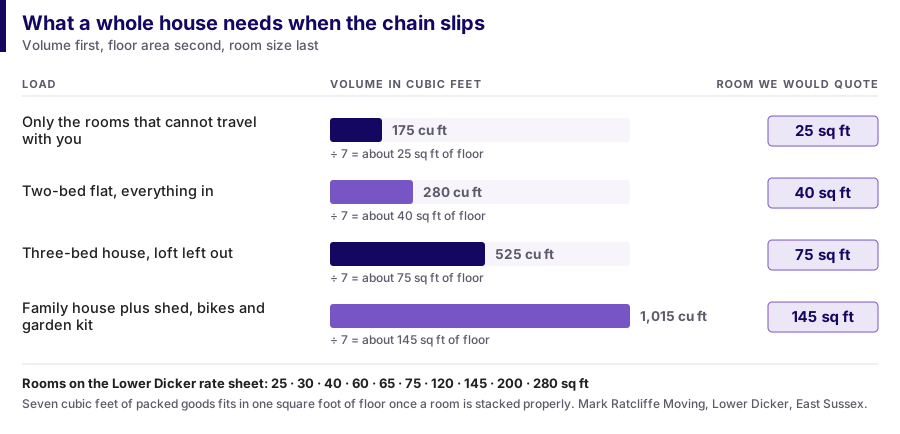
The row that changes people’s minds is the five-to-eight-week one, because that is where room size stops being a detail. Our rooms run 30, 50, 75, 100, 150 and 200 square feet, with 250 square feet and upwards for a five-bedroom house or a stock move. Goods stack at roughly seven cubic feet for every square foot of floor, so a load surveyed at 280 cubic feet needs about 40 square feet of floor, which puts it in the 50 sq ft room rather than the 75 a nervous guess would book — £27 a week instead of £36. Across ten days that difference is noise. Across the eight weeks a stalled chain can easily run to, it is £72, the largest single number you could have changed, and changing it afterwards costs a second handling.
That arithmetic is the reason we measure rather than eyeball. It is also the structural reason a sealed room usually beats a self-access unit on the total figure while looking dearer on the weekly one, which is counted out properly on the containerised storage in Sussex page. You are buying volume of goods, not floor you walk around.
Four questions to put to us, or to any firm you are comparing us against, before you agree anything. What is the billing unit, weekly or calendar monthly? What is the minimum period? Are handling in and handling out included in the storage figure or charged separately? And what does a part-load retrieval cost, given you may well want one. Every one of those has a right answer and none of them should take a firm more than a minute. How a storage quote is built from volume, duration and handling takes all fourteen line items apart, and our pricing guide for removals and storage shows how the same inputs feed a moving quote.
One honest caveat on the delay table above. It describes how gap storage is normally structured, not a commitment on your job. The unit, the minimum and the handling basis that apply to you are stated on your written quote, and if any of them are missing from a quote you have been sent, that is the thing to ring about rather than the headline figure.
The hardest part of a completion gap for a remover is not the storage. It is holding a delivery slot against a date that does not exist yet. We do it by carrying a provisional date in the diary from the moment the load goes into store, then moving it as the chain firms up. It is not a reservation you pay to hold, and it is not a promise that any date is available — it is a working assumption that gets corrected, sometimes three or four times.
What we need, and roughly when we need it:
| What you are asking for | Notice that works | What we need from you | If it is shorter than that |
|---|---|---|---|
| Provisional redelivery date | At the point the load goes into store | Your best guess, plus the worst case | Not applicable — a guess is enough |
| Confirmed redelivery date | Around a working week, where the chain allows | The date in writing from your conveyancer | Often possible; depends entirely on the diary that week |
| Moving a confirmed date again | As soon as you know, at any notice | One phone call, not an email chain | We would rather know late than find out on the morning |
| Part-load retrieval from store | A couple of working days | The inventory numbers, or a plain description | Depends whether the items are at the front of the stack |
| A booked visit to your room at the depot | Around twenty-four hours | Who is coming, and photo ID on arrival | Depot hours and staffing decide it |
| Change of delivery address entirely | As early as possible | The new postcode, parking and access details | Usually fine; a shuttle or a permit may be needed |
| Extra cover on a rising declared value | Before the value rises, not after | An updated figure for the goods in store | Cover cannot be applied retrospectively |
Two honest caveats. Friday and the last working day of the month are the two busiest slots in UK conveyancing, and they are consequently the two hardest days to conjure a crew for at short notice. If your chain will tolerate a Tuesday, take the Tuesday. And a new address we have never seen may need a look before we commit a vehicle to it, particularly in the terraces around Brighton and the narrow lanes in the older parts of Eastbourne, where access, not distance, is what dictates the day.
People rarely plan a completion gap well because they are planning a move, not a period of camping. The result is a family in a holiday let or a spare room with all of their clothing, both laptops and every cable in the house sealed in a steel room twelve miles away.
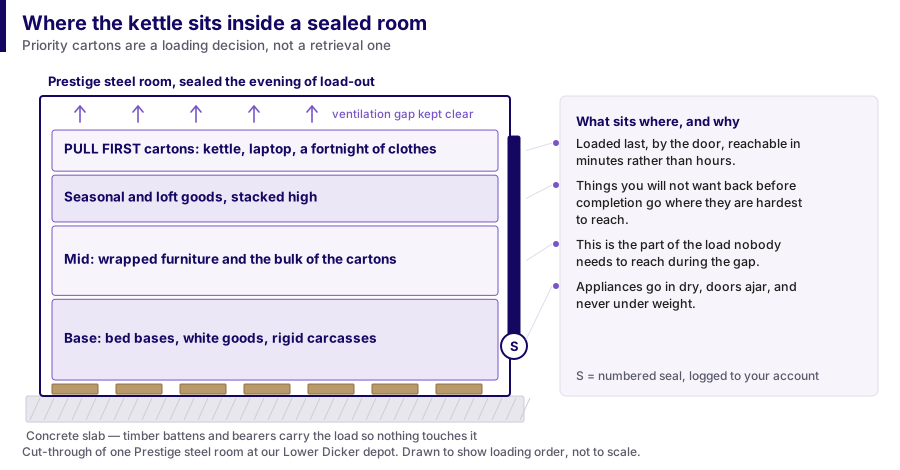
There are two ways to deal with it and one of them is much better. The good one is to keep items out on the day. The crew load last-on and first-off, or simply do not load at all, whatever you have set aside. It costs nothing, it takes five minutes, and it is the reason the seven-day row in the countdown table exists.
What goes in the keep-out pile, based on what we get asked to retrieve:
The second way is retrieval, and it works, but it is a crew job rather than a walk-in. A steel room that has been loaded properly is stacked tight to the walls and to the ceiling; getting a specific carton out means breaking down part of the stack, finding it and rebuilding. Give us a couple of working days and an inventory number and it is straightforward. Give us a description of a box and it is a search.
That is why labelling is decided on packing day, not later. If there is any chance of a retrieval, the inventory number goes on two faces of every carton so it can be read from the aisle rather than from the top, and the keep-out candidates get a room code you will actually remember. We build that in when packing and storage are booked together, which is set out on the packing and storage service page. Where we have packed the house as well, the labelling is ours from the first carton and a retrieval takes half the time, which is the quiet benefit of a full packing service that nobody puts in the brochure.
This is the call that arrives with no notice and a great deal of panic behind it. Exchange of contracts is binding, so a collapse after exchange is rare — but rare is not never. Deaths, repossessions, a lender pulling an offer at the eleventh hour and outright fraud all happen, and when they do the goods are frequently already on a vehicle.
From our side, the answer is undramatic. The load stays in its room. What was booked as a three-week hold becomes an open-ended one and nothing about the goods changes: same room, same seal, same inventory, same reference. Nobody has to attend, nothing is moved, and no decision has to be taken that week. If it turns into months rather than weeks, the arrangement rolls onto the footing described on our long-term storage in Sussex page, which is where the condition checks and the periodic review belong.
What we will not do is give you a view on the legal position. Whether you are still bound, what your remedy is against the other party and what happens to your deposit are questions for your conveyancer and, quite possibly, for a litigator. We have watched enough of these to know that the removal firm’s opinion is worth precisely nothing in that conversation.
There is one rule we do apply, and it occasionally annoys people. We do not empty a house into store on the strength of an unexchanged completion date unless you have told us plainly that you want to, understanding that you are moving out of a property you still legally own into storage you are paying for. Plenty of people do choose exactly that, usually to break a chain or to go into rented accommodation. It is a legitimate strategy. It should just be a decision rather than a drift.
The other collapse is quieter: the gap that keeps extending. A fortnight becomes six weeks, six becomes four months, and at some point the question stops being “when do we deliver” and starts being “is all of this worth storing”. That is a conversation worth having at around the three-month mark rather than at the twelve-month one, and it is the point at which the moving checklist earns its keep as a decluttering prompt rather than a packing one. Paying to store a garage of things nobody intends to unpack is a slow way to lose money. The honest fix is usually downsizing the load before it goes back into a house, with a clearance crew for whatever does not survive that decision.
We raise this unprompted on every storage-gap job, because it is the detail that gets missed while everyone is thinking about dates. A household contents policy is written against an address. When you complete on the sale and hand the keys over, that address stops being yours. The new address is not yours yet either. For the length of the gap, your contents are in a third place that appears on neither policy.
Some insurers will carry contents in transit and in commercial storage for a limited period if you ask them to. Some will not. Some will cover the goods but not while they are in a third party’s custody, which is exactly what storage is. The answer is specific to your policy and your insurer, and it is a five-minute phone call that people make in week three instead of week zero.
Three questions to put to your insurer, in this order:
Where your own policy will not follow the goods, cover can be arranged as part of the storage instead. What matters more than where the cover comes from is the declared value being realistic on the day the room is sealed — the figure you give is the figure you are covered against, not what the contents would cost to replace today. Our terms, conditions and cover details set out how declared values are handled and what the exclusions are, and we would rather you read them before the load goes in than after something goes wrong.
One more small thing. Tell your conveyancer that the contents are going into storage. It rarely affects the transaction, but it does affect what they should be telling you about timings for the vacant-possession clause, and it stops the solicitor assuming you are living in the property up to the day of completion.
We have been running Sussex moves since 2017 and the mistakes in a completion gap are remarkably consistent. None of them are stupid. They are all reasonable reactions to a bad week, and they all cost more than the thing they were avoiding.
Do not split the load across three places. The classic is a relative’s garage, a friend’s loft and a hired lock-up, with the fragile things in the car. It feels thrifty for about four days. Then something is needed and nobody can remember which site it went to, and the eventual delivery into the new house requires three separate collections. One inventory, one place.
Do not cancel the crew to save the loading day. If you are handing keys over, the house is being emptied regardless. The only question is who empties it, and doing it yourself over a weekend with a hire van and a brother-in-law is how backs and banisters get damaged.
Do not leave the loft and the garage until the new date is known. They are the two spaces that always overrun, and they overrun worst when the crew arrives to find them untouched. If you are packing yourself, those go first.
Do not shrink-wrap upholstery for a stay of unknown length. Plastic film is a transit material. Over weeks it traps moisture against fabric, leather and timber. Everything that goes into our rooms is pad-wrapped in breathable quilted blankets instead, and if you are preparing pieces yourself first, how to prepare furniture for storage covers the difference properly.
Do not assume the gap will be short because everyone says it will be. Plan the keep-out bag for a month. If the keys land in nine days you have lost nothing; if they land in five weeks you have not spent the intervening time booking retrievals.
Do not go quiet on us. The single most useful thing a customer in a gap does is send a two-line update when nothing has changed. It keeps the provisional slot pointed at something real, and it means the week your date finally lands we already know where your load is in the racking and what vehicle it needs.
If you want a sense of how this goes when it goes well, the reviews left by our Sussex customers include a fair number written by people whose chains fell over. That is the population this page is written for.
Yes, and plenty of people do — usually to break a chain or because they have already exchanged on the sale and the purchase is lagging. We collect on the date you choose, store the load, and deliver when the purchase completes. The decision is yours and your conveyancer’s; the logistics are straightforward either way.
Nothing is lost. The booking stays live, the deposit stays against your job, and we redirect the loading day to our depot rather than to your new address. Two things get conflated here, so to be clear: holding your slot and your deposit through a delay is our own contractual commitment, while the BAR Advance Payment Guarantee is separate insolvency cover for advance payments if a member firm ceases trading. The only thing that changes on a delayed completion is the destination on the run sheet and the fact that there is now a delivery to schedule later.
Gap storage is billed by the week with a one-week minimum, and part weeks are not prorated anywhere in this trade — three days and six days cost the same. Under about forty-eight hours the load can often stay sealed on the vehicle overnight instead, which avoids a storage period and a handling altogether. Our Sussex weekly rates run from £18 a week for a 30 sq ft room of boxes to £63 a week for a three-bedroom house in a 150 sq ft room, every price including VAT and £5,000 of cover. Past a month the billing usually moves to four-week periods in advance, charged at four times the weekly figure. The unit, the minimum and whether handling in and out are included are all stated on your written quote before you agree to anything.
About a working week is comfortable and lets us allocate the right crew and vehicle. We have turned loads around in forty-eight hours when a completion landed early, but that depends entirely on what the diary looks like that week, and Fridays and month-ends are the hardest days to find at short notice.
Yes, with a couple of working days’ notice. A properly loaded room is stacked tight, so retrieval means breaking down part of the stack and rebuilding it — give us the inventory number rather than a description of the box and it is quick. Better still, keep those items out on loading day and avoid the trip entirely.
Your goods stay exactly where they are, in the same sealed room against the same reference, and the hold simply becomes open-ended. Nothing needs deciding that week. If it runs into months we move the arrangement onto a long-term footing with periodic condition checks.
Often not, or only for a limited number of days. Contents cover is written against an address, and once you complete on the sale that address is no longer yours. Ring your insurer before the loading day and ask specifically about goods in a professional remover’s storage and the single-item limit away from the insured address.
No. You sign the inventory at your house before the vehicle leaves, and the crew loads the room at Lower Dicker. You are welcome to come and see the room during depot hours, but it is a visit rather than a requirement, and it needs booking about a day ahead.
Yes, and it is more common than you would think when funds arrive too late in the afternoon to unload safely. It is usually the better option once the wait passes a certain point, and we will say so on the day rather than sit outside a house running the clock up.
From the blog

Storage between house moves costed by week and month, container storage vs self storage, and the point where storing costs more than replacing.

Moving day step-by-step timeline — hour-by-hour, from the 8am crew arrival through to the signed inventory at the new property.
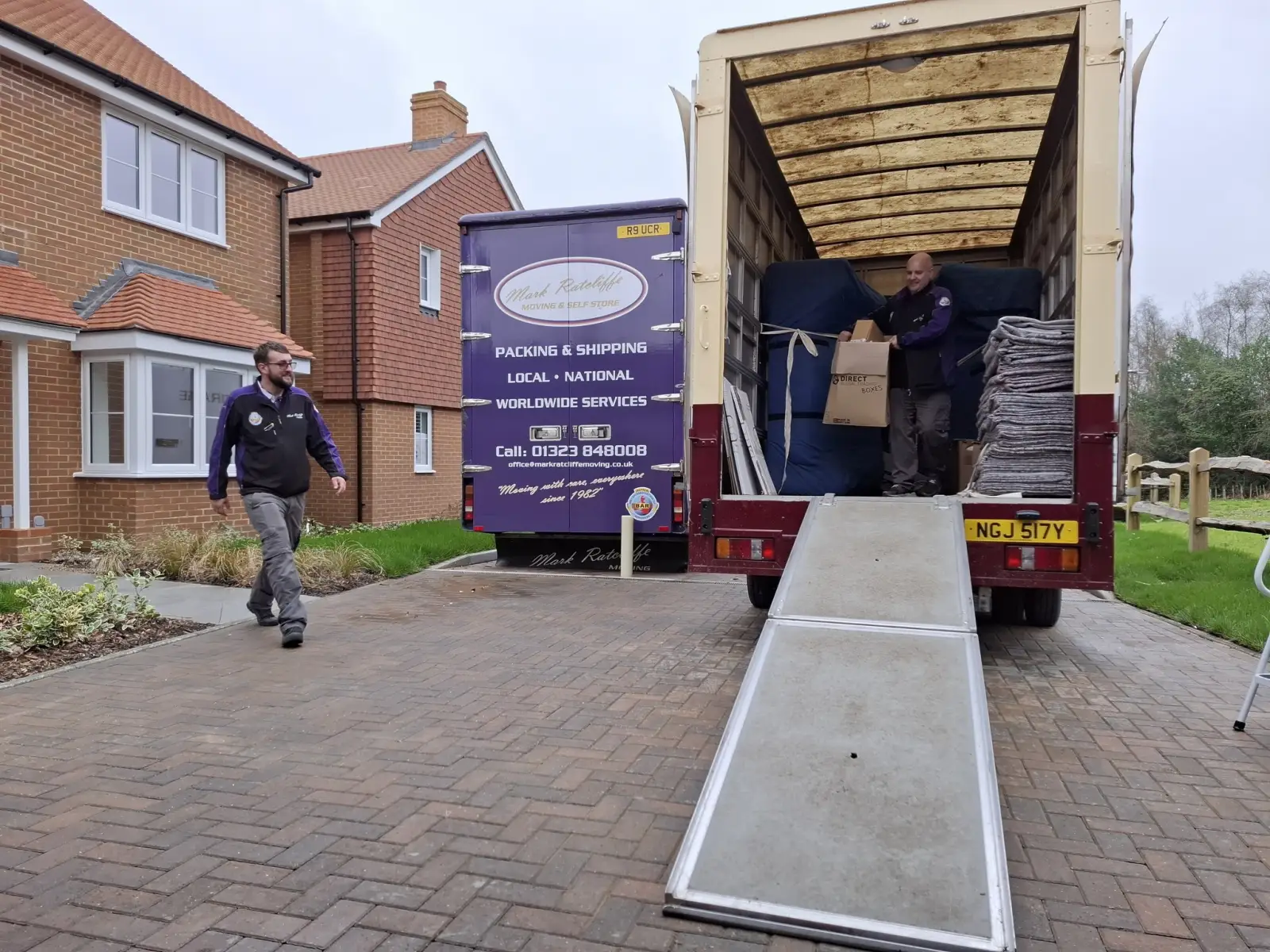
Moving house in 2026? Follow our complete step-by-step preparation guide with an 8-week checklist to make your move as smooth and stress-free …
Tell us the original completion date, roughly what is in the house and whether the new date is known or unknown. That is enough for us to hold a room and keep your loading day. Sussex rooms start at £18 a week including VAT with £5,000 of cover in the price, and the current offer is first 4 weeks half price when we collect for you. Survey by video or in person, written quote, and one point of contact from the loading day to the redelivery.